
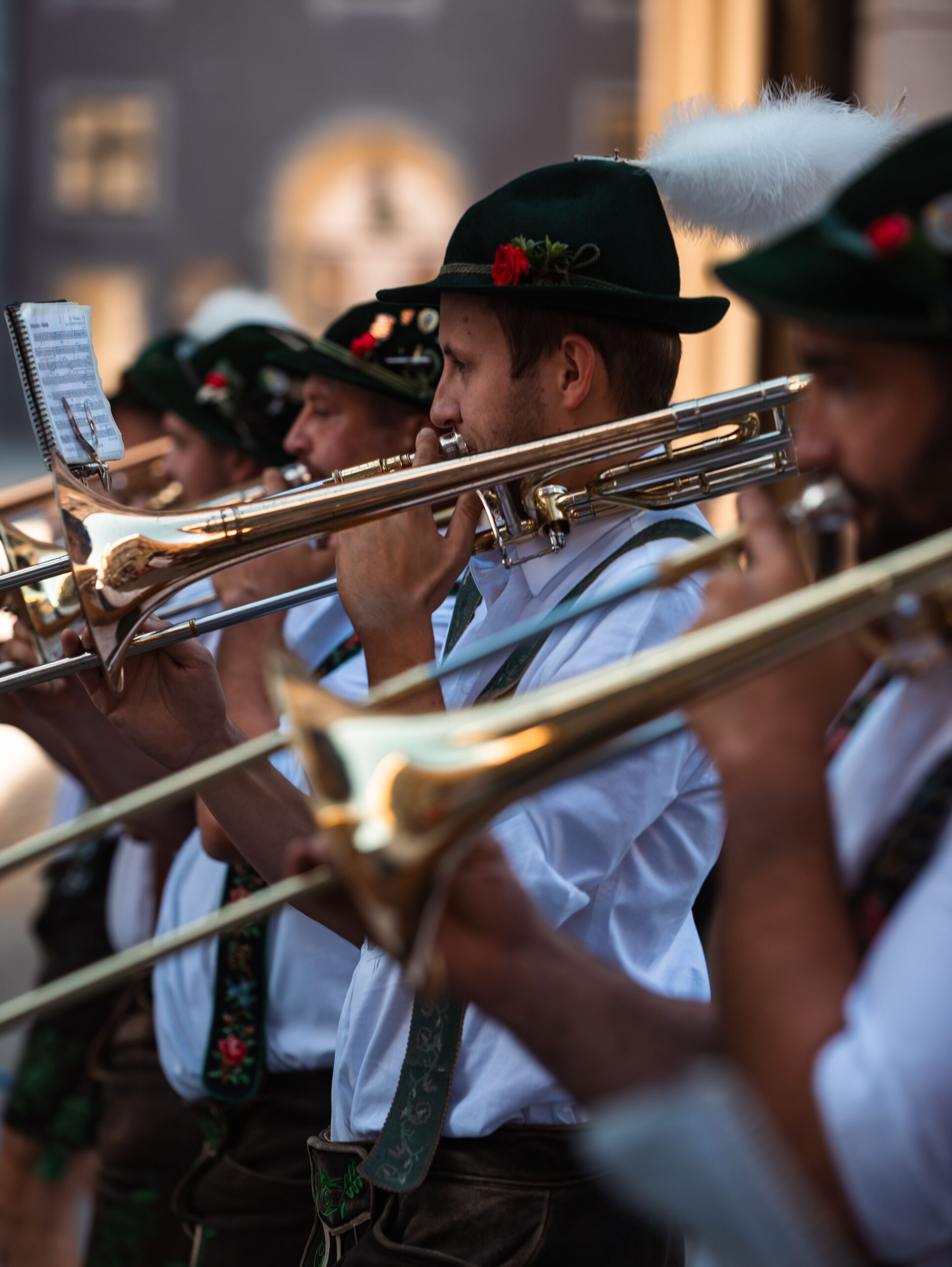
The name is pure onomatopoeia: “oompah” imitates the alternating pattern of a brass band, where the tuba thumps out the bass note — the “oom” — and the tenor horns and clarinets answer on the off-beat with a clipped “pah.” Stack that pattern under a polka or a march and you have the sound that fills every beer tent in Bavaria. What English speakers call oompah, Germans call Blasmusik, and it is far older and more organised than the lederhosen-and-lager image suggests. This is Guide № 008 in The Love Germany Guide series.
Get the Full Collectible Guide (Free PDF)
Oompah Bands — in a beautifully designed, printable booklet. The Love Germany Guide № 008.
Where the Name Actually Comes From
“Oompah” is an English coinage, not a German word — it describes the rhythmic engine of a wind band rather than any particular tune. In a traditional Blaskapelle (brass band), the tuba or the helicon plays the strong downbeat while the mid-range brass fill the weak beats, producing the bouncing two-feel that drives polkas, marches and waltzes. Germans themselves rarely say “Oompah-Musik”; they speak of Blasmusik, or of a Trachtenkapelle when the players wear regional dress such as lederhosen and dirndl. The term you hear at an American or British “Oktoberfest” event is essentially a friendly outsider’s nickname for a genuine and serious musical form.
From Village Bandstand to Beer Tent
The roots of this music lie in 19th-century military and civic wind bands, which spread across the German-speaking lands as towns formed their own amateur ensembles. That tradition never went away: wind and brass playing is still organised through thousands of local music associations, coordinated nationally by the Bundesvereinigung Deutscher Musikverbände, which represents amateur wind music across Germany and runs graded performance badges and competitions. The polished “Bohemian” style many visitors picture — rich flugelhorn melodies over a crisp off-beat — was popularised in the mid-20th century by ensembles playing in the Egerländer manner, a sound associated with German communities from the historic Eger region of Bohemia.
The beer-tent format most tourists meet is a more recent commercial development layered on top of that older association culture. The giant marquees of the Oktoberfest in Munich, and the house band at the Hofbräuhaus am Platzl, turned Blasmusik into a mass hospitality experience over the last century — which is why the two things now feel inseparable to outsiders even though the village band came first.
The Instruments and the Sound
A typical band is built around the brass: trumpets and flugelhorns carry the melody, tenor horns and trombones handle the harmony and off-beats, and the tuba anchors the bass. Clarinets add the bright upper line, and many bands include an accordion for texture. The repertoire leans on three core dance forms — the polka in a quick two, the march, and the slower waltz in three — plus set-piece drinking songs. It is not easy music to play well: tuning a brass section in a hot, loud tent, and keeping a polka tight at speed, demands real technique, which is why the best tent bands are professionals rather than amateurs having a singalong.
Where You Actually Hear Them Today
Beyond Munich, Blasmusik is woven into ordinary life across southern Germany and the wider Alpine region, appearing at parish festivals, Christmas markets, harvest celebrations and town anniversaries throughout the year. The tradition is strong enough to support large dedicated festivals — the cross-border Woodstock der Blasmusik in Ried im Innkreis, just over the Austrian border, draws tens of thousands of players and fans. Popular “Volksmusik” acts such as the South Tyrolean group Kastelruther Spatzen grew out of the same brass-and-folk world and fill arenas. For visitors to Munich, the city’s own tourism service at München lists where traditional music is played year-round, and brewery beer halls such as Paulaner stage regular live sets outside festival season.
The Repertoire and Its Rituals
If you spend an evening in a tent, you will hear the toasting song “Ein Prosit der Gemütlichkeit” many times over — bands cue it every few minutes, the room stands, raises glasses and toasts. There is also a well-known pacing rule at Oktoberfest: during the day and early evening the tents are required to keep to quieter traditional brass music, and only after 6pm do bands switch to louder pop, Schlager and party anthems. That is why an afternoon visit sounds like a village concert and a late-night one sounds like a stadium singalong — it is regulation as much as mood.
Myths Worth Retiring
Myth: Oompah is uniquely Bavarian. Wind-band tradition runs through Germany, Austria, Switzerland and historic Bohemia alike. Its tight association with Bavaria owes a great deal to Oktoberfest’s global fame rather than to any exclusive origin there.
Myth: It is just loud music for drinking. Blasmusik is a structured amateur movement with graded exams, regional competitions and tens of thousands of registered ensembles. The beer tent is the loudest shop window, not the whole house.
Myth: The lederhosen beer-tent show is an ancient folk ritual. The civic wind band is genuinely old, but the modern commercial tent format — costumed house bands, hourly toasting songs, a post-6pm pop switch — is largely a 20th-century invention.
Frequently Asked Questions
Is “oompah” something Germans say?
Not really. It is an English nickname for the off-beat brass sound. Germans use Blasmusik for the music and Blaskapelle or Trachtenkapelle for the band itself.
Can I hear a band outside Oktoberfest?
Yes, easily. Parish fairs, Christmas markets, town festivals and brewery beer halls host brass bands throughout the year, and dedicated festivals draw huge crowds well away from the autumn tent season.
Should I request a song or tip the band?
In a busy tent the set list is fixed and the band plays to the whole room, so individual requests rarely land. There is no tipping convention for the stage; the better move is simply to stand and join in when “Ein Prosit” strikes up.
More The Love Germany Guides
The Love Germany Guide is a numbered series — one tightly focused subject at a time, each with its own downloadable collectible edition. Guide № 001 is The Pretzel (Brezel), Guide № 002 is Oktoberfest, Guide № 003 is The Beer Stein, Guide № 004 is German Beer & the Purity Law (Reinheitsgebot), Guide № 005 is German Beer Garden Etiquette, Guide № 006 is German Slang & Denglisch, Guide № 007 is German Riesling & Wine Culture, This is Guide № 008. More editions are on the way.
🇩🇪 Join Love Germany
Every week, get hidden stories, local secrets, and travel inspiration from people who live and love it.
Tours & experiences in Germany


Powered by Viator. Some links are affiliate links — we may earn a small commission at no extra cost to you.