
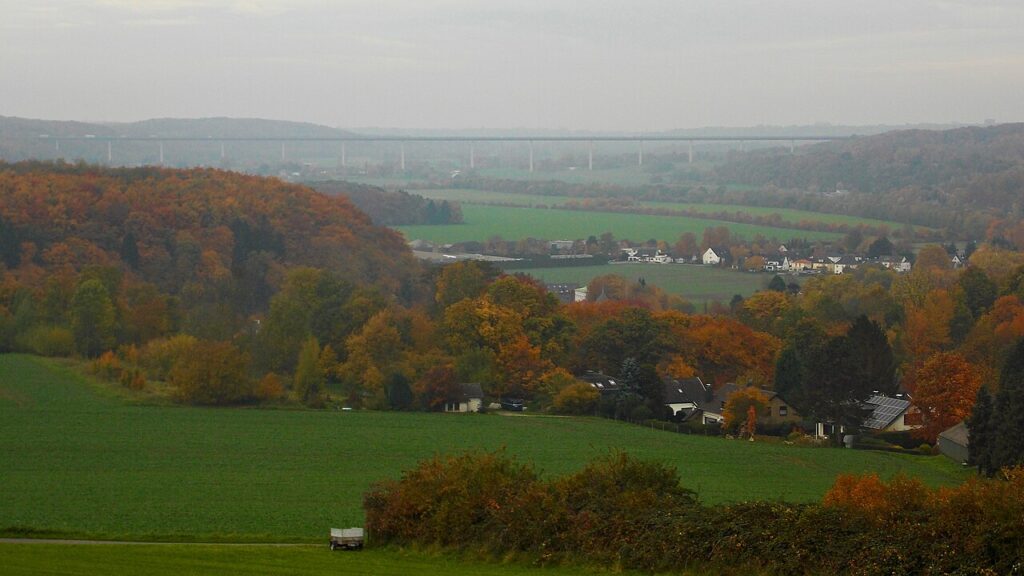
The Bergisches Land doesn’t appear on many travelers’ itineraries, and that’s part of its appeal. Stretching east from the Rhine between Cologne and Düsseldorf, this hilly, forested region was once the territory of the Dukes of Berg—hence the name—and it developed its own architectural style, culinary traditions, and landscape character distinct from the wine valleys to the south and the industrial Ruhr to the north.
You’ll recognize the region by its green-and-black half-timbered houses, slate roofs, and the distinctive use of red brick. The towns feel residential and lived-in rather than polished for tourism, and the wooded ridges and reservoir valleys offer some of the best hiking in western Germany.
Solingen: Blades, Castles, and the Müngstener Bridge
Solingen has been synonymous with knives and blades since the Middle Ages. The city’s blacksmith tradition is still alive—Zwilling, Wüsthof, and dozens of smaller makers are based here—and you can see the craft up close at the Deutsches Klingenmuseum, a blade museum housed in a former monastery. The collection spans swords, scissors, surgical instruments, and cutlery from around the world.
Just outside town, Schloss Burg sits high above the Wupper River, a reconstructed medieval castle that once served as the seat of the Counts of Berg. The interior houses period rooms and exhibits on regional history. Below the castle, the Müngstener Brücke—Germany’s highest railway bridge—spans the Wupper Valley at 107 meters. You can walk beneath it along riverside trails, or take the old ferry across for a closer look.
Solingen is easily reached by S-Bahn from Cologne or Düsseldorf in under 30 minutes.
Wuppertal and the Schwebebahn
Wuppertal’s claim to fame is the Schwebebahn, a century-old suspended monorail that glides above the Wupper River for 13 kilometers. It’s both public transport and tourist attraction—locals use it for their daily commute, but riding the full line offers views of the valley, bridges, and industrial architecture that defined the city’s textile and manufacturing past.
The city itself is spread along the valley and feels more functional than picturesque, but the historic Luisenviertel district retains its 19th-century charm, and the Von der Heydt Museum houses one of Germany’s finest provincial art collections, with works by Monet, Picasso, and German Expressionists.
Wuppertal is a 20-minute train ride from Düsseldorf.
Reservoirs, Trails, and the Bergisch Panoramasteig
The Bergisches Land is lake country, though the lakes are man-made. A series of reservoirs—Wupper-Talsperre, Bevertalsperre, and others—were built in the early 20th century to supply water and prevent flooding. Today, they’re surrounded by forest trails, quiet beaches, and small cafés.
The Bergischer Panoramasteig is the region’s flagship long-distance trail, a 244-kilometer loop that passes through all the major towns and landscapes. You don’t need to hike the whole thing—day sections between Altenberg, Odenthal, and Lindlar take you through beech forests, meadows, and past half-timbered farms.
Spring and early summer are ideal. The woods are green, the reservoirs are full, and the trails aren’t crowded.
Altenberg Cathedral and Bergisch Coffee Culture
In the small town of Altenberg, the former Cistercian abbey church—known simply as the Altenberger Dom—rises above the forest like a cathedral without a city. Its Gothic windows are among the largest in Germany, and the interior is stark, light-filled, and surprisingly peaceful. It’s used by both Catholics and Protestants, a rarity in Germany.
Nearby, stop at a traditional Bergische Kaffeetafel, a regional coffee table spread that includes waffles, rice pudding, rye bread, butter, jam, and honey. It’s served on tiered stands and meant to be leisurely. You’ll find it at country inns around Odenthal and Lindlar, often paired with a slice of Dröppelminna, the local drip coffee pot that’s become a regional icon.
Practical Tips for Visiting the Bergisches Land
The region is compact and easy to explore by regional train and bus, especially if you’re based in Cologne or Düsseldorf. A day trip to Solingen or Wuppertal works well, but if you want to hike or visit the reservoirs, consider staying overnight in Altenberg or Gummersbach.
Most towns have small visitor centers with trail maps. The Bergisches Land isn’t flashy or famous, but it’s green, quiet, and genuinely local—a side of western Germany that feels worlds away from the Rhine tourist trail.
Want more stories like this—one every day, straight to your inbox? Subscribe to the Love Germany newsletter and discover the country beyond the guidebooks.
Tours & experiences in Germany


Powered by Viator. Some links are affiliate links — we may earn a small commission at no extra cost to you.