
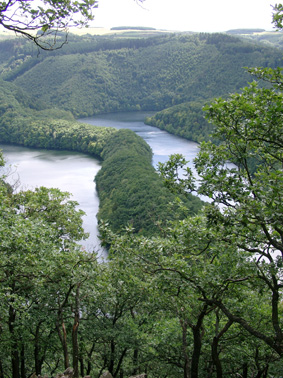
The Eifel National Park, established in 2004, covers 110 square kilometers of ancient forest and volcanic landscape in North Rhine-Westphalia, less than an hour’s drive from Cologne. This is Germany’s youngest national park, and also one of its wildest—a patchwork of primeval beech forests, rushing streams, and high moorland where nature is slowly reclaiming what was once military training ground and managed woodland.
The park lies in the northern Eifel hills, a region shaped by volcanic activity millions of years ago. Today, those volcanic roots reveal themselves in crater lakes called maars, mineral springs, and a landscape of dramatic ridges and valleys. Red deer roam freely here—the park protects one of central Europe’s largest populations. In autumn, during the rutting season, you can hear the stags bellowing across the forest at dawn.
The Best Hiking Trails
The Wildnis-Trail is the park’s signature route: a four-day, 85-kilometer trek that crosses the entire national park from Monschau-Höfen in the south to Hürtgenwald in the north. You’ll walk through dense beech forest, cross high moors, and descend into stream valleys where the only sound is running water and birdsong. The trail is well-marked with a wildcat logo, and there are guesthouses and small hotels at each overnight stop.
If you have less time, the Kloster-Route is a beautiful 19-kilometer loop from Heimbach that takes you past the ruins of medieval Kloster Mariawald and through old-growth forest. The route climbs to the Kermeter ridge, where an accessible wooden walkway leads to a viewing platform with panoramas across the Rursee reservoir.
For families, the shorter Schöpfungspfad near Heimbach is a gentle 4.7-kilometer trail with interactive stations explaining the forest ecosystem. It’s mostly flat and stroller-friendly for the first half.
The Rursee and Urftsee
Two reservoirs lie within the national park boundaries: the Rursee and the smaller Urftsee. Both were created in the early 20th century for water supply and flood control, but they’ve become integral to the park’s ecosystem. The deep, clear water reflects the forested hillsides, and electric passenger boats cruise between Rurberg, Schwammenauel, and Einruhr from Easter through October.
The boat trip between Rurberg and Einruhr takes about 45 minutes and offers the best way to see the park’s steep valley slopes and spot red deer drinking at the water’s edge in early morning or late afternoon. You can combine the boat with hiking: take the boat one way and walk back along the shoreline trail.
Kayaking and stand-up paddleboarding are permitted on the Rursee, and several outfitters in Rurberg and Einruhr rent equipment. Fishing is also allowed with a permit, and the reservoirs hold pike, perch, and trout.
Heimbach and Vogelsang
Heimbach is the park’s gateway town, a small settlement tucked into a narrow valley where the Rur River emerges from the forest. The Art Nouveau power station, still operating, offers guided tours showing how hydroelectric power has been generated here since 1905. Above the town, Burg Hengebach is a restored medieval castle with a good café and weekend concerts in summer.
Six kilometers into the park from Heimbach, you’ll find Vogelsang, a vast complex built as a Nazi elite training school in the 1930s and later used as a Belgian military base until 2006. Today it’s a documentation center and exhibition space addressing the site’s dark history within the context of democracy and human rights. The architecture is brutalist and unsettling, but the exhibitions are thoughtful and necessary. Vogelsang also serves as a national park visitor center, with rangers on hand to recommend routes and current wildlife sightings.
Practical Information
The park is open year-round and free to enter. The main visitor centers are at Vogelsang and Rurberg, both with exhibitions, trail maps, and ranger programs. Guided wildlife walks happen most weekends—check the park website for the current schedule. The red deer rut in September and early October is the best time for wildlife watching, but also the busiest season.
By car, the park is 60 kilometers southwest of Cologne via the A1 and B266. Parking is available at all trailheads, though lots fill quickly on sunny weekends. By train, take the Rurtalbahn from Düren to Heimbach; the station is right at the park edge. On Sundays and holidays from Easter to October, the Nationalpark-Shuttle bus connects Heimbach, Vogelsang, and Rurberg.
Monschau, just outside the southern park boundary, makes an excellent base with its half-timbered old town and good hotel selection. Simmerath and Schleiden also have guesthouses within a short drive of park trailheads.
Bring sturdy boots—the trails can be muddy even in summer—and layers. The forested valleys stay cool, but the exposed ridges can be windy. Ticks are common from spring through autumn, so check carefully after hiking.
Want more stories from Germany’s forests, valleys, and hidden corners? Subscribe to the Love Germany newsletter and get one short story a day, straight to your inbox.
Tours & experiences in Germany


Powered by Viator. Some links are affiliate links — we may earn a small commission at no extra cost to you.