
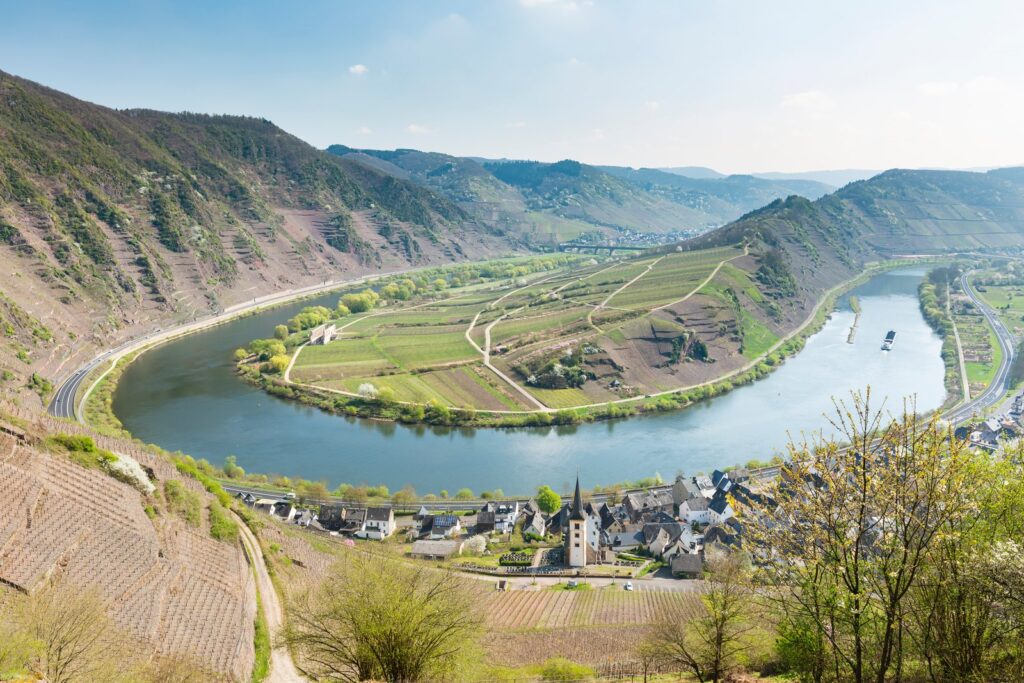
The Mosel Valley grows wine at angles that would make most farmers laugh. Some vineyards here tilt at 60 degrees or more, requiring hand harvesting on slopes so steep that workers use winches and monorail tracks to haul grapes uphill. The slate terraces that terrace the valley from Trier to Koblenz represent centuries of backbreaking labor, and they produce Rieslings with a mineral edge and electric acidity you won’t find anywhere else.
Why Slate and Slope Matter
The Mosel’s blue Devonian slate doesn’t just make for dramatic scenery. It stores heat from the sun during the day and radiates it back at night, extending the growing season for vines that would otherwise struggle this far north. The steep incline maximizes sun exposure, and the river below reflects additional light back onto the grapes. This combination of geology and geography creates ideal conditions for Riesling, which thrives on stress and rewards patience.
The steepest vineyards, classified as Steillagen (slopes over 30 degrees), require five to seven times more labor than flat vineyards. Everything from pruning to harvesting happens by hand. In some sites, workers wear harnesses. In others, they rely on small cable cars called Seilwinden to move equipment and fruit. It’s viticultural mountaineering, and it shows in the price and quality of the wine.
Villages Where the Vines Climb Highest
The section between Bernkastel-Kues and Traben-Trarbach contains some of the Mosel’s most dramatic vineyard sites. The Bernkasteler Doctor, one of Germany’s most famous single vineyards, rises almost vertically above the town’s half-timbered marketplace. Legend says the wine cured a 14th-century archbishop, but the real cure is in the slate and the southwest exposure.
Downstream, the village of Ürzig is home to the Ürziger Würzgarten, a rust-red slate amphitheater that produces wines with exotic spice notes. The iron-rich soil here gives the Riesling a distinctive character—some tasters detect cinnamon, others clove. The village itself is small, with a handful of family wineries and a ferry that crosses to Erden, another serious vineyard town.
Further upriver, Piesport claims the largest contiguous vineyard amphitheater on the Mosel. The Piesporter Goldtröpfchen (“little golden droplet”) slopes curve around the river in a perfect south-facing bowl. It’s gentler than the extreme sites, but still steep enough to require careful footwork during harvest.
Visiting the Terrace Vineyards
The best way to understand these vineyards is to walk them. Many wineries offer guided hikes through their Steillagen, often ending with a tasting in the cellar. Weingut Joh. Jos. Prüm in Wehlen and Weingut Markus Molitor in Bernkastel-Kues both run seasonal vineyard tours that explain the logistics of steep-slope viticulture. Wear sturdy shoes—the slate is loose and the inclines are real.
For a broader view, take the hiking trail that runs along the ridgeline above Ürzig and Erden. The Moselsteig long-distance trail passes through here, and the views down onto the terraces and the river are worth the climb. Spring and early summer offer green vines and cooler temperatures; late September and early October bring the harvest, when you’ll see workers on the slopes and tractors hauling grapes to the cellar.
The river itself offers another perspective. Small tour boats run between Bernkastel and Traben-Trarbach, and from the water you can appreciate the sheer scale of the terrace construction. Some slopes rise 200 meters from river to ridgetop, tier after narrow tier of slate-walled vineyard.
Tasting the Terrace Effect
The slate expresses itself in the glass as a fine, stony minerality—a slight smokiness, a graphite edge, sometimes a faint salinity. The best Mosel Rieslings balance that mineral backbone with bright fruit and crisp acidity. They’re low in alcohol (often 8 to 10 percent), high in flavor, and built to age. A good Spätlese from a steep site can evolve for 20 years or more, developing honey, petrol, and dried apricot notes over time.
Most family wineries along the Mosel welcome visitors for tastings, often without an appointment. Dr. Loosen in Bernkastel, Selbach-Oster in Zeltingen, and Weingut Wegeler in Bernkastel-Kues all produce wines from top Steillagen sites and offer tastings in their historic cellars. Ask to try wines from specific vineyards—the difference between a village-level Riesling and a single-vineyard Großes Gewächs from a terrace site is dramatic.
The Mosel terrace vineyards are a reminder that great wine often comes from places where logic says it shouldn’t. The steeper the slope, the harder the work, and the more profound the result. It’s agriculture as art, and every bottle carries the weight of that vertical effort.
Want more stories from Germany’s wine country, villages, and landscapes? Subscribe to the Love Germany newsletter and get one short story a day, straight to your inbox.
Tours & experiences in Germany


Powered by Viator. Some links are affiliate links — we may earn a small commission at no extra cost to you.