
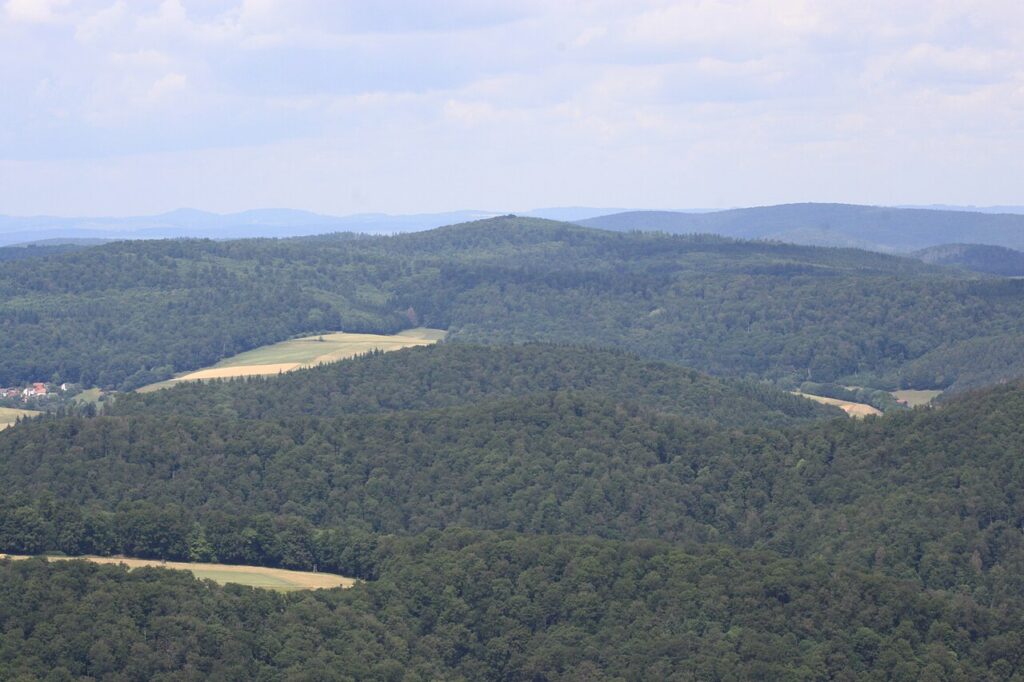
The Harz Mountains harbor one of Europe’s largest narrow-gauge railway networks, where coal-fired steam locomotives still haul passengers through dense spruce forests, across stone viaducts, and up to the summit of the Brocken. The Harzer Schmalspurbahnen (HSB) operates 140 kilometers of track across three main routes, connecting towns like Wernigerode, Quedlinburg, and Nordhausen with mountain villages and hiking trails that would otherwise require long drives on winding roads.
This isn’t a heritage line running twice on weekends. The HSB carries more than a million passengers each year on daily scheduled service, with locomotives built between 1897 and 1956 burning through tons of Lusatian lignite coal every week. The whistle, the sulfur smell, the rhythmic chuff—it’s working transport that happens to look like a museum piece.
The Brocken Railway: Germany’s Highest Narrow-Gauge Line
The Brockenbahn climbs 19 kilometers from Drei Annen Hohne station to the 1,141-meter summit of the Brocken, gaining more than 500 meters in elevation. Trains depart hourly in summer, less frequently in winter, and the journey takes about 50 minutes one way. The line opened in 1899 and was closed during the Cold War when the Brocken sat inside a restricted military zone. Service resumed in 1991.
On clear days, the views from the summit stretch across Lower Saxony, Saxony-Anhalt, and Thuringia. More often, the Brocken wears its famous fog, the same mist that inspired Goethe’s Walpurgisnacht scenes in Faust. The summit hosts a weather station, a small museum, and several restaurants, but most visitors ride up, walk the short loop trail, and ride back down. In winter, the track cuts through deep snow, and ice clings to the locomotive’s running gear.
You can board the Brockenbahn at Drei Annen Hohne (with connections from Wernigerode) or at Schierke, a ski village halfway up the mountain. Many hikers take the train one direction and walk the other; the descent from the Brocken to Schierke takes about 90 minutes on well-marked trails.
The Harzquerbahn and Selketalbahn: Valley Lines Through Forest and Farmland
The Harzquerbahn runs 60 kilometers from Wernigerode to Nordhausen, crossing the Harz from north to south through the Holtemme and Bode river valleys. This is the longest and busiest of the three routes, with trains stopping at villages like Benneckenstein and Eisfelder Talmühle. The track follows the valley floor for much of the route, passing timber-framed houses, old mills, and stretches of mixed forest where deer graze in the clearings at dawn.
The Selketalbahn branches off at Eisfelder Talmühle and runs 35 kilometers through the Selke Valley to Quedlinburg, a UNESCO World Heritage town with more than 2,000 half-timbered buildings. This line feels quieter, with fewer tourists and more locals using it to reach trailheads or commute between villages. The section between Alexisbad and Mägdesprung passes through particularly dense forest, where the track hugs the riverbank and moss grows thick on the rocks.
Both lines share the same narrow gauge—1,000 millimeters—and the same rolling stock, so you can combine routes into longer journeys. A day ticket covers unlimited travel on the entire network.
Rolling Stock and Operations
The HSB roster includes 25 steam locomotives, most of them 0-4-4-0 Mallets built in the 1950s at the Lokomotivbau Karl Marx works in Babelsberg. These articulated engines were designed specifically for the steep grades and tight curves of the Brocken line. Older locomotives, including several from the 1890s, handle lighter duties on the valley routes or appear on special runs.
The railway also operates diesel locomotives on some early-morning and late-evening services, particularly in winter when steam operations are more costly. If you want guaranteed steam, check the timetable on the HSB website—steam-hauled trains are marked separately.
Locomotives take on water and coal at several stations along the network, and crews change at Drei Annen Hohne. The entire operation runs on a shoestring budget compared to Swiss or Austrian mountain railways, with ticket revenue covering most operating costs. Freight service ended decades ago, but the tracks still carry occasional work trains hauling ballast or maintenance equipment.
Planning Your Visit
Wernigerode makes the best base, with frequent Deutsche Bahn connections to Hanover, Magdeburg, and Goslar. The HSB station sits just below the town center, a five-minute walk from the half-timbered Marktplatz. Quedlinburg also has good rail connections and offers a quieter alternative if you plan to explore the Selketalbahn.
Book tickets online through the HSB website or buy them at any station. Day passes offer the best value if you plan multiple journeys. Reservations are recommended for the Brockenbahn during summer weekends and around Walpurgisnacht (April 30), when the Brocken sees its heaviest crowds.
Winter brings a different landscape—bare trees, frozen waterfalls, and snow piled high along the tracks—but also shorter days and occasional service disruptions when heavy snow blocks the line. Spring and autumn offer milder weather and thinner crowds, though fog on the Brocken remains a year-round possibility.
Most visitors ride the Brockenbahn and call it done. If you have a second day, take the Harzquerbahn or Selketalbahn and get off at a random village—Stiege, Hasselfelde, Alexisbad—where the only sound is the wind in the pines and the fading whistle of the departing train.
Want one short story about Germany in your inbox every day? Subscribe to the Love Germany newsletter and join thousands of readers discovering the country beyond the guidebooks.
Tours & experiences in Germany


Powered by Viator. Some links are affiliate links — we may earn a small commission at no extra cost to you.