
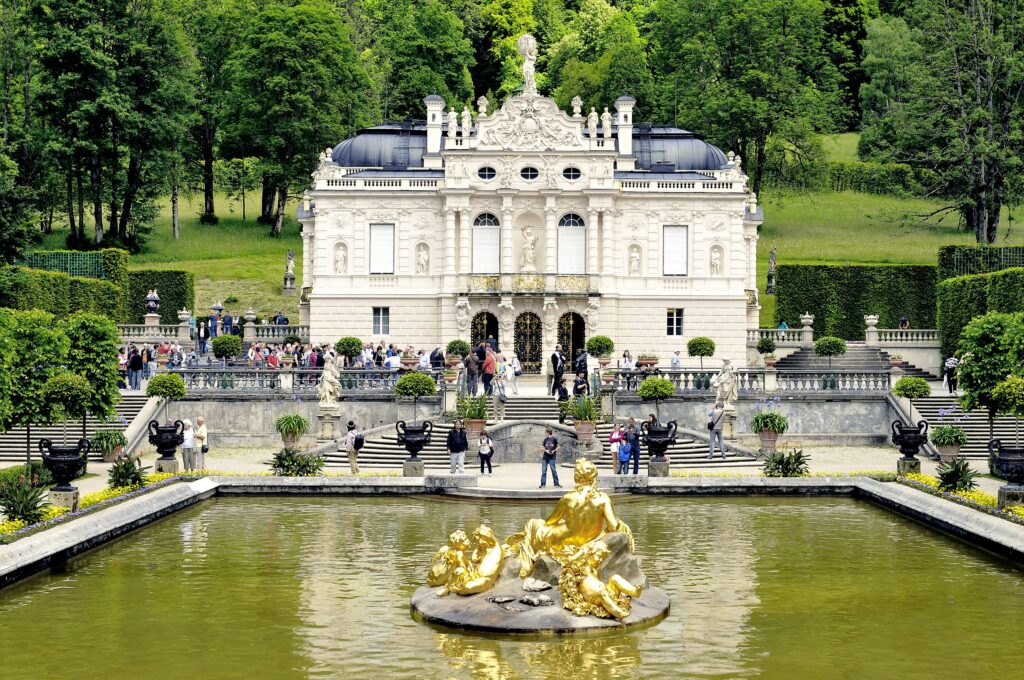
While Neuschwanstein gets the crowds and the postcards, Schloss Linderhof remains King Ludwig II’s most personal retreat—the only one of his three grand palaces he lived to see finished. Built between 1874 and 1878 in a remote alpine valley near Ettal, this intimate rococo jewel reveals more about Bavaria’s fairy-tale king than any castle tower ever could.
The palace sits in the Graswang Valley, about 25 kilometers from Oberammergau and 95 kilometers southwest of Munich. It’s small by royal standards—just ten rooms—but every surface drips with gold leaf, mirrors, and porcelain. Ludwig modeled it after the Petit Trianon at Versailles, channeling his obsession with France’s Sun King, Louis XIV.
Inside the Palace
Guided tours (the only way to see the interior) last about 30 minutes and take you through Ludwig’s private apartments. The Hall of Mirrors is the showpiece: an oval room lined floor-to-ceiling with reflective glass and illuminated by a 108-candle chandelier. Ludwig would sit here alone at night, reading by candlelight, the mirrors multiplying the flames into infinity.
The bedroom is equally extravagant, dominated by a massive blue canopied bed and a porcelain peacock. Ludwig slept here fewer than 40 nights in total—he preferred nocturnal visits, arriving after dark and departing before dawn. The Tapestry Chambers display Gobelin tapestries depicting pastoral scenes, while the Audience Room features a ceiling fresco of Atlas holding up the heavens.
Tours run in German and English year-round, with tickets available at the entrance or online in advance. In summer, expect waits of up to an hour; early morning or late afternoon visits move faster.
The Park and Follies
Linderhof’s real magic lies outdoors. The terraced formal gardens climb the mountainside behind the palace, anchored by a Neptune Fountain and a music pavilion where a 30-meter jet of water erupts every half hour. Ludwig designed the grounds himself, blending French baroque symmetry with alpine wilderness.
The Venus Grotto is the park’s strangest marvel—an artificial cave inspired by Wagner’s opera Tannhäuser. Inside, a lake shimmers under electric lighting (cutting-edge technology in the 1870s), with a golden shell-shaped boat moored at the shore. Ludwig would have orchestras play while he floated alone in the grotto, lost in operatic fantasy. The grotto underwent a decade-long restoration and reopened in 2024; tours are limited and book up quickly.
Don’t miss the Moorish Kiosk, a turquoise-and-gold pavilion Ludwig purchased from the 1867 Paris World’s Fair and reassembled here. Inside sits a peacock throne where the king would smoke hookahs and dream of distant lands. Nearby, the Moroccan House—a timber structure from the 1878 Paris Exposition—served as his reading retreat.
Getting There and Practical Tips
Linderhof is best reached by car via the B23 from Garmisch-Partenkirchen or Oberammergau. Parking costs €3 and sits a ten-minute walk from the palace entrance. By public transport, take the train to Oberammergau, then bus 9622 to Linderhof (limited service, check schedules carefully—buses don’t run in winter).
The palace is open daily except January 1, Shrove Tuesday, December 24, 25, and 31. Winter hours (October through March) run 9:30 a.m. to 4 p.m.; summer until 5:30 p.m. Admission is €10 for the palace alone, €13.50 including park structures. The grounds are free to wander when buildings are closed.
Wear good walking shoes—the park covers 50 hectares, and paths climb steep grades. In winter, trails can be icy; the grotto and some follies close November through March. Combine your visit with Ettal Abbey, five kilometers north, where Benedictine monks still brew beer and distill liqueurs in a stunning baroque monastery.
Why Linderhof Matters
Unlike the theatrical fantasy of Neuschwanstein or the unfinished grandeur of Herrenchiemsee, Linderhof feels lived-in. You can picture Ludwig here—pacing the mirrored hall at midnight, drifting in his golden boat, reading by lamplight in his Moroccan cabin. It’s the clearest window we have into the mind of a king who preferred dreams to governance and beauty to reality.
The valley itself is stunning: forested ridges, alpine meadows, and the sudden shock of rococo opulence in wilderness. It’s Germany’s most underrated royal palace, and the one that stays with you longest after you leave.
Want more stories from Germany’s castles, valleys, and hidden corners? Subscribe to the Love Germany newsletter and get one short story a day—no fluff, just the country we love.
Tours & experiences in Germany


Powered by Viator. Some links are affiliate links — we may earn a small commission at no extra cost to you.