
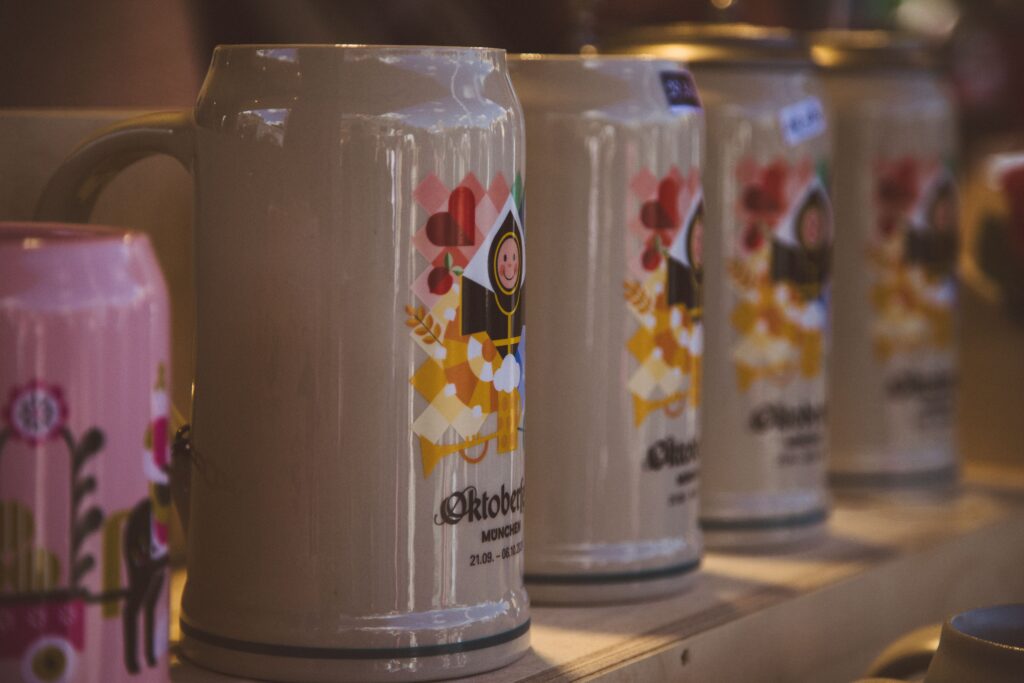
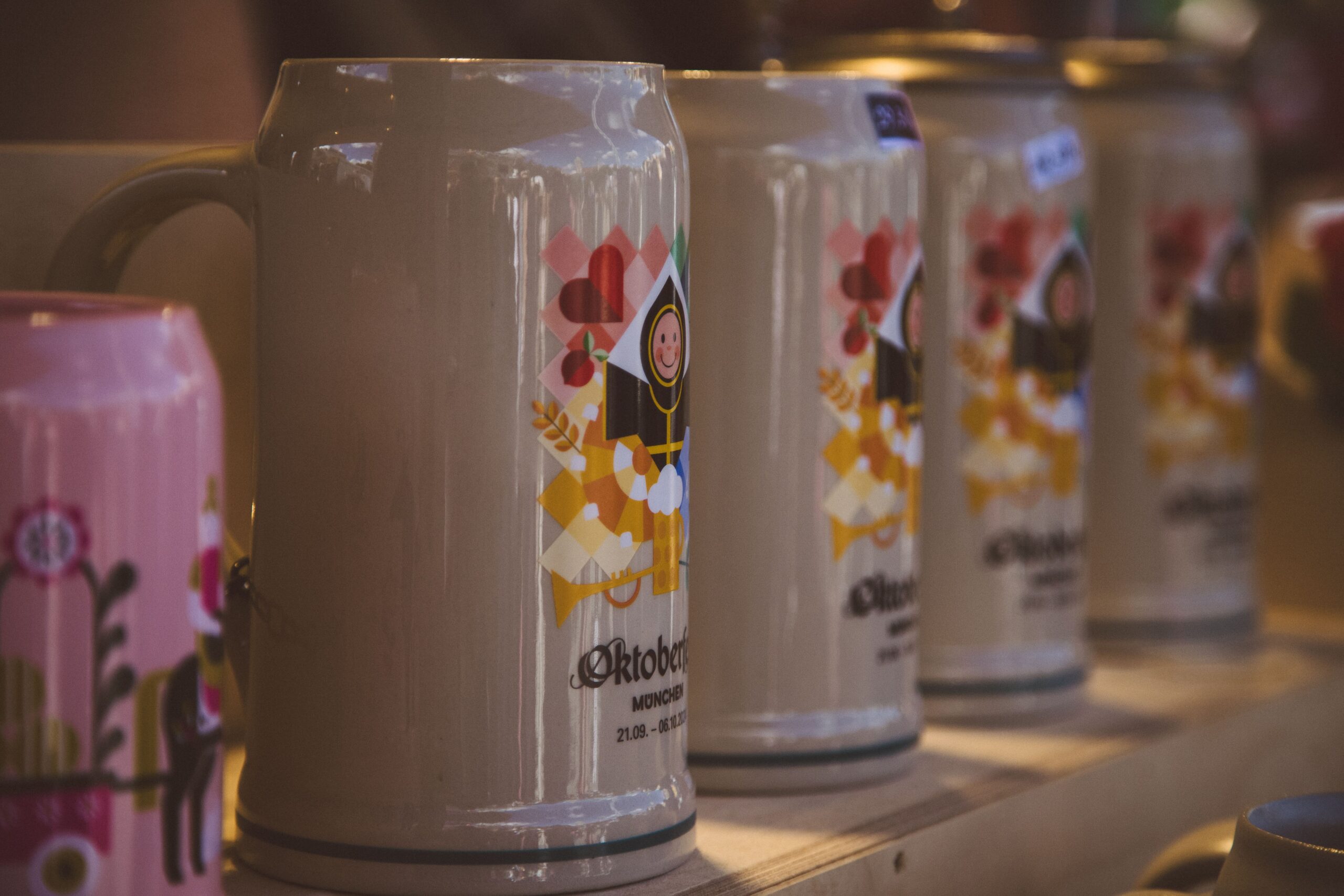
Look closely at an antique German beer stein and you may find a small hinged pewter lid with a thumb-lever on top — a feature that traces back to the aftermath of the bubonic plague, when several German principalities passed hygiene laws requiring food and drink vessels to be covered against flies. That lid is the reason the stein looks so different from an ordinary mug, and it is where the vessel gets much of its character. Welcome to Guide № 003 in The Love Germany Guide series.
Get the Full Collectible Guide (Free PDF)
The Beer Stein — in a beautifully designed, printable booklet. The Love Germany Guide № 003.
What the Word “Stein” Actually Means
The English word “stein” is a shortening of the German Steinzeug, meaning stoneware — the fired clay material many traditional lidded tankards were made from. Interestingly, Germans themselves rarely call the vessel a “Stein” on its own; the common German words are Krug (jug/mug) or Maßkrug for the litre-sized version. The clipped “stein” is largely an English-language usage that took hold abroad, especially in the United States, among collectors and importers.
Why the Lid Exists
The hinged lid is the stein’s signature, and it was born of practicality rather than decoration. Following waves of plague and insect-borne disease across Europe in the late medieval and early modern periods, sanitation ordinances in parts of what is now Germany required covers on beverage containers. Craftsmen added a pewter lid worked by a thumb-lift so a drinker could keep the beer covered yet open it one-handed. Over time the once-functional lid became a canvas for ornament, cast and engraved with figures, coats of arms, and scenes.
How a Traditional Stein Is Made
Classic steins are stoneware, a dense ceramic fired at high temperatures — commonly cited figures put stoneware firing above roughly 1,200°C — which vitrifies the clay so it holds no water and rings when tapped. The famous grey bodies with cobalt-blue decoration come from the Westerwald region, a stoneware-producing area west of the Rhine that has worked this style for centuries. Other steins are earthenware, glass, porcelain, or carved from materials like wood; the pewter fittings were traditionally the work of a separate metalworking trade.
The Maß and the Oktoberfest Connection
The heavy glass mugs hoisted at Munich’s Oktoberfest are a specific thing: the Maß (pronounced “mahss”), a one-litre serving. The dimpled glass litre mug most people picture is largely a modern festival vessel, and it is usually lidless, which sometimes surprises visitors expecting the ornate covered stein. A full one is genuinely heavy — the glass alone weighs over a kilogram before the beer goes in — which is part of why serving staff carrying several at once draw applause. For more on the festival itself, see Guide № 002 in this series.
Reading an Old Stein Like a Collector
Collectors look at the body material, the lid, and the marks. Character steins — moulded into shapes like people, animals, or buildings — and regimental steins made as keepsakes for German soldiers around the turn of the twentieth century are especially sought after; genuine regimental pieces often have a lithophane in the base, a thin translucent scene visible when you hold the empty vessel to the light. Because reproductions are common, serious buyers check maker’s marks, capacity stamps, and the quality of the pewter and glaze rather than trusting decoration alone.
Myths Worth Retiring
Myth: “Stein” is the everyday German word for a beer mug. In Germany the usual words are Krug or Maßkrug. “Stein” as a standalone term is chiefly an English-language collector’s usage derived from Steinzeug (stoneware).
Myth: All authentic steins have lids. The lid is traditional and historically rooted in hygiene law, but plenty of authentic drinking vessels — including the standard Oktoberfest litre glass — have no lid at all.
Myth: The lithophane image in the base proves a stein is very old. Lithophanes appear in some genuine antique steins, but they are also widely reproduced in later souvenir pieces, so the image alone is not proof of age or value.
Frequently Asked Questions
Why do some steins have a glass bottom?
A clear base is often explained by the popular story that a drinker could watch for an enemy’s approach while drinking, though this tale is more folklore than documented history. A more reliable explanation is that a glass bottom lets you check the beer’s clarity, and it also shows off a lithophane scene when held to the light.
Can you still buy new traditional steins?
Yes. Workshops in regions such as the Westerwald continue to produce stoneware steins, and firms like Villeroy & Boch and various Bavarian makers sell both traditional and decorative models. For everyday use, food-safe glazes and lead-free pewter are the modern standard.
Are old steins safe to drink from?
We would treat genuine antiques as display pieces. Older glazes and pewter can contain lead, and a valuable collectible is better protected on a shelf than in a dishwasher. For drinking, we recommend a modern stein made to current food-safety standards.
More The Love Germany Guides
The Love Germany Guide is a numbered series — one tightly focused subject at a time, each with its own downloadable collectible edition. Guide № 001 is The Pretzel (Brezel), Guide № 002 is Oktoberfest, This is Guide № 003. More editions are on the way.
🇩🇪 Join Love Germany
Every week, get hidden stories, local secrets, and travel inspiration from people who live and love it.
Tours & experiences in Germany


Powered by Viator. Some links are affiliate links — we may earn a small commission at no extra cost to you.