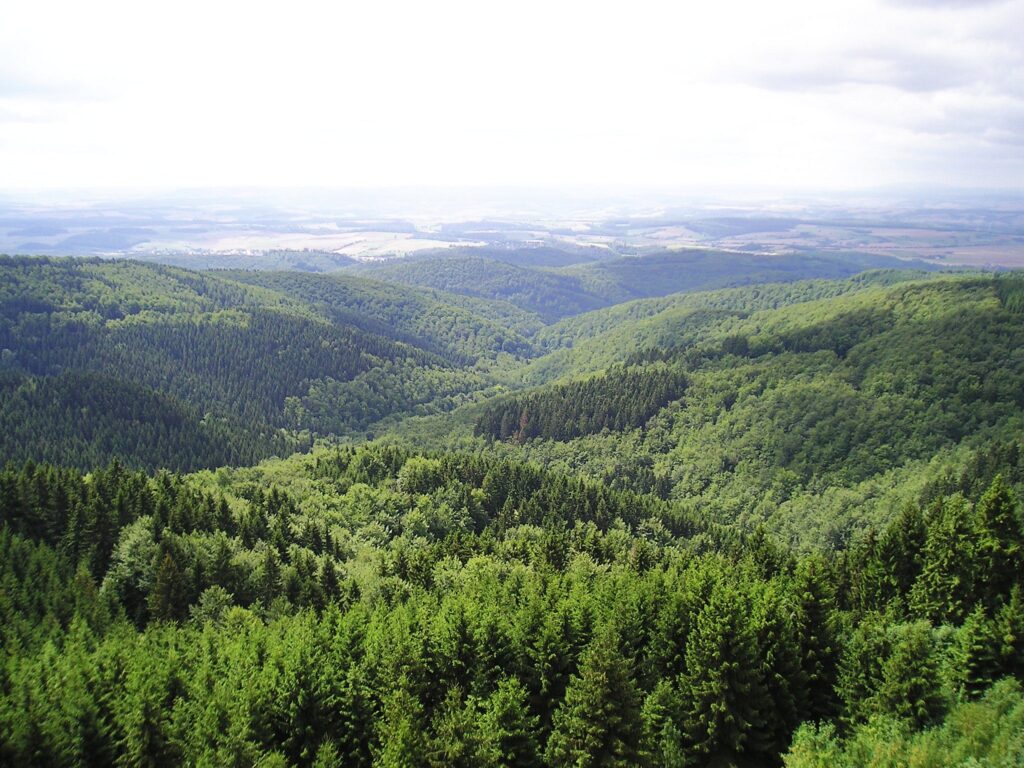
The Harz Mountains rise abruptly from the North German Plain, a compact massif of dense forests, granite peaks, and half-timbered towns that has captivated travelers for centuries. Straddling the border between Lower Saxony, Saxony-Anhalt, and Thuringia, this mid-elevation range packs remarkable variety into a small footprint—you can stand on Germany’s northernmost peak above 1,000 meters, ride a narrow-gauge steam train through spruce forests, and explore UNESCO-listed medieval towns, all within a day’s drive.
The Harz rewards slow exploration. Unlike the Alpine drama of Bavaria, this is a landscape of intimate valleys, sudden rock outcrops, and villages where slate roofs gleam after rain. It’s where Goethe set the witches’ sabbath in Faust, where silver mining built fortress-like towns, and where you’ll still find more hikers than tour buses on weekday mornings.
The Brocken: Summit, Steam, and Witches
At 1,141 meters, the Brocken dominates the Harz both physically and mythologically. Its bare, windswept summit—often shrouded in fog—has inspired legends of witches gathering on Walpurgis Night (April 30) for centuries. Goethe climbed it twice; Heinrich Heine wrote about it; and today it remains the range’s most popular destination.
The most atmospheric way up is aboard the Brockenbahn, a narrow-gauge steam railway that huffs and clanks from Wernigerode or Drei Annen Hohne to the summit in about 90 minutes. The locomotives date from the 1950s, and on cold mornings the steam mingles with mist in the spruce forests. Book tickets in advance during summer and around Walpurgis Night, when the trains fill with revelers in witch costumes.
Hikers have dozens of trails to choose from. The classic route from Torfhaus (about 10 kilometers one way) crosses the high moor and offers the most dramatic approach. From Schierke, the climb is shorter but steeper. The summit itself is a peculiar mix of alpine weather station, tourist facilities, and Cold War history—the Brocken sat in the restricted zone until 1989, used by Soviet and East German forces for surveillance.
Quedlinburg and Goslar: UNESCO Timber and Stone
The Harz’s two great medieval towns anchor opposite ends of the range. Quedlinburg, with more than 2,000 half-timbered houses spanning six centuries, is an architectural encyclopedia in cobblestone. The town clings to its royal past—German kings were elected here in the 10th century—and the Romanesque collegiate church on the castle hill commands views across red rooftops to the plains beyond.
Walk the narrow lanes around the Markt early in the morning before day-trippers arrive. The Finkenherd neighborhood, with its leaning, multicolored facades, is particularly photogenic. For context, visit the Fachwerkmuseum Ständerbau, housed in a 14th-century building that explains timber-frame construction techniques.
Goslar, 40 kilometers west, trades Quedlinburg’s timber for stone and slate. This was a wealthy mining town, and its Kaiserpfalz (Imperial Palace) reminds visitors of its medieval importance. The Rammelsberg mine, a thousand years of ore extraction now preserved as a museum, offers underground tours that bring the region’s silver-mining heritage to life. Both towns are compact enough to explore in a few hours, but staying overnight lets you experience them after the tour buses leave.
The Selketal: Narrow Valleys and Narrow-Gauge Rails
South of Quedlinburg, the Selke Valley cuts a winding path through the eastern Harz. The Selketalbahn, another narrow-gauge line, follows the river from Quedlinburg through Alexisbad to Stiege, stopping at villages where time seems negotiable. The railway shares the valley with a well-marked hiking trail, and you can easily combine the two—ride up, walk down, or vice versa.
The valley’s quiet beauty rewards those who venture off the main routes. Falkenstein Castle perches on a crag above the Selke near Meisdorf, its medieval walls intact and views expansive. The nearby town of Ballenstedt, with its baroque palace and castle gardens, makes a pleasant base for exploring the less-visited southeastern Harz.
Practical Tips for Visiting the Harz
The Harz is accessible year-round, but each season offers distinct advantages. Spring brings wildflowers to the valleys and occasional snow on the Brocken. Summer is peak season—book accommodation well ahead, especially in Quedlinburg and Wernigerode. Autumn colors peak in late September and early October, and the forests glow gold and copper. Winter turns the Brocken into a Nordic wonderland, and the narrow-gauge trains look particularly magical against snow.
For transportation, the HarzCard offers unlimited travel on regional buses and narrow-gauge railways, plus free or discounted entry to many attractions. It’s available for multiple days and pays for itself if you’re using the steam trains. Wernigerode makes the most convenient base for exploring the northern Harz, with good train connections and proximity to the Brockenbahn.
Hiking infrastructure is excellent, with thousands of kilometers of marked trails. The Harzer Wandernadel system turns hiking into a treasure hunt—collect stamps at 222 checkpoints throughout the range, and you can earn bronze, silver, and gold hiking badges. Pick up a stamp booklet at tourist offices or trailheads.
For a quiet corner, head to the western Harz around Clausthal-Zellerfeld, a former mining town at 600 meters elevation. The high plateau here—dotted with historic reservoirs that once powered the mines—sees fewer visitors but offers excellent hiking and cross-country skiing.
The Harz compresses Germany’s fairy-tale landscape into a manageable package. You don’t need weeks to experience it—a long weekend gives you time for a summit, a medieval town, and a steam train journey. But many visitors find themselves returning, drawn back by the forests, the stories, and the sense that around the next valley bend, something worth seeing is waiting.
Want more stories from Germany’s hidden corners? Subscribe to the Love Germany newsletter—one short story a day, delivered to your inbox.
Tours & experiences in Germany


Powered by Viator. Some links are affiliate links — we may earn a small commission at no extra cost to you.