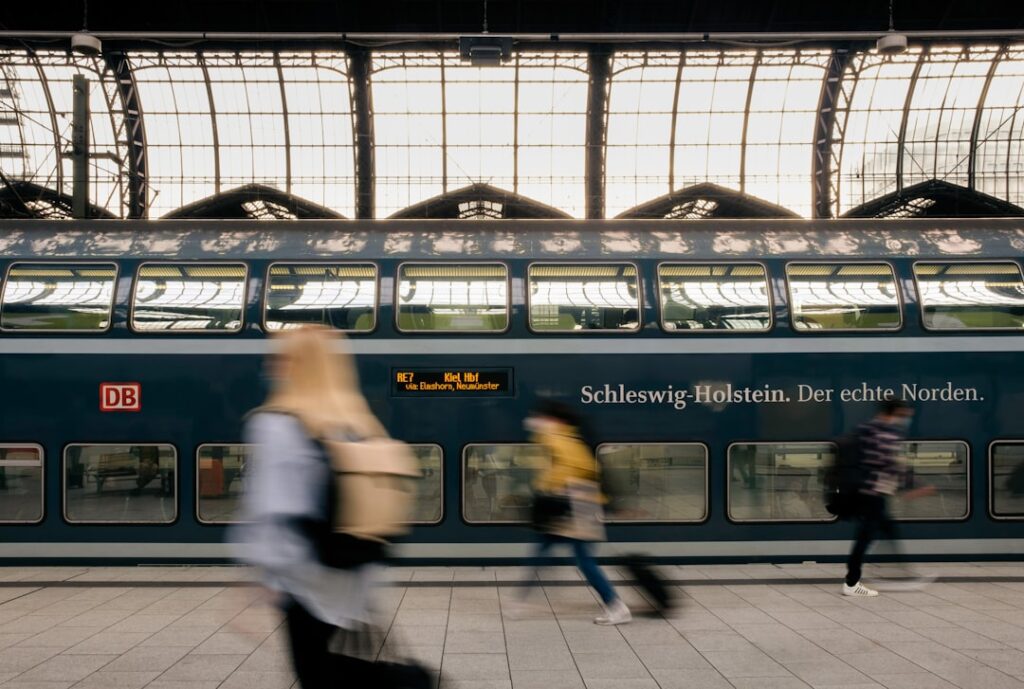
Germany’s regional train network is one of Europe’s best-kept travel secrets. While the high-speed ICE trains get all the attention, the slower regional trains—known as Regionalbahn (RB) and Regional-Express (RE)—offer an affordable, scenic, and thoroughly authentic way to explore the country. They stop at small towns the fast trains skip, wind through valleys the autobahn bypasses, and cost a fraction of the price.
If you’re planning to visit the Romantic Road, the Rhine Valley, or the Bavarian Alps, mastering the regional train system will save you money and open up corners of Germany most tourists never see.
Understanding the System: RB, RE, and S-Bahn
Germany’s regional trains fall into three main categories. The Regionalbahn (RB) is the slowest, stopping at nearly every station—perfect for short hops between neighboring towns. The Regional-Express (RE) skips smaller stops and connects mid-sized cities more quickly. In metropolitan areas, the S-Bahn functions like a suburban commuter rail, linking city centers to outlying neighborhoods and nearby towns.
Unlike ICE trains, you don’t need a reservation on regional trains. Just buy a ticket and board. Tickets are valid for any train on your route that day, so if you miss one, catch the next. Trains run frequently on major routes—often every 30 minutes—but check schedules for rural lines, where service can be sparse on weekends.
Use the Deutsche Bahn website or DB Navigator app to plan routes. Both show all train types, including regional options, and let you filter out the pricier high-speed trains if you prefer to travel slowly and cheaply.
Tickets and Passes That Save You Money
The biggest advantage of regional trains is cost. A single journey from Munich to Garmisch-Partenkirchen on an ICE costs around €35, but the same trip on an RB train costs just €22—and you’ll get better views of the Alps along the way.
For day trips and short excursions, buy point-to-point tickets at station machines or via the app. But if you’re exploring a region, the Bayern-Ticket (Bavaria), Rheinland-Pfalz-Ticket (Rhineland-Palatinate), or Niedersachsen-Ticket (Lower Saxony) offer unlimited regional travel for €26 to €32 per day for one person, with just €6 to €8 for each additional traveler (up to five people). That means a group of four can explore all of Bavaria for around €44 total.
These passes are valid on all RB, RE, and S-Bahn trains within the state, plus local buses and trams in most cities. They’re available from 9 a.m. on weekdays (midnight on weekends) until 3 a.m. the next day—plenty of time for a full day out.
The Quer-durchs-Land-Ticket works nationwide on regional trains for €44 (€8 per additional traveler) and follows the same time rules. It’s ideal if you’re crossing state lines—say, from Frankfurt to Heidelberg to Strasbourg (France).
Best Routes for Scenic Regional Travel
Regional trains shine on routes where the journey itself is the destination. The Munich to Garmisch-Partenkirchen line climbs steadily into the Bavarian Alps, offering postcard views of peaks, forests, and the Zugspitze. From Garmisch, you can continue to Mittenwald or Oberammergau on local trains.
The Rhine Valley line between Koblenz and Mainz runs right along the river, passing castle-topped hills, terraced vineyards, and the Lorelei rock. Trains run hourly, and you can hop off at Bacharach, St. Goar, or Boppard to explore medieval towns and riverside trails.
In the Black Forest, the Schwarzwaldbahn (Black Forest Railway) between Offenburg and Konstanz winds through tunnels, over viaducts, and past half-timbered villages. Stop in Triberg to see Germany’s highest waterfalls or continue to Lake Constance.
The Baltic coast line from Lübeck to Stralsund connects Hanseatic towns and seaside resorts, with easy connections to Rügen Island. Trains hug the coast intermittently, offering glimpses of the sea and historic brick architecture.
Tips for a Smooth Journey
Regional trains can be crowded on weekends and holidays, especially on popular routes like Munich to the Alps. Arrive early to snag a window seat, or travel midweek for a quieter experience.
Bikes are allowed on most regional trains for a small fee (usually €5 to €6), but space is limited. Look for the bicycle symbol on the timetable and board the designated car.
Don’t expect onboard Wi-Fi or dining cars—regional trains are bare-bones. Bring snacks, download maps, and pack a book or podcasts. Half the charm is slowing down and watching the countryside roll by.
Always validate your ticket if required (though app and machine tickets are usually pre-validated). Ticket inspectors are thorough, and fines for traveling without a valid ticket start at €60.
Finally, embrace delays and missed connections with patience. Regional trains are reliable overall, but tight connections can be tricky. Build in buffer time, especially if you’re catching a long-distance train afterward.
Germany’s regional trains aren’t the fastest way to travel, but they’re often the most rewarding. They take you through landscapes and towns that feel untouched by mass tourism, and they do it for a price that leaves room in your budget for an extra night in a guesthouse or a round at a beer garden. Once you get the hang of the system, you’ll wonder why you ever considered renting a car.
Want more insider tips on traveling Germany like a local? Subscribe to the Love Germany newsletter and get one short story a day, straight to your inbox.
Tours & experiences in Germany


Powered by Viator. Some links are affiliate links — we may earn a small commission at no extra cost to you.