
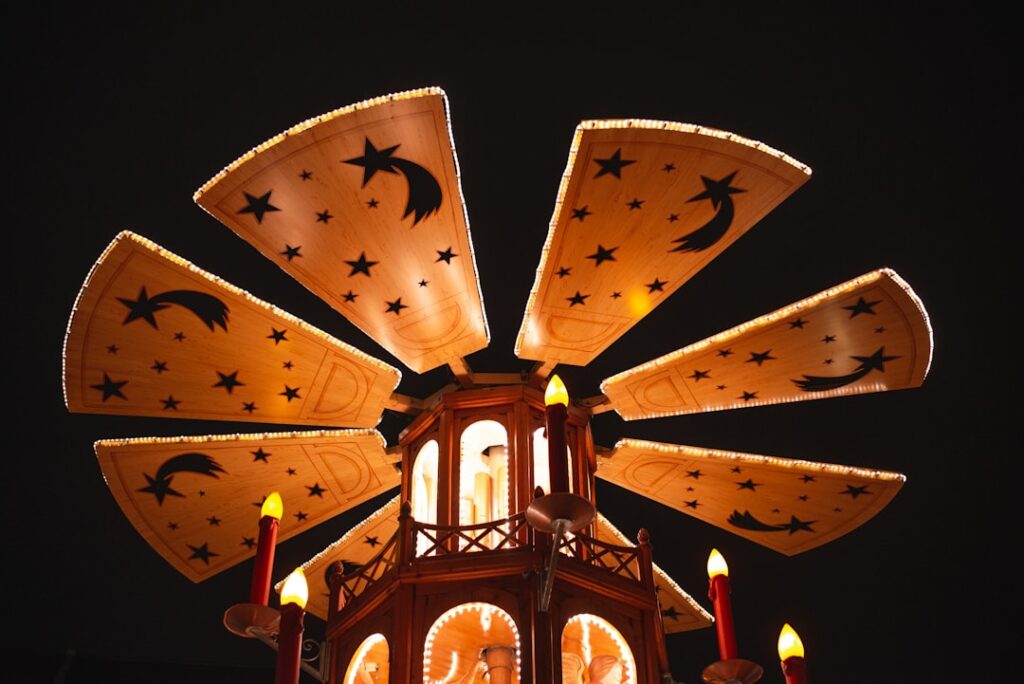
Walk through any German Christmas market and you’ll eventually spot it: a multi-tiered wooden carousel spinning gently above the stalls, powered by nothing but candlelight and rising heat. The Christmas pyramid, or Weihnachtspyramide, is one of Germany‘s most enchanting holiday traditions, and its story begins in the mines and workshops of Saxony’s Erzgebirge mountains.
These aren’t just decorations. They’re masterpieces of folk art that tell stories—of nativity scenes, of mining heritage, of Alpine villages—all while performing a delicate dance between fire, air, and craftsmanship that has captivated Germans for more than two centuries.
The Erzgebirge: Where Pyramids Were Born
The Christmas pyramid emerged in the early 19th century in the Erzgebirge, the “Ore Mountains” along Germany’s border with the Czech Republic. When the region’s silver mines began to decline, miners turned their carving skills to toy-making and Christmas decorations. They’d already been crafting Lichtergestelle—wooden light holders for their dark winter homes—and someone had the inspiration to add a propeller blade on top, driven by heat from candles below.
The towns of Seiffen, Annaberg-Buchholz, and Schneeberg became centers of this craft. Visit Seiffen today and you’ll find the Erzgebirgisches Spielzeugmuseum (Toy Museum), where you can trace the evolution of pyramids from simple single-tier designs to the elaborate seven-story creations that now stand in market squares. The museum sits right in the heart of Germany’s “Toy Village,” where workshops still produce hand-turned figurines and pyramids using traditional methods.
During Advent, Annaberg-Buchholz hosts one of the Erzgebirge’s most atmospheric Christmas markets, where local carvers demonstrate their craft and you can watch pyramids being assembled by hand. The scent of wood shavings mingles with Glühwein and roasted almonds.
How a Christmas Pyramid Actually Works
The engineering is simple but ingenious. Candles placed around the pyramid’s base heat the air above them. That warm air rises through the structure and hits angled propeller blades at the top, causing the entire carousel to rotate. The tiers—usually anywhere from one to four levels on household pyramids, more on the massive public versions—display hand-carved and painted wooden figures.
Traditional scenes include nativity tableaux on the bottom tier, with shepherds, angels, and the Three Kings on levels above. But Erzgebirge pyramids often celebrate mining heritage: you’ll see carved miners in their traditional black uniforms, complete with tiny pickaxes and helmets, or woodcutters and foresters representing other regional trades.
The figures themselves are works of art. Erzgebirge carvers are known for their Reifendrehen technique—turning wood on a lathe to create smooth, simplified forms that are then painted by hand. The style is distinctive: rounded bodies, simple faces, a folk-art aesthetic that’s been refined over generations.
Germany’s Grand Christmas Market Pyramids
While tabletop pyramids grace German homes throughout Advent, it’s the towering outdoor versions that truly steal the show at Christmas markets. These aren’t just scaled-up decorations—they’re architectural achievements that can reach five stories high.
Dresden’s Striezelmarkt, Germany’s oldest Christmas market, features a pyramid that stands nearly 50 feet tall and displays more than 100 hand-carved figures. The pyramid dominates the Altmarkt square, and watching it slowly turn against the backdrop of Dresden’s illuminated baroque architecture is worth the trip alone.
Leipzig’s market pyramid reaches similar heights and showcases scenes from Leipzig’s history alongside traditional Christmas imagery. Cologne’s market at the Dom hosts its own towering version, and even smaller markets in towns like Rothenburg ob der Tauber and Nuremberg feature impressive multi-story pyramids as centerpieces.
The best time to see these pyramids is late afternoon into evening, when the markets are in full swing and the candles (or, on modern large pyramids, electric lights designed to look like candles) are lit. The slow rotation, the intricate carvings illuminated from below, and the market atmosphere create something genuinely magical.
Bringing the Tradition Home
If you’re visiting Germany during the Christmas season, authentic Erzgebirge pyramids make exceptional souvenirs—though be prepared for both the price and the packing challenge. A quality handmade pyramid from Seiffen or Annaberg-Buchholz represents hours of skilled work.
Prices for traditional pyramids start around €80 for simple single-tier designs and climb into the hundreds for elaborate multi-tier versions with dozens of figures. Look for the “Echt Erzgebirge” seal, which guarantees the piece was made in the region using traditional methods.
Käthe Wohlfahrt, the famous Christmas store chain with locations in Rothenburg ob der Tauber, Heidelberg, and Rüdesheim, carries excellent selections of Erzgebirge pyramids year-round, with knowledgeable staff who can explain the different styles and carving workshops. But for the widest selection and most authentic experience, visit the Erzgebirge itself, particularly during the region’s mountain Christmas markets in late November and December.
The pyramids work best with traditional wax candles rather than the tea lights many people try to use—the shape and height of the candle affects the heat flow and rotation speed. And yes, they really do spin just from candle power, though it takes a few minutes for the air to warm enough to get them moving.
More Than Decoration
What makes the Christmas pyramid more than just another holiday decoration is how it concentrates so much of German Christmas tradition into one object: the woodcarving heritage of the Erzgebirge, the importance of candlelight during the darkest time of year, the mining history that shaped entire regions, and that particularly German attention to Gemütlichkeit—the cozy warmth of home in winter.
Watching one turn slowly on a December evening, whether on your own table or towering above a crowded Christmas market, connects you to generations of German craftspeople and the long winters that shaped their creativity.
Want more stories about Germany’s traditions, regions, and hidden corners? Subscribe to the Love Germany newsletter and get one short story about Germany delivered to your inbox each day—the country beyond the guidebooks, one tale at a time.
Tours & experiences in Germany


Powered by Viator. Some links are affiliate links — we may earn a small commission at no extra cost to you.