
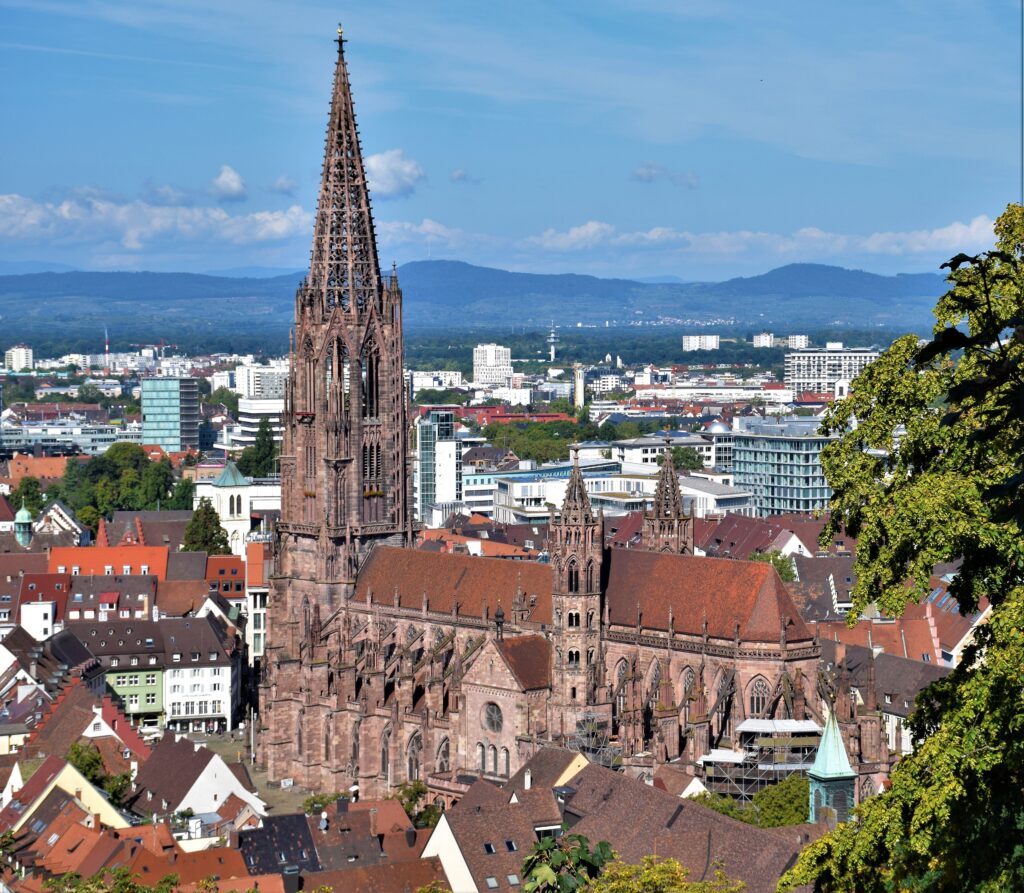
Tucked between the Rhine plain and the forested slopes of the Black Forest, Freiburg im Breisgau claims more sunshine than any other major German city. That climate—and a pedestrian-friendly Altstadt rebuilt after World War II with careful respect for its medieval plan—makes this university town one of southwestern Germany’s most appealing destinations.
Founded in 1120, Freiburg balances Gothic grandeur with a progressive, bike-friendly culture. Its location makes it an ideal base for exploring the southern Black Forest, the Kaiserstuhl wine region, and even day trips across the border to Alsace.
The Münster and the Marktplatz
Freiburg’s cathedral, the Münster Unserer Lieben Frau, dominates the city center with its lacy sandstone spire—one of the few Gothic towers in Germany completed in the Middle Ages. Construction began around 1200, and the tower, finished in 1330, rises 116 meters without flying buttresses, a feat of engineering that still draws architects today.
Step inside to see the jewel-toned stained glass windows, some original to the 13th and 14th centuries, and Hans Baldung Grien’s altarpiece in the university chapel. The tympanum above the main portal depicts the Last Judgment in stone figures so finely carved you can see the folds in their robes.
The Münsterplatz hosts a daily market (Monday through Saturday) where farmers from the surrounding hills sell Schwarzwälder Schinken, wild mushrooms, local cheeses, and flowers. The square is ringed by the red Historisches Kaufhaus, a 16th-century merchant hall with Habsburg coats of arms, and cafés where you can sit with a Käsespätzle or a slice of Schwarzwälder Kirschtorte.
The Bächle: Freiburg’s Medieval Water Channels
Narrow streams called Bächle run through the cobbled streets of the Altstadt, fed by the Dreisam River. Originally designed in the 13th century to provide water for firefighting and livestock, these channels now serve as the city’s quirky trademark. Legend says that if you accidentally step in one, you’ll marry a Freiburger.
The Bächle are at their most charming on Konviktstraße and Fischerau, where they frame half-timbered houses and reflect the warm sandstone of the buildings. In summer, children float little wooden boats down them, and the burbling water cools the air on hot afternoons.
Schlossberg and the Vineyard Views
For perspective on Freiburg’s setting, take the Schlossbergbahn funicular from the Stadtgarten up to the Schlossberg, a wooded hill on the edge of the old town. The ride takes three minutes; at the top, a network of trails leads to the Schlossbergturm, a modern steel lookout tower offering 360-degree views over the red rooftops, the cathedral spire, the Rhine plain, and the Black Forest ridges.
On clear days, you can see the Vosges Mountains in France. Trails also lead to the Kanonenplatz, a terrace with a beer garden where locals gather at sunset with a Rothaus Pils or a glass of Gutedel, the light white wine grown on the steep hillsides south of the city.
If you prefer to hike up, take the trail from Schwabentor, one of the two surviving medieval gates. The route passes through terraced vineyards maintained by the city’s winemakers; some are open for tastings by appointment.
Day Trips and Black Forest Access
Freiburg is the most convenient base for exploring the southern Black Forest. The Höllental (Hell Valley) railway, which runs east from Freiburg’s Hauptbahnhof, climbs through gorges and tunnels to Titisee, a glacial lake surrounded by hiking trails. The train journey itself is scenic, winding through the Ravenna Gorge and past the Hirschsprung, a rock leap named for a legendary stag.
To the west, the Kaiserstuhl, a volcanic hill rising from the Rhine plain, produces some of Baden’s finest wines—Grauburgunder, Weissburgunder, and Spätburgunder. The towns of Burkheim and Ihringen have tasting rooms and half-timbered streets. Rent a bike in Freiburg (the city has excellent cycling infrastructure) and follow the marked Kaiserstuhl wine route, about 40 kilometers of gentle, vineyard-lined roads.
Freiburg is also a 45-minute train ride from Basel, Switzerland, and an hour from Colmar in Alsace, making it easy to combine a visit with cross-border exploration.
Practical Tips for Visiting Freiburg
Freiburg’s Hauptbahnhof is well-connected by ICE and regional trains from Frankfurt (2 hours), Munich (4.5 hours), and Stuttgart (2.5 hours). The Altstadt is a 10-minute tram ride or a 20-minute walk from the station; tram line 1 runs directly to the cathedral.
The city center is largely car-free. If you’re driving, park at one of the park-and-ride lots on the edge of town and take the tram in. The KONUS guest card, provided free by many hotels in the Black Forest region, covers local public transport.
Visit between May and September for the best weather and the liveliest market atmosphere, but be prepared for crowds. Late autumn offers fewer tourists, golden foliage in the vineyards, and the chance to taste Federweißer, the half-fermented new wine sold in October.
For lunch, try Martin’s Bräu on Kaiser-Joseph-Straße for local beer and Baden specialties, or the market stalls on Münsterplatz for Lange Rote, Freiburg’s famous grilled sausage served in a long roll. The Markthalle, a covered market near the cathedral, has wine bars and cheese counters ideal for assembling a picnic.
If you’d like more stories like this—one short feature a day on Germany’s towns, trails, and traditions—subscribe to the Love Germany newsletter. We’ll send you the details worth knowing, no fluff, just the good stuff.
Tours & experiences in Germany


Powered by Viator. Some links are affiliate links — we may earn a small commission at no extra cost to you.