Germany’s Baltic Sea coast runs more than 750 kilometers from the Danish border to Poland, threading through Schleswig-Holstein and Mecklenburg-Vorpommern. Unlike the North Sea’s tidal flats and wind-battered dunes, the Baltic offers calm waters, long stretches of fine white sand, and a string of old trading ports whose brick cathedrals and warehouses recall the centuries when the Hanseatic League ruled northern commerce.
The region draws summer beachgoers and off-season walkers in equal measure. Spring and autumn bring milder crowds, gentler prices, and the kind of slanting coastal light that painters favor.
Lübeck and the Brick Gothic Coast
Lübeck sits just inland from the coast, the medieval queen of the Hanseatic League and still the architectural anchor of the region. Its Altstadt, ringed by the Trave River, is a UNESCO World Heritage site where seven church spires punctuate the skyline. The twin towers of the Marienkirche, the Holstentor gate, and the stepped gables of merchant houses form one of northern Europe’s most intact medieval ensembles.
From Lübeck, the coast runs northeast to Travemünde, the city’s beach resort and ferry port. The promenade stretches along a wide sandy beach, backed by grand turn-of-the-century hotels and a four-masted barque, the Passat, moored as a museum ship. Travemünde’s casino and spa architecture reflect its 19th-century heyday as a fashionable watering hole.
Further east, Wismar and Rostock anchor the Mecklenburg coast. Both were Hanseatic powerhouses, and both retain their vast brick Gothic churches. Wismar’s market square, one of the largest in northern Germany, is dominated by the Wasserkunst, an ornate Renaissance well pavilion. Rostock’s university, founded in 1419, and the quarter around the Kröpeliner Straße give the city a youthful energy that complements its medieval core.
Rügen: Germany’s Largest Island
Rügen, connected to the mainland by causeway and bridge, is Germany’s largest island and its most visited Baltic destination. The island’s northern coast is defined by the Jasmund National Park, where beech forests rise above chalk cliffs that plunge 118 meters into the sea. The Königsstuhl, the most famous formation, has drawn tourists since the Romantic era, when Caspar David Friedrich painted it in 1818.
The island’s resort towns—Binz, Sellin, Göhren—line the eastern shore, their Belle Époque villas gleaming white against the sand. Each town has a Seebrücke, a long wooden pier extending into the Baltic, where visitors stroll at sunset and watch ferries pass. The architecture, known as Bäderarchitektur, is a late-19th-century blend of wooden balconies, gabled roofs, and wedding-cake trim, meticulously restored since reunification.
Rügen’s interior is quieter: rolling farmland, beech avenues, and small fishing villages like Vitt, tucked into a narrow valley near Cape Arkona. The cape itself, the island’s northernmost point, is crowned by two lighthouses and a Slavic fortress site, with views across to Denmark on clear days.
Usedom and the Eastern Coast
Usedom, straddling the German-Polish border, claims the longest beach promenade in Europe and more hours of sunshine than nearly anywhere else in the country. The three imperial spas—Ahlbeck, Heringsdorf, Bansin—form a continuous resort strip along the southern shore, each with its own historic pier and grand hotel quarter.
Ahlbeck’s Seebrücke, built in 1899, is the oldest on the German Baltic coast and appears on countless postcards. Heringsdorf, once frequented by Kaiser Wilhelm II, retains its palatial villas and Europe’s longest beach pier at 508 meters. The island’s interior offers cycling routes through pine forests and wetlands, and the town of Ückeritz provides a quieter base near the Achterwasser lagoon.
Stralsund and the Gateway to the Islands
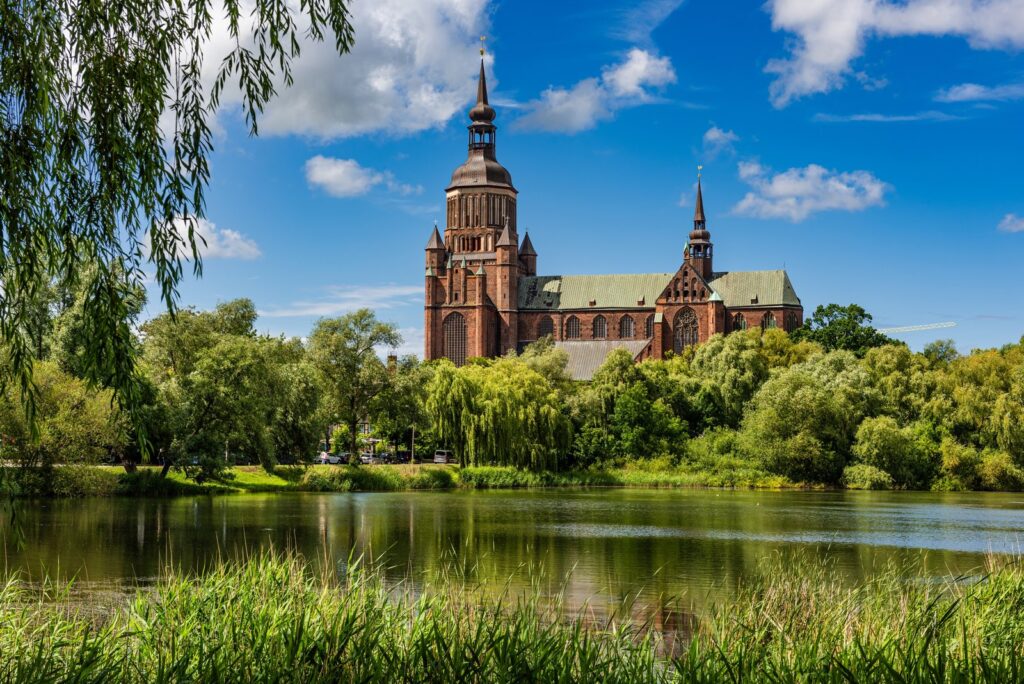
Stralsund, facing Rügen across the Strelasund strait, is another Hanseatic jewel and UNESCO site. The city’s Rathaus and Nikolaikirche anchor the Alter Markt, while the harbor hosts the Ozeaneum, a modern marine museum with Baltic Sea and North Atlantic aquariums.
Stralsund serves as the gateway to both Rügen and the smaller island of Hiddensee, a car-free retreat accessible only by ferry. Hiddensee, just 17 kilometers long, is a haven for cyclists and walkers, its landscape a mix of heath, dunes, and the 72-meter Dornbusch cliff.
Practical Notes
The Baltic coast is well connected by regional train, with direct services from Hamburg and Berlin to Rostock, Stralsund, and the island resorts. Rental cars offer the most flexibility for exploring smaller villages and coastal trails. Summer, especially July and August, brings the warmest water and the busiest beaches; May, June, and September offer milder weather and fewer crowds.
The region’s seafood tradition centers on smoked fish, herring, and eel, sold from small smokehouses along the harbor fronts. Sanddorn (sea buckthorn), a tart orange berry, appears in juices, liqueurs, and desserts throughout the coast.
If the Baltic’s mix of medieval ports, forest-backed beaches, and island light appeals to you, subscribe to the Love Germany newsletter. We send one short story a day, straight to your inbox—no fluff, just the Germany we love.
Tours & experiences in Germany


Powered by Viator. Some links are affiliate links — we may earn a small commission at no extra cost to you.