Nestled in the heart of Franconia in northern Bavaria, Bamberg is one of Germany’s most enchanting yet often overlooked treasures. This remarkably well-preserved medieval town, built across seven hills like its Italian namesake Rome, escaped World War II bombing entirely, leaving its 1,000-year-old architecture gloriously intact. In 1993, UNESCO recognized Bamberg’s Old Town as a World Heritage Site, praising its authentic medieval urban layout and extraordinary collection of buildings spanning Romanesque, Gothic, Renaissance, and Baroque periods.
But Bamberg isn’t just a living museum—it’s a vibrant university town with a thriving brewing culture that produces one of the world’s most distinctive beers: Rauchbier, or smoked beer. With more breweries per capita than almost anywhere else in the world and a stunning riverside setting along the Regnitz River, Bamberg offers travelers an intoxicating blend of history, culture, and Franconian hospitality.
The Architectural Wonders of Bamberg’s Old Town
Bamberg’s most iconic sight is the Altes Rathaus (Old Town Hall), an extraordinary half-timbered building that appears to float in the middle of the Regnitz River on an artificial island. According to legend, the bishop refused to give citizens land for a town hall, so they drove stakes into the river and built it there instead. The building’s remarkable frescoes create stunning optical illusions, and the Rococo council chamber inside houses a porcelain collection worth visiting.
The Bamberg Cathedral (Bamberger Dom) dominates the skyline with its four towers and contains several medieval masterpieces, including the only papal tomb north of the Alps (Pope Clement II) and the enigmatic Bamberger Reiter (Bamberg Horseman), a 13th-century equestrian statue whose identity remains a mystery. The nearby Neue Residenz, the former prince-bishops’ palace, boasts stunning Baroque state rooms and the Rose Garden, which offers panoramic views across the town’s red-tiled rooftops.
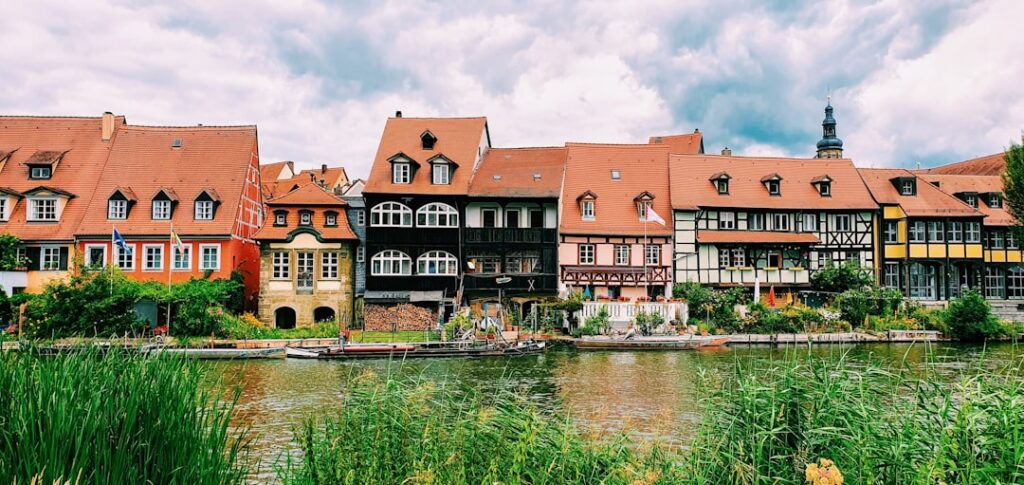
Wander through Little Venice (Klein Venedig), a picturesque row of colorful medieval fishermen’s houses lining the Regnitz riverbank. This is Bamberg at its most photogenic, especially during summer when geraniums overflow from window boxes. Cross the river to explore the narrow, winding streets of the Gärtnerstadt (Gardeners’ Quarter), where families have cultivated vegetables, herbs, and especially licorice for centuries.
Rauchbier and Bamberg’s Legendary Beer Culture
Bamberg is home to eleven breweries, an astonishing number for a town of just 77,000 people, and the undisputed world capital of Rauchbier. This distinctive smoked beer gets its unique flavor from malt dried over beechwood fires, a traditional technique that predates modern malting methods. The taste is polarizing—some describe it as liquid bacon, others as campfire in a glass—but it’s an essential part of the Bamberg experience.
The best place to try authentic Rauchbier is Schlenkerla, a historic brewery tavern dating to 1405, where locals and visitors crowd wooden tables beneath vaulted ceilings blackened by centuries of smoke. Order a Rauchbier and pair it with Franconian specialties like smoked pork shoulder (Schäufele) or onion-stuffed beef rolls (Zwiebeln). For a different perspective, visit Spezial, another excellent Rauchbier brewery, or try Fässla and Greifenklau for more traditional Franconian lagers.
Getting There and Getting Around
Bamberg is easily accessible by train from major German cities. Direct regional trains connect to Nuremberg (about 45 minutes), Munich (2-2.5 hours), and Würzburg (1 hour). From Frankfurt, the journey takes approximately 2.5 hours with one change. The compact Old Town is entirely walkable, and the main sights cluster within a 20-minute stroll of each other.
The train station sits about 1.5 kilometers from the Old Town center—an easy 20-minute walk or a short bus ride (lines 901, 902, 910, or 920). Consider purchasing the Bamberg Card, which offers free public transportation and discounts on museums and guided tours. However, Bamberg’s greatest pleasures come from simply wandering its medieval lanes without a rigid itinerary.
When to Visit and Insider Tips
Bamberg shines year-round, but each season offers distinct advantages. Spring (April-May) brings blooming gardens and the traditional Bockbieranstich (strong beer tapping) celebrations. Summer (June-August) features warm weather perfect for riverside beer gardens, though this is peak tourist season. The Sandkerwa festival in late August transforms the riverside into a massive folk festival with live music and traditional Franconian food.
Autumn (September-October) is arguably the best time to visit—pleasant temperatures, golden foliage, and the celebration of Rauchbier season without summer crowds. Winter brings one of Germany’s most atmospheric Christmas markets, with stalls scattered across the cathedral square and the Old Town Hall island.
For the ultimate insider experience, join a guided beer tour to visit smaller, lesser-known breweries like Ambräusianum or the monastery brewery Klosterbräu. Book accommodations well in advance during festival periods. Consider staying overnight—Bamberg’s magic intensifies in early morning when mist rises from the river and evening when floodlit buildings glow golden against the dark sky. Finally, don’t leave without trying Bamberger Hörnla, a local crescent-shaped potato variety served throughout Franconian restaurants, preferably with the aforementioned Schäufele.
Whether you’re drawn by medieval architecture, brewing traditions, or simply the chance to experience an authentic German town untouched by mass tourism, Bamberg delivers an unforgettable taste of Franconian culture.