Few cities embody the resilience of the human spirit quite like Dresden. Once called the “Florence on the Elbe” for its breathtaking baroque architecture, Dresden was devastated during World War II, only to rise again with painstaking determination. Today, the reconstructed Frauenkirche and the magnificent Zwinger Palace stand as twin jewels of Saxon splendor, offering visitors an unforgettable journey through Germany’s artistic and architectural heritage.
The Frauenkirche: A Phoenix Rising
The Church of Our Lady (Frauenkirche) dominates Dresden’s Neumarkt square with its distinctive stone bell dome, one of the largest in Europe. Originally completed in 1743, this Protestant baroque masterpiece was designed by George Bähr and stood as a symbol of Dresden’s golden age for two centuries. The church was reduced to rubble during the February 1945 firebombing, and its blackened stones remained as a war memorial throughout the Communist era.
The decision to rebuild came after German reunification, and the reconstruction project became one of the most ambitious in European history. Using original plans and incorporating salvaged stones—the dark ones visible in the facade today—the Frauenkirche was meticulously reconstructed and reconsecrated in 2005. The result is nothing short of spectacular. Inside, the church’s pastel interior glows with soft pinks, blues, and golds, while the dome soars overhead in perfect geometric harmony. Climb the 67 meters to the viewing platform for panoramic views across Dresden’s baroque skyline and the winding Elbe River.
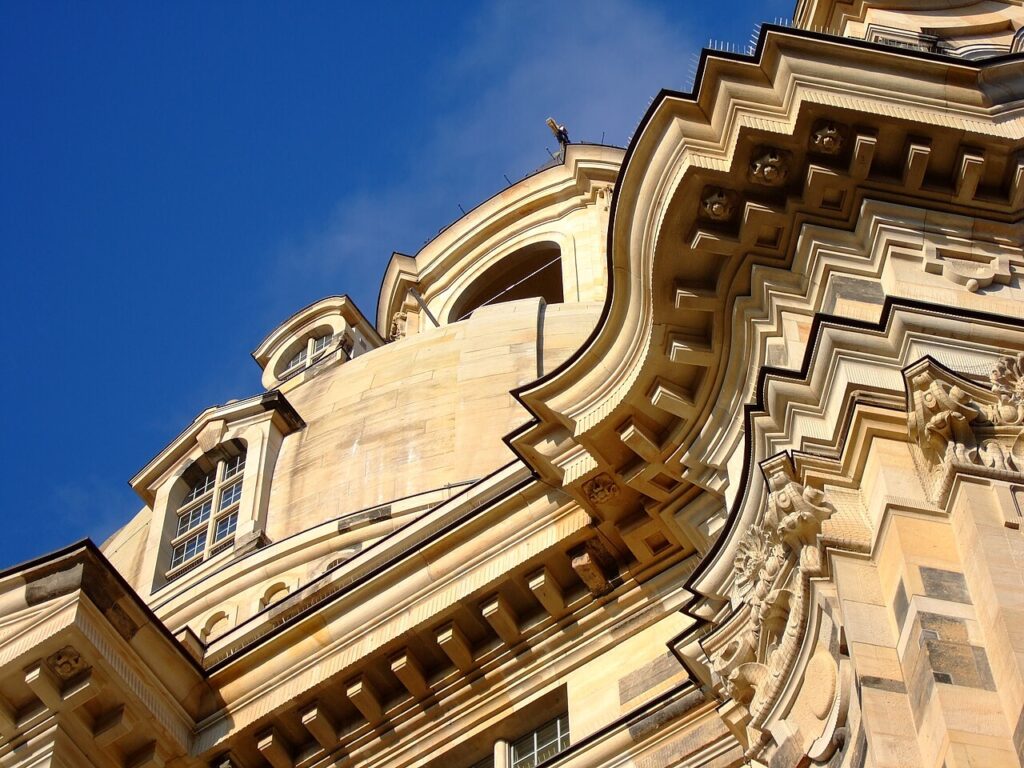
Don’t miss the altar, a faithful recreation of the original baroque masterpiece, and look for the cross atop the dome—crafted by a British blacksmith whose father flew bombing missions over Dresden, a powerful symbol of reconciliation.
The Zwinger: Saxony’s Palace of Art and Science
Just a ten-minute walk from the Frauenkirche lies the Zwinger, one of Germany’s most important baroque buildings. Commissioned by Augustus the Strong in the early 18th century, this palatial complex was designed as an orangery and a venue for lavish court festivals. The name “Zwinger” refers to the castle ward that once occupied this space between Dresden’s medieval fortifications.
The Zwinger’s architecture alone justifies a visit. The sprawling courtyard is framed by ornate pavilions and galleries adorned with sculptures, fountains, and playful putti. The Crown Gate (Kronentor), topped with a gilded Polish crown, serves as the complex’s signature landmark. The Nymph’s Bath fountain, with its baroque water features and mythological figures, comes alive during summer months and provides a refreshing respite.
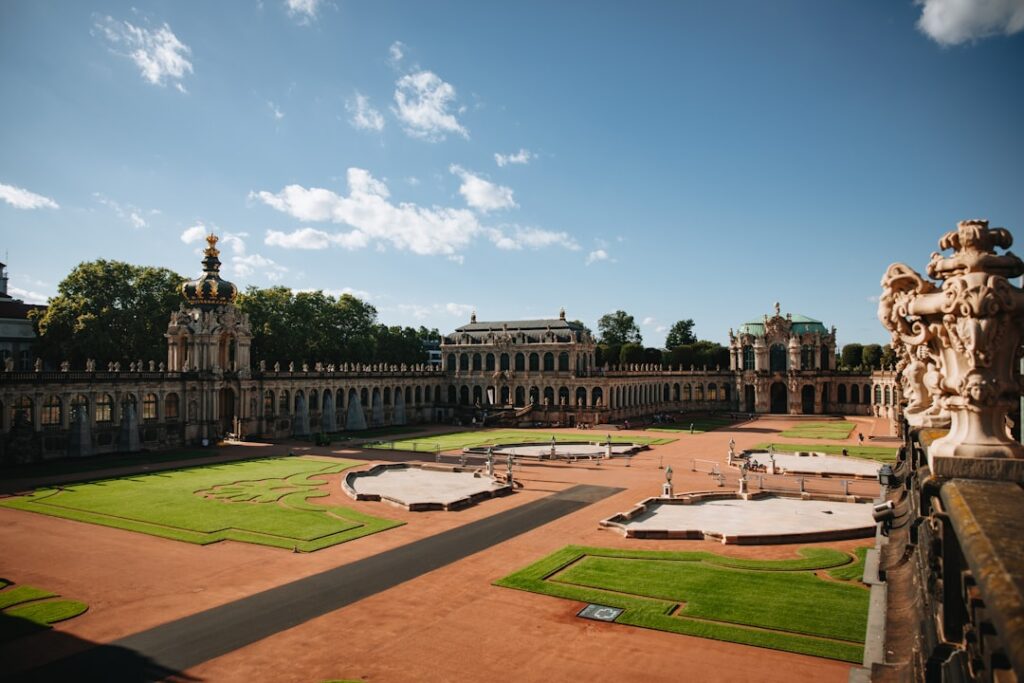
But the Zwinger isn’t merely beautiful—it houses world-class museums. The Old Masters Picture Gallery (Gemäldegalerie Alte Meister) contains Raphael’s Sistine Madonna, one of the most famous paintings in Western art, along with works by Rembrandt, Vermeer, and Canaletto. The Porcelain Collection showcases Augustus’s obsession with East Asian ceramics—the largest collection of Chinese and Japanese porcelain outside Asia. Science enthusiasts shouldn’t miss the Royal Cabinet of Mathematical and Physical Instruments, featuring historic clocks, globes, and scientific devices.
Planning Your Visit
Dresden is easily accessible by train from Berlin (2 hours), Prague (2.5 hours), or Munich (5.5 hours). The city’s compact Altstadt (Old Town) makes exploring on foot ideal, with the Frauenkirche and Zwinger less than a kilometer apart.
Best time to visit: May through September offers the best weather and longest days, perfect for appreciating the architecture and courtyard spaces. The Dresden Striezelmarkt, Germany’s oldest Christmas market, transforms the Altstadt in December, though expect crowds. Spring and fall provide milder temperatures and fewer tourists while maintaining pleasant conditions.
For the Frauenkirche, admission to the church itself is free, though donations are encouraged. Dome climbing costs around €8 and is well worth it—book timed tickets online to avoid queues. The church hosts frequent concerts; attending an evening organ recital adds a magical dimension to your visit.
At the Zwinger, a day pass covering all museums costs approximately €14, with audio guides available in English. Allocate at least three hours to properly explore the galleries, though art lovers could easily spend a full day here.
Insider Tips
Start your day early at the Frauenkirche to beat tour groups—the church opens at 10 AM on weekdays. Photography is permitted inside, but be respectful during services. For the best exterior photos, golden hour just before sunset bathes the sandstone in warm light.
After visiting the Zwinger, cross through the Semperoper courtyard to reach the Brühlsche Terrasse, Dresden’s “Balcony of Europe.” This elevated promenade along the Elbe offers stunning river views and connects to the Fürstenzug, a 102-meter-long porcelain mural depicting Saxon royalty.
Combine your baroque explorations with lunch at Kastenmeiers near the Frauenkirche for upscale Saxon cuisine, or grab a traditional Eierschecke (Saxon cheesecake) at Café Schinkelwache. For dinner, the Neustadt across the river offers vibrant restaurants and bars in a less touristy atmosphere.
Finally, consider a Dresden Card (from €25), which includes public transportation and museum discounts—worthwhile if you’re exploring multiple attractions over two or three days.
Dresden’s Frauenkirche and Zwinger represent more than architectural magnificence—they’re testaments to cultural preservation and the enduring power of beauty. Whether you’re drawn by art, history, or simply the romance of baroque splendor, these two landmarks offer an essential German experience that resonates long after you’ve left the banks of the Elbe.