
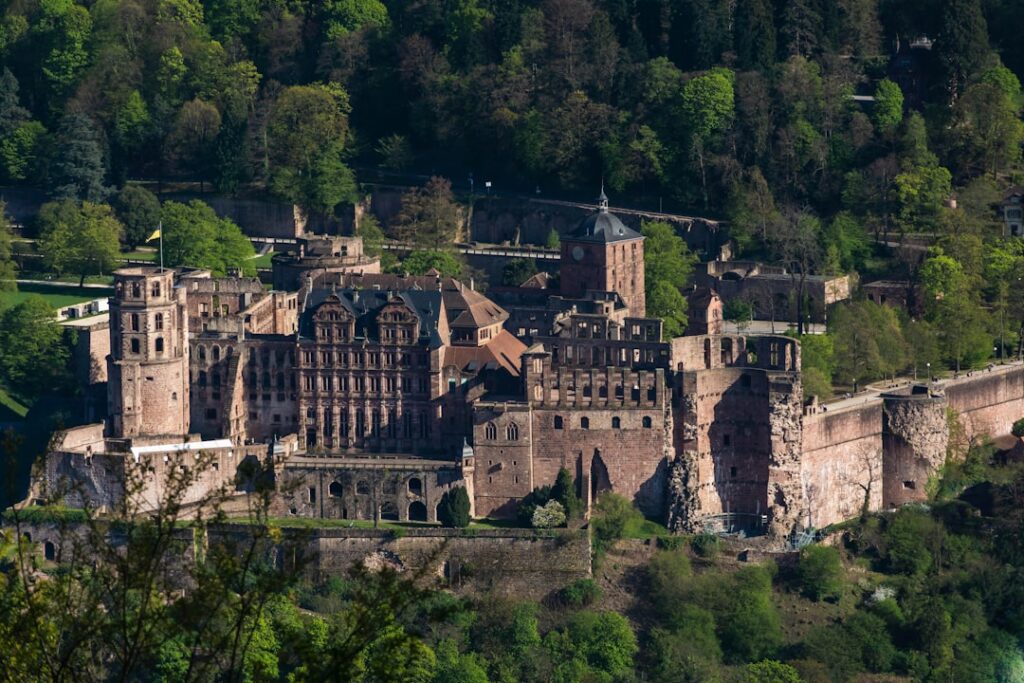
Heidelberg Castle doesn’t need to be intact to be unforgettable. Perched on the Königstuhl hillside above the Neckar River, this Renaissance palace—half-restored, half-ruined—has inspired poets, painters, and travelers since the Romantic era made decay fashionable. Mark Twain called it “the most magnificent ruin we had yet seen,” and he wasn’t exaggerating. Between the world’s largest wine barrel, terraced gardens with panoramic views, and stone walls glowing red in the sunset, Schloss Heidelberg is one of Germany’s most evocative landmarks.
The Castle That Wars and Lightning Couldn’t Finish
Built between the 13th and 17th centuries, Heidelberg Castle was the seat of the Prince Electors of the Palatinate, one of the most powerful dynasties in the Holy Roman Empire. The palace complex mixes Gothic, Renaissance, and Baroque styles—each prince added his own wing, creating a patchwork of architectural ambition.
Then came disaster. French troops destroyed much of the castle during the War of the Palatine Succession in 1693, and lightning strikes in the 18th century finished the job. Locals used the ruins as a quarry until Romantic writers and artists arrived, declaring the crumbling walls more beautiful than any restoration could be. Today, parts of the castle have been rebuilt, but much remains romantically ruined—exactly as visitors seem to prefer it.
What to See Inside
The castle courtyard is free to wander, but a ticket gets you into the interior rooms, the apothecary museum, and the famous Great Heidelberg Tun—a wine barrel built in 1751 that holds 58,000 gallons. It was filled only three times (wine evaporated faster than it could be consumed), but it remains a marvel of ambitious Baroque engineering. A wooden dance floor was built on top so courtiers could literally party above an ocean of wine.
Don’t miss the Ottheinrich Building, the castle’s Renaissance showpiece. Its ornate façade, covered in classical statues and allegorical figures, survived the wars mostly intact and offers a glimpse of the palace’s former grandeur. Inside, the rooms are sparse but atmospheric, with exhibits on the castle’s history and architectural evolution.
The German Apothecary Museum, housed in the castle, is a quirky gem. Its collection of mortars, pestles, and Renaissance-era medicine bottles—including remedies made from crushed toads and powdered mummies—is both fascinating and faintly unsettling.
The Gardens and the View
The castle’s terraced gardens, the Hortus Palatinus, were once called the “Eighth Wonder of the World.” Built in the early 1600s by Prince Elector Friedrich V for his English bride, Elizabeth Stuart, the gardens featured fountains, grottos, and elaborate parterres. Most were destroyed in the wars, but the restored sections and the surviving arcades give a sense of their former splendor.
The real payoff, though, is the view. From the castle terraces, you look straight down onto Heidelberg’s red-roofed Altstadt, the arched Old Bridge spanning the Neckar, and the forested hills beyond. Come in late afternoon when the light turns the sandstone walls amber and pink, and you’ll understand why this spot became a pilgrimage site for Romantic artists.
Getting There and Practical Tips
The castle sits about 260 feet above the old town. You can hike up via steep cobblestone paths from the Kornmarkt (about 10 minutes), or take the Bergbahn funicular from the same square. The funicular runs every 10 minutes and continues up to the Königstuhl summit if you want even higher views.
Tickets to the castle interior cost around €9 for adults and include entry to the apothecary museum and the Great Tun. English-language audio guides are available and worth the extra few euros—they bring the ruins to life with stories of court intrigue, wars, and lightning strikes. Guided tours run several times daily.
Visit early in the morning or late afternoon to avoid cruise-ship crowds that descend midday. The castle stays open until dusk in summer, making sunset visits magical. If you’re in Heidelberg in summer, check the schedule for the Schlossfestspiele, an open-air theater festival held in the castle courtyard, or the occasional fireworks that recreate (safely) the castle’s fiery destruction.
Heidelberg is an easy day trip from Frankfurt (about an hour by train) or Stuttgart. But the city and its castle deserve more than a few rushed hours—stay overnight and explore the old town’s student taverns, the Philosopher’s Walk across the river, and the castle by moonlight when the crowds have gone home.
Want more stories like this? Subscribe to the Love Germany newsletter and get one short story a day—castles, villages, food, and hidden corners you won’t find in the guidebooks.
Tours & experiences in Germany


Powered by Viator. Some links are affiliate links — we may earn a small commission at no extra cost to you.