
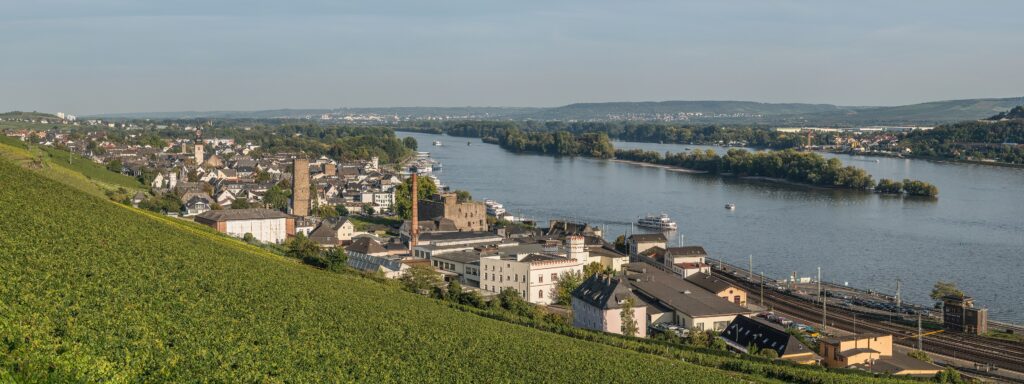
Rüdesheim am Rhein sits at the entrance to the Middle Rhine Valley’s dramatic gorge, where steep vineyard slopes meet the river and castle ruins dot nearly every hilltop. This compact wine town of 10,000 draws visitors for its famous Drosselgasse alley, its cable car ride above the vines, and its role as both a Rhine cruise stop and a base for exploring the UNESCO World Heritage landscape upstream.
But beyond the tourist bustle, Rüdesheim rewards travelers who linger: it’s a working wine town with centuries-old estates, a quirky collection of mechanical instruments, and hiking trails that climb into some of Germany’s most celebrated Riesling territory.
The Drosselgasse and Rüdesheim’s Wine Heart
The Drosselgasse is Rüdesheim’s beating heart—a narrow, cobbled lane barely 150 meters long, lined with half-timbered wine taverns, souvenir shops, and open-air terraces. Live accordion music spills from doorways, and servers pour local Riesling by the glass from early afternoon until late evening.
It’s touristy, yes, but it’s also authentic in its own way: these are real wine taverns (Weinstuben) serving wines from Rüdesheim estates, often with simple plates of cheese, sausage, and pretzels. Visit in the late afternoon or early evening for the best atmosphere, and don’t be shy about claiming a bench and settling in.
For a quieter wine experience, walk east along Oberstrasse to the estates themselves. Many offer tastings by appointment or during open hours—ask at the tourist office on Rheinstrasse for current schedules. The steep Rüdesheimer Berg vineyards produce some of the Rheingau’s most structured Rieslings, with a mineral backbone shaped by slate and quartzite soils.
The Seilbahn and Niederwald Monument
Rüdesheim’s cable car, the Seilbahn, lifts you 230 meters above the town in open gondolas, gliding over vineyards with sweeping views of the Rhine below. The ten-minute ride lands you at the Niederwald Monument, a towering 1883 statue of Germania commemorating German unification—controversial in its day, but undeniably dramatic in its hillside setting.
From the monument plaza, walking paths lead through beech forest and vineyard edges. The most popular route follows the Rheinsteig long-distance trail west toward Assmannshausen, a red-wine village 4 kilometers away (another cable car descends from there). The trail is well-marked and moderately easy, with constant river views and the chance to stop at a vineyard hut for a glass of wine.
If you’re short on time, simply enjoy the view from the monument terrace and ride the cable car back down. The Seilbahn runs daily from April through October, weather permitting, with reduced hours in shoulder seasons.
Siegfried’s Mechanisches Musikkabinett
Tucked into Rüdesheim’s Brömserhof, a medieval courtyard complex near the riverfront, Siegfried’s Mechanisches Musikkabinett is one of Germany’s most charming small museums. The collection includes more than 350 self-playing musical instruments: orchestrions, music boxes, barrel organs, and player pianos, dating from the 18th century to the early 20th.
Guided tours (in German and English) bring the instruments to life—literally. Your guide winds, cranks, and activates pieces throughout the hour-long visit, filling the rooms with mechanical waltzes, operatic arias, and salon melodies. It’s whimsical, nostalgic, and surprisingly moving, a reminder of how people made music before recordings.
The museum is open daily from late March through December, with tours departing regularly. Reserve ahead in summer, especially on weekends when Rhine cruise passengers flood the town.
Getting There and When to Visit
Rüdesheim is easily reached by train from Frankfurt (1 hour via Wiesbaden) or Koblenz (45 minutes along the Rhine’s left bank, requiring a ferry crossing at Bingen). The train station sits a few minutes’ walk from the Drosselgasse and riverfront.
Rhine cruise boats stop at Rüdesheim on routes between Koblenz and Mainz, making it an ideal break in a day’s river journey. If you’re driving, park in one of the riverside lots near the Bingen ferry—the old town is largely pedestrianized.
Visit in late spring (May) or early fall (September and October) for the best balance of weather, wine harvest energy, and manageable crowds. Summer weekends can be overwhelming, with tour groups and cruise passengers converging on the Drosselgasse. Weekdays are quieter, and early mornings belong almost entirely to locals.
Rüdesheim makes an excellent base for exploring the Middle Rhine Valley upstream—castles, clifftop villages, and the Loreley Rock are all within easy reach—but it’s also rewarding as a standalone visit, a compact dose of Rhine romance, Riesling, and hillside views.
Want more stories like this from across Germany? Subscribe to the Love Germany newsletter—one short story a day, straight to your inbox.
Tours & experiences in Germany


Powered by Viator. Some links are affiliate links — we may earn a small commission at no extra cost to you.