
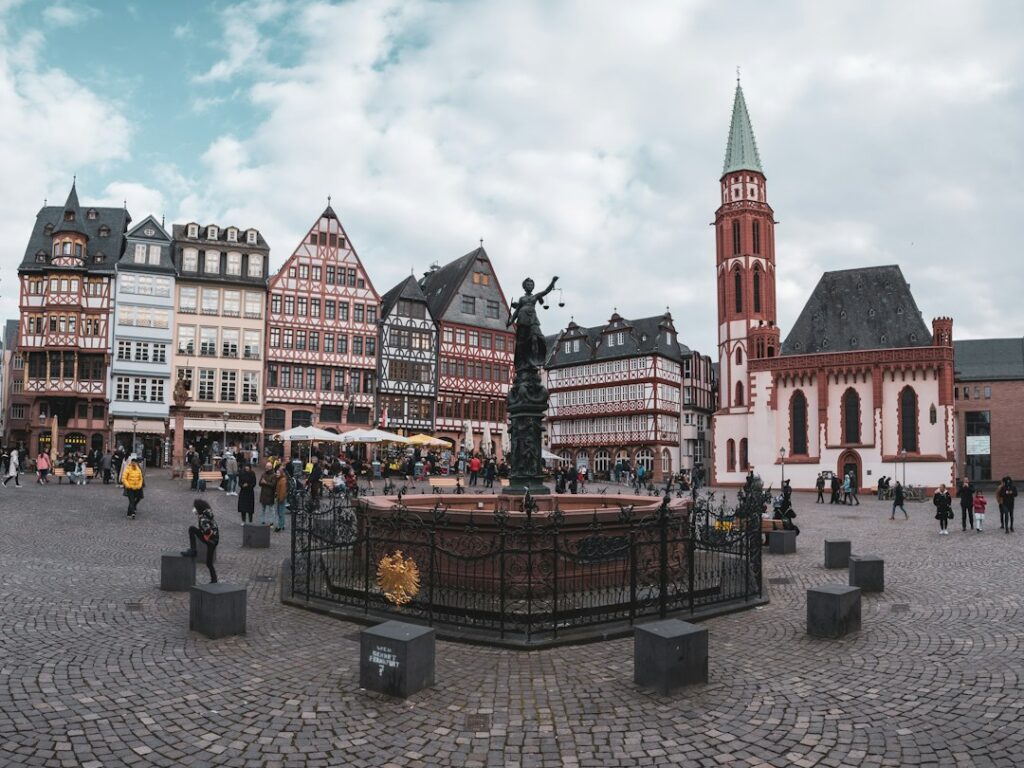
Frankfurt may be synonymous with gleaming bank towers and the European Central Bank, but at its heart lies the Römerberg—a cobblestoned square lined with reconstructed medieval buildings that tell the story of Germany’s coronation city. This is where Holy Roman Emperors celebrated their coronations, where traders gathered for centuries, and where Frankfurt’s soul persists beneath the modern skyline.
The square was flattened during World War II and painstakingly rebuilt in the 1980s. What you see today is a faithful reconstruction of the Altstadt as it stood for hundreds of years, complete with its distinctive stepped gables and timber frames. It’s a living museum that doubles as the city’s most visited gathering place.
The Römer: Germany’s Most Famous City Hall
The Römer—Frankfurt’s city hall since 1405—anchors the western side of the square with its iconic three-gabled facade. The name comes from a private merchant house, Zum Römer, that the city purchased along with two neighboring buildings. Together, they’ve served as Frankfurt’s seat of government for more than six centuries.
Inside, the Kaisersaal (Imperial Hall) is lined with portraits of 52 Holy Roman Emperors, commissioned in the 1840s. After a coronation at the nearby cathedral, emperors would process here for lavish banquets. The hall is open to visitors and remains in use for official city receptions. Entry costs €9, and you can wander through several historic rooms at your own pace.
Across the square, the Ostzeile—a row of six half-timbered houses with names like Großer Engel and Goldener Greif—recreates the merchant architecture that once dominated Frankfurt. Each facade is slightly different, reflecting centuries of organic growth before the bombs fell in 1944.
The Old Nikolai Church and Justice Fountain
At the center of the Römerberg stands the Gerechtigkeitsbrunnen, the Fountain of Justice, topped with a statue of Lady Justice holding scales and sword. During coronation festivities, the fountain famously flowed with wine—red from one side, white from the other—for the crowds to enjoy. Today it’s the square’s most photographed landmark, especially when the Christmas market transforms the space each December.
The Old Nikolai Church, on the southern edge, served as Frankfurt’s imperial chapel and hosted pre-coronation ceremonies. The Gothic structure dates to the 13th century, though it too required extensive rebuilding after the war. Its bells still ring over the square, and it occasionally hosts concerts and exhibitions. Entry is free when open.
Museums and the New Old Town
Just east of the Römerberg, the Dom-Römer Quarter opened in 2018 as Europe’s largest reconstruction project of medieval architecture. Thirty-five buildings—15 faithful reconstructions of historic houses, 20 modern interpretations—now fill the footprint between the square and the cathedral. Narrow lanes like Hühnermarkt and Krönungsgasse wind through the quarter exactly as they did before 1944, complete with tiny cafes, shops, and apartments.
The Historical Museum Frankfurt sits at the square’s southern edge, completely redesigned in recent years to tell the city’s story from Roman settlement to modern financial center. Admission is €8, and the permanent collection includes the largest city model in Germany—a miniature Frankfurt as it appeared in the 1920s, before the destruction.
For a different perspective, cross the Iron Footbridge to Sachsenhausen and look back at the square and cathedral from across the Main River. The skyline juxtaposition—medieval and modern—is Frankfurt in a single frame.
Visiting the Römerberg
The Römerberg is a five-minute walk from Frankfurt Hauptbahnhof, or take the U4 or U5 to Dom/Römer station, which deposits you directly at the square. It’s always open, day and night, and free to wander. The best light for photos comes in late afternoon when the sun hits the Römer’s western facade.
The Christmas market here, one of Germany’s oldest, runs from late November through December 22. Outside of that, the square hosts regular farmers’ markets, open-air concerts, and festivals throughout the warmer months. Weekday mornings are quietest if you want the square to yourself.
Several cafes ring the square with outdoor seating—Apfelwein Wagner and Zum Standesämtchen are local favorites—though prices reflect the tourist location. For better value and atmosphere, duck into the Dom-Römer Quarter’s side lanes, where newer spots cater more to residents.
If you’re exploring Frankfurt more broadly, the Frankfurt Treasure Quest covers the Römerberg and surrounding Altstadt with a self-guided puzzle adventure that adds a layer of storytelling to your walk through the city’s historic core.
Frankfurt may live in the future, but the Römerberg keeps one foot firmly in its imperial past. It’s proof that even a city of glass and steel needs a cobblestoned heart.
Want more stories like this from across Germany? Subscribe to the Love Germany newsletter—one short story a day, straight to your inbox.
Tours & experiences in Germany


Powered by Viator. Some links are affiliate links — we may earn a small commission at no extra cost to you.