
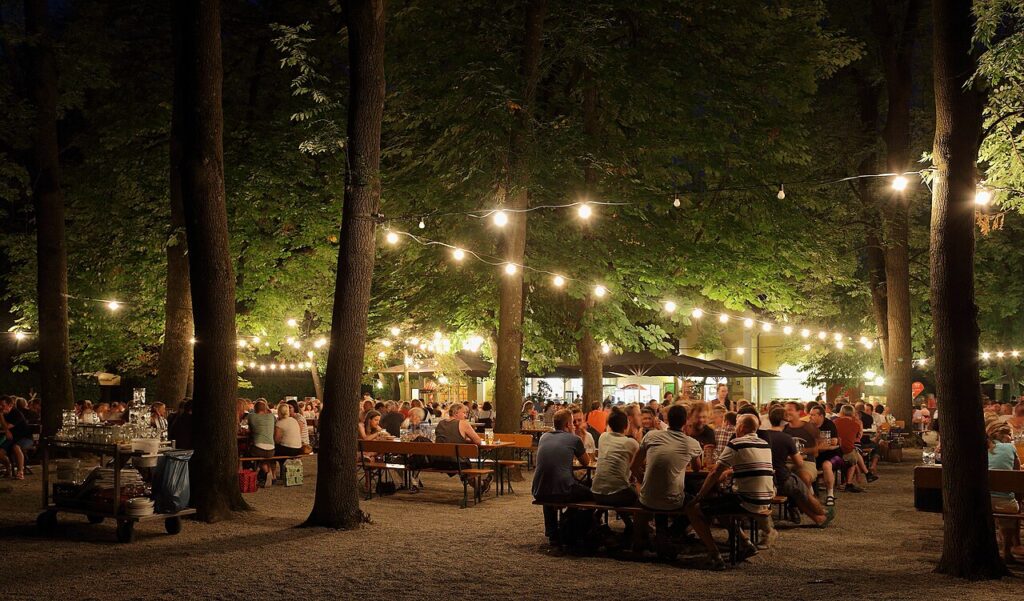
Walk into any beer garden in Bavaria on a warm afternoon and you’ll see something that hasn’t changed in two hundred years: strangers sharing long wooden tables under chestnut trees, half-liter mugs of lager catching the sunlight, and pretzels the size of dinner plates passed hand to hand. Germany’s biergartens aren’t bars with patios. They’re institutions with rules, rituals, and a social contract older than most American cities.
Understanding how they work—and why they matter—turns a pleasant afternoon into a genuine cultural experience.
How Beer Gardens Were Born
The biergarten tradition started in Munich in the early 1800s, born from necessity and Bavarian stubbornness. Before refrigeration, brewers stored their lager in deep cellars dug along the Isar River, where temperatures stayed cool year-round. To keep the cellars even colder, they planted chestnut trees overhead—their broad leaves and shallow roots provided shade without damaging the cellars below.
Brewers realized they could serve beer directly from those cellars during the summer months, setting up simple benches under the trees. Munich’s tavern owners, furious at the competition, lobbied for restrictions. In 1812, King Maximilian I brokered a compromise: brewers could sell beer from their gardens, but not food. Customers could bring their own.
That ruling created the defining feature of a traditional biergarten: you can bring your picnic. It’s not just allowed—it’s expected, respected, and protected by law to this day.
The Rules Are the Point
A real biergarten follows specific traditions. Seating is communal—long tables where you sit wherever there’s space, next to families, retirees, and tourists who’ve done their homework. You don’t wait for a server. You walk to the counter, order your beer (usually by the Maß, a full liter), grab pretzels or Obatzda (Bavarian cheese spread) if you want, and carry it back yourself.
If the table has a tablecloth, you’re in the serviced section—you’ll need to order food and wait for staff. If it’s bare wood, it’s self-service and BYOF (bring your own food). Locals arrive with whole picnics: cold roast chicken, radishes carved into spirals, cheese, bread, and pickles. No one bats an eye.
Munich’s Augustiner-Bräu near the Hackerbrücke and the sprawling Hirschgarten (Europe’s largest beer garden, seating 8,000) are textbook examples. In the English Garden, the Chinesischer Turm beer garden serves 7,000 under a pagoda-style tower, with a brass band on summer weekends and enough space that it never feels frantic.
Beyond Bavaria: Germany’s Regional Beer Gardens
While Bavaria owns the tradition, beer gardens appear across Germany with local twists. In Franconia, around Bamberg and Forchheim, Keller beer gardens sit on hilltops outside town, originally cellars for storing smoked lager. Wilde Rose Keller in Forchheim and Spezial-Keller in Bamberg pour their own brews with views over forests and rooftops.
Berlin’s beer gardens tend to be more casual, with a multicultural crowd and menus beyond pretzels and sausages. Prater Garten in Prenzlauer Berg, open since 1837, and Café am Neuen See in the Tiergarten bring the tradition north with chestnut shade and communal tables, but a more cosmopolitan vibe.
In the Rhineland, beer gardens serve Kölsch in small glasses instead of liter mugs, and the atmosphere leans more toward café than forest clearing. In Stuttgart and the Swabian hills, wine gardens (Besenwirtschaften) follow similar rules, substituting Riesling for lager and Maultaschen for pretzels.
When to Go and What to Know
Beer garden season runs from late April through September, peaking in June and July when the sun doesn’t set until after 9 p.m. Weekends draw crowds, but weekday afternoons offer a quieter, more local experience. Arrive by mid-afternoon to claim a shaded spot—by 6 p.m., the good tables are gone.
Bring cash. Many beer gardens don’t take cards at the counter. Expect to pay a deposit (Pfand) on your mug, returned when you bring it back. If you’re bringing food, keep it simple and respectful—no fast food bags or pizza boxes. Bread, cheese, cold cuts, and fruit fit the spirit.
Don’t expect craft beer or flights. Beer gardens serve the classics: Helles, Märzen, Radler (beer mixed with lemon soda), and alcohol-free options. The point isn’t variety—it’s consistency, quality, and the ritual of pouring a liter of the same lager your great-grandparents drank under the same trees.
Why It Still Matters
In a country known for efficiency and order, beer gardens are Germany’s great leveler. Doctors sit next to construction workers. Retirees chat with students. Tourists fumble with their deposits while locals patiently wait their turn. The rituals—sharing tables, serving yourself, bringing your own food—strip away pretense and create accidental community.
It’s a tradition that insists on simplicity, rewards participation, and works because everyone follows the same unwritten rules. Once you’ve done it right—carried your own liter, shared a table with strangers, spread out your picnic under centuries-old chestnuts—you understand why Bavaria fought to protect it.
Want more stories like this—practical, specific, and rooted in the Germany beyond the guidebooks? Subscribe to the Love Germany newsletter. One short story a day, no fluff, just the details that matter.
Tours & experiences in Germany


Powered by Viator. Some links are affiliate links — we may earn a small commission at no extra cost to you.