
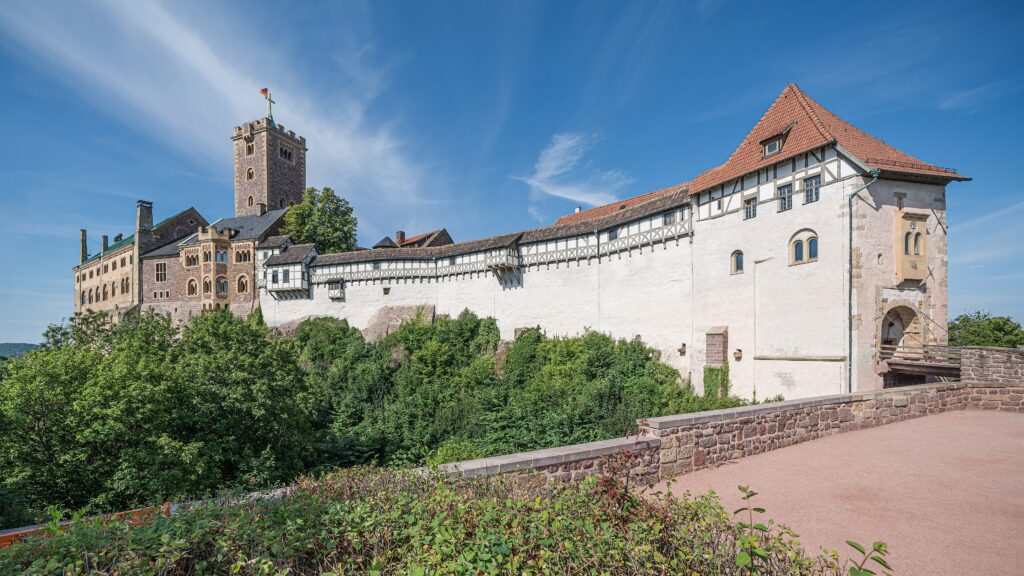
The Wartburg rises from a forested hill above Eisenach like a medieval dream made real. This isn’t just another pretty castle—it’s the stage where some of Germany’s most pivotal moments unfolded. Martin Luther hid here for ten months in 1521, translating the New Testament into German while the Catholic Church hunted him. Saint Elisabeth of Hungary lived within these walls in the 13th century. Medieval poets competed in song contests that inspired Wagner’s Tannhäuser. And in the 19th century, students gathered here to imagine a unified Germany that didn’t yet exist.
Unlike Neuschwanstein’s fairy-tale fantasy, the Wartburg is the real thing—a UNESCO World Heritage site that’s stood since 1067, watching over Thuringia and shaping the German language, faith, and national consciousness.
Luther’s Room and the Birth of Modern German
After Martin Luther refused to recant his writings at the Diet of Worms in 1521, his protector Frederick the Wise staged a fake kidnapping and whisked him to the Wartburg for his own safety. For ten months, Luther lived in a small wood-paneled room disguised as “Junker Jörg” (Knight George), complete with a beard and secular clothing.
What he did during that isolation changed Europe. He translated the New Testament from Greek into German in just eleven weeks, creating a text that wasn’t just readable—it was beautiful, poetic, and accessible. His translation standardized the German language, giving scattered dialects a common literary form. You can visit Luther’s study room today, still furnished simply with a desk, chair, and the wooden walls he stared at while wrestling with Greek verbs and theological revolution.
The famous inkstain on the wall—where Luther supposedly threw an inkwell at the devil—is likely legend reinforced by souvenir-hunting tourists. But the room itself is genuine, and standing in it feels like stepping into the hinge of history.
The Festsaal and the Minnesingers
Two centuries before Luther, the Wartburg hosted the legendary Sängerkrieg—a contest of Minnesingers (medieval troubadours) that may or may not have happened exactly as the stories tell it. Walther von der Vogelweide, Wolfram von Eschenbach, and other poet-musicians supposedly competed in the castle’s magnificent Festsaal (Festival Hall) around 1207.
Whether the contest was real or romanticized, the Festsaal itself is breathtaking. Restored in the 19th century with Byzantine-style mosaics depicting the legend, the hall stretches nearly 40 meters long, its walls glowing with gold tesserae and narrative scenes. This is where Richard Wagner found inspiration for Tannhäuser, his opera about art, desire, and redemption set at the Wartburg.
The castle also preserves Elisabeth’s Chamber, honoring Saint Elisabeth of Hungary (1207–1231), who lived here as Landgravine of Thuringia. Known for her charity and care for the poor, Elisabeth’s legend—turning bread into roses to hide her almsgiving from her disapproving husband—is woven into the castle’s identity.
Visiting the Wartburg: Practical Details
The Wartburg sits on a hill above Eisenach, about 50 kilometers west of Erfurt and easily reached by train from Frankfurt, Leipzig, or Weimar. From Eisenach’s train station, it’s a pleasant 30-minute walk uphill through beech forest, or you can take bus 10 to the lower parking area and walk the final ten minutes.
Once you reach the castle courtyard, you’ll need to join a guided tour to see the interior—German-language tours run continuously throughout the day, and English tours are available at set times (check the website for the current schedule). The tour lasts about 45 minutes and covers Luther’s room, the Festsaal, Elisabeth’s chambers, and the Romanesque Palas (palace).
The castle museum, accessible without a tour, displays medieval art, weapons, and Luther memorabilia. Don’t miss the view from the South Tower—on clear days, you can see across the Thuringian Forest.
Arrive early in summer and on weekends; the Wartburg draws crowds, especially during school holidays. Late afternoon visits in spring or autumn offer softer light, fewer visitors, and the forest walk at its most atmospheric.
Beyond the Castle: Eisenach and Bach’s Birthplace
Eisenach itself deserves a few hours. Johann Sebastian Bach was born here in 1685, and his half-timbered birthplace on the Frauenplan is now a museum with historical instruments and live demonstrations. The Georgenkirche, where Bach was baptized and Luther preached, anchors the Markt square.
For lunch, try Thuringian bratwurst at one of the market stands—Eisenach’s version is seasoned with marjoram and caraway, grilled over beechwood, and served in a crisp roll. The Lutherstube, a cozy timber-beamed restaurant near the Bachhaus, serves regional classics like Thüringer Rostbrätl (marinated pork cutlet) and Klöße (potato dumplings).
If you’re a hiker, the Wartburg sits on the Rennsteig, Germany’s oldest long-distance trail. Even a short walk along the ridgeline offers forest views and the kind of quiet that makes you understand why this landscape inspired both mystics and reformers.
Want more stories like this from every corner of Germany? Subscribe to the Love Germany newsletter—one short story a day, from fairy-tale castles to village bakeries, sent straight to your inbox each morning.
Tours & experiences in Germany


Powered by Viator. Some links are affiliate links — we may earn a small commission at no extra cost to you.