
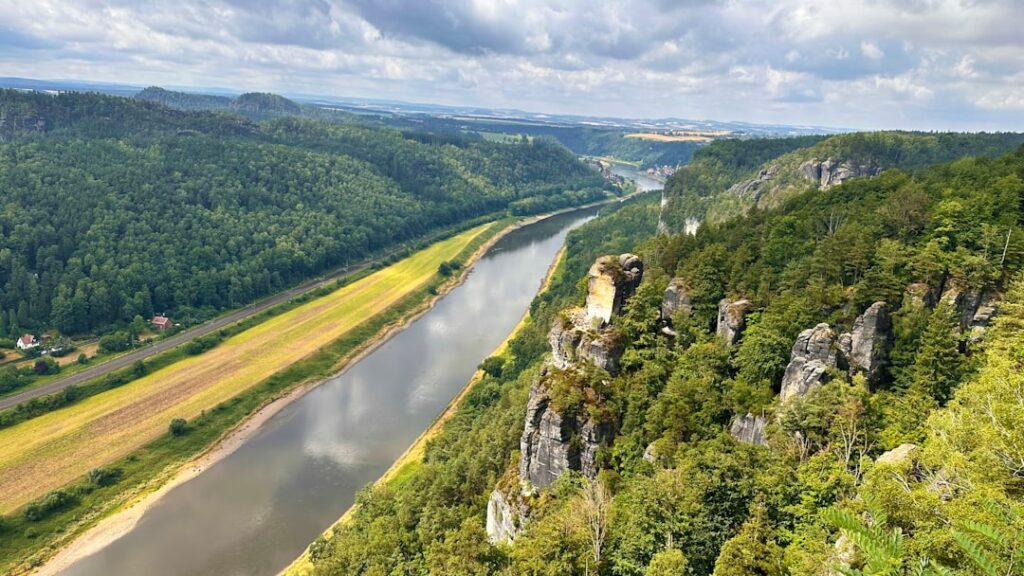
Saxon Switzerland defies its name on two counts: it’s not in Switzerland, and the sandstone towers that rise from the Elbe River valley look nothing like the Alps. What German Romantic painters called Sächsische Schweiz in the 18th century is actually a 36,000-hectare labyrinth of table mountains, deep gorges, and weathered rock pinnacles along the Czech border, carved by millennia of erosion into Central Europe’s most theatrical landscape.
The national park begins where Dresden’s suburbs end, making it one of Germany’s most accessible wilderness areas. You can leave the city center after breakfast and stand atop the Bastei Bridge before lunch.
The Bastei: Saxon Switzerland’s Signature View
The Bastei rock formation—a jagged ridge of sandstone pillars 194 meters above the Elbe—offers the park’s most famous panorama. The sandstone bridge connecting the towers was built in 1851 and remains the most photographed spot in the region. Arrive before 9 a.m. or after 5 p.m. to avoid the tour buses from Dresden and Prague.
From the parking area in Rathen, it’s a steep 20-minute climb through beech forest, or you can take the ferry across the Elbe from Kurort Rathen train station (regional trains from Dresden Hauptbahnhof run every 30 minutes) and walk up through the village. The Felsenburg Neurathen, a medieval rock castle whose foundations are carved directly into the stone, sits just behind the bridge and gives you a sense of how people have used these formations for defense since the 11th century.
Climbing the Schrammsteine Ridge
For a longer hike with fewer crowds, the Schrammsteine ridge delivers everything Saxon Switzerland promises: exposed scrambles, steel ladders bolted into vertical rock faces, and views across an ocean of sandstone towers. The classic loop from Bad Schandau climbs to the Schrammsteinaussicht viewpoint, traverses the ridge past the Wildschützensteig gorge, and descends through the Kirnitzschtal valley—about 12 kilometers and five hours total.
The trail isn’t technically difficult, but sections require a head for heights and hands on rock. Metal rungs and railings assist on the steepest pitches. Wear proper hiking boots with ankle support; the sandstone can be slippery when wet.
Bad Schandau, the park’s main gateway town, has several good guesthouses and a historic Kurpark along the Elbe. The S-Bahn from Dresden takes 45 minutes.
Königstein Fortress: Europe’s Unconquered Citadel
Festung Königstein sits atop a table mountain plateau 240 meters above the Elbe, surrounded on all sides by sheer sandstone cliffs. No army ever took it by force. The fortress complex—a small city of barracks, wells, and armories built over four centuries—covers 9.5 hectares and includes one of Europe’s deepest wells, hand-dug 152 meters through solid rock.
Augustus the Strong imprisoned alchemists here in the early 18th century, ordering them to make gold (they made porcelain instead, founding the Meissen manufactory). Later it served as a royal treasury, a military prison, and briefly a POW camp. Today it’s a museum with fortress walls you can walk, casemates you can explore, and views across the entire national park.
The fortress sits above the village of Königstein, one stop past Rathen on the Dresden-Bad Schandau rail line. From the village, it’s a steep 30-minute walk up cobbled switchbacks, or a shuttle bus runs from the station.
Practical Notes for Visiting
Saxon Switzerland sprawls across the border into Czech Bohemian Switzerland National Park (České Švýcarsko), and many of the best hikes cross between countries. Carry your passport. The Pravčická brána, Europe’s largest natural sandstone arch, sits just over the Czech side and makes a worthwhile extension from Bad Schandau.
The park’s sandstone is fragile and climbing regulations are strict. Rock climbing is permitted only on marked towers and only with proper registration—Saxon Switzerland pioneered free climbing in the 19th century and maintains traditional ethics. As a hiker, stay on marked trails to prevent erosion.
Spring (April to May) and autumn (September to October) offer the best hiking conditions and the most dramatic light for photography. Summer weekends can be crowded on the main trails. Winter hiking is possible but requires caution—ice forms on shaded rock faces and metal ladders.
For maps and detailed trail information, stop at the national park visitor center in Bad Schandau. The staff can suggest routes matching your fitness level and time available.
If you’re based in Dresden and want a guided introduction to the area, the Dresden & Bastei Bridge Day Trip to Germany from Prague covers the highlights with transportation included, though it’s designed for Prague-based travelers and also picks up in Dresden.
Want more stories from Germany’s landscapes, towns, and traditions? Subscribe to the Love Germany newsletter—one short story a day, straight to your inbox.
Tours & experiences in Germany


Powered by Viator. Some links are affiliate links — we may earn a small commission at no extra cost to you.