
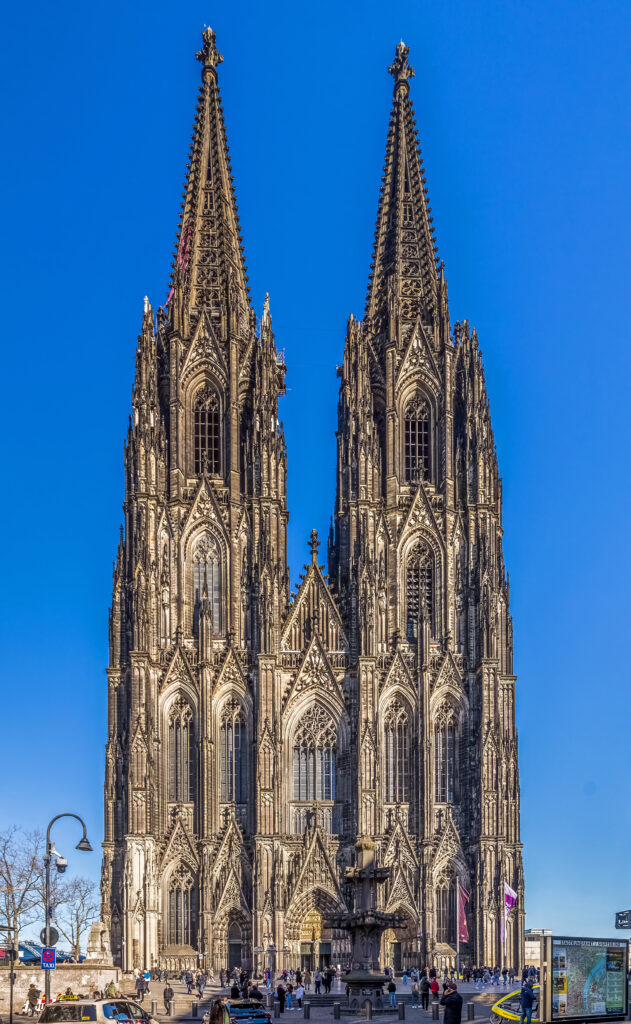
Cologne Cathedral—Kölner Dom—rises 157 meters above the Rhine, a blackened Gothic giant that somehow survived World War II bombing raids that flattened nearly everything around it. Its twin spires define the city skyline, visible from almost everywhere in Cologne, and up close, the sheer scale of the place makes you wonder how medieval builders pulled this off.
They started in 1248. They finished in 1880. In between came the Reformation, wars, Napoleon, and a 300-year construction pause that left the cathedral half-built and capped with a wooden crane. Today, it’s Germany’s most visited landmark, drawing more than six million people a year. Most come for the architecture. The smart ones stay for the details.
What You’re Looking At
Cologne Cathedral is High Gothic architecture at its most ambitious. The facade alone took 632 years to complete, and the level of detail—thousands of statues, tracery, pinnacles, and flying buttresses—makes it feel less like a building and more like a stone forest. The blackened patina isn’t grime; it’s a natural weathering of the local sandstone that gives the cathedral its distinctive dark appearance.
Inside, the nave soars 43 meters high, supported by 56 massive pillars. The stained glass is spectacular—the oldest windows date to the 13th century, and the south transept features a stunning modern window by Gerhard Richter installed in 2007, composed of 11,500 squares of colored glass that scatter light like gemstones.
The real treasure is the Shrine of the Three Kings, a golden reliquary behind the high altar that supposedly holds the bones of the Magi. It’s the reason the cathedral was built in the first place—Archbishop Rainald von Dassel brought the relics from Milan in 1164, and Cologne became an instant pilgrimage destination. The shrine itself is a masterpiece of medieval goldsmithing, covered in filigree, enamel, and precious stones.
Climbing the South Tower
If you’re in decent shape, climb the south tower. It’s 533 steps up a narrow spiral staircase—no elevator, no shortcuts—but the view from the top is worth every burning quad muscle. You’ll pass the bell chamber halfway up, home to St. Peter’s Bell, a 24-ton monster cast in 1923 and the largest free-swinging church bell in the world.
At the viewing platform, you’re 100 meters above the city with panoramic views over Cologne’s old town, the Rhine, and on clear days, the distant hills of the Eifel. The cathedral’s second spire rises just across from you, close enough to appreciate the stone carving that you’d never see from ground level. The tower is open daily; get there early in summer to beat the crowds.
Treasury and Archaeological Zone
Don’t skip the Cathedral Treasury, tucked into the basement on the north side. The collection includes medieval vestments, monstrances, chalices, and Archbishop Engelbert’s blood-stained robes from his assassination in 1225. It’s a small museum, but the craftsmanship on display is extraordinary.
Just outside the cathedral, the Romano-Germanic Museum sits directly over the Dionysus Mosaic, a stunning 3rd-century floor discovered during wartime excavations. The museum’s collection covers Cologne’s Roman past—the city was called Colonia Claudia Ara Agrippinensium and served as a provincial capital—with glass, jewelry, and inscriptions that bring ancient life along the Rhine into focus.
Practical Information
Cologne Cathedral is free to enter and open daily, though visiting hours are limited during services. The tower climb and treasury require separate tickets, available at the entrance on the south side. Plan at least an hour for the cathedral itself, longer if you’re climbing or visiting the treasury.
The cathedral sits directly beside Cologne’s main train station (Köln Hauptbahnhof), making it absurdly easy to reach by train from anywhere in Germany. The Cologne–Bonn Airport is 15 minutes away by S-Bahn.
If you’re visiting in December, the Christmas markets around the cathedral are among Germany’s finest—multiple markets sprawl across the old town, with the Weihnachtsmarkt am Dom offering the best backdrop for mulled wine and gingerbread.
One insider tip: visit late in the afternoon on a weekday. Morning tour groups thin out, the light through the stained glass warms up, and you’ll have room to stand in the nave without getting elbowed. The cathedral is also stunning at night when floodlights illuminate the facade.
Want more stories like this in your inbox? Subscribe to the Love Germany newsletter—one short story a day about Germany beyond the guidebooks.
Tours & experiences in Germany


Powered by Viator. Some links are affiliate links — we may earn a small commission at no extra cost to you.