
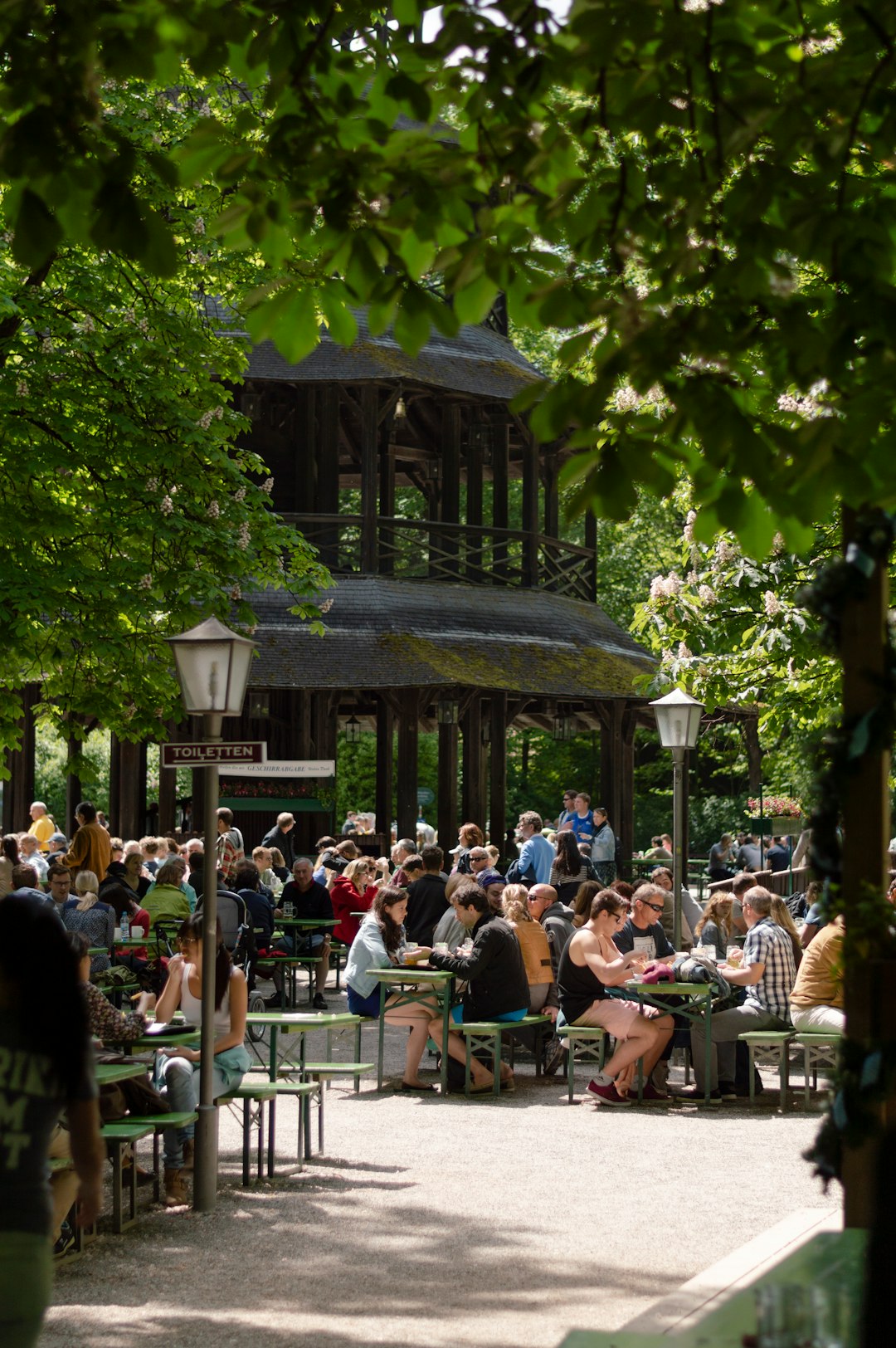
In a proper Bavarian beer garden, you are allowed by law to spread out a checkered cloth, unpack your own bread, radishes and sausage, and eat it at the brewery’s tables without buying a scrap of their food — you only have to buy the beer. That right traces back to a royal compromise from 1812 and was defended by tens of thousands of Münchners in the streets in 1995. This is Guide № 005 in The Love Germany Guide series.
Get the Full Collectible Guide (Free PDF)
German Beer Garden Etiquette — in a beautifully designed, printable booklet. The Love Germany Guide № 005.
Why the Chestnut Trees Came First
The classic beer garden was born out of a refrigeration problem. Before ice machines, Munich brewers dug deep cellars along the Isar to keep their lager cool through summer, then covered the ground with gravel and planted broad-canopied horse chestnut trees to shade the earth below. Chestnuts have shallow, spreading roots that do not pierce the cellar vaults, so they were the tree of choice. Brewers set out simple tables on that gravel and sold beer straight from the cellar above — and the modern beer garden is essentially that arrangement, preserved.
You can still read the layout today: a true traditional beer garden has gravel underfoot and chestnut (or occasionally lime) trees overhead. Munich’s Königlicher Hirschgarten seats roughly 8,000 people under exactly this canopy and is generally described as the largest beer garden in the world, while the one beside the Chinesischer Turm in the Englischer Garten is the best-known example within the city’s great public park.
The Bring-Your-Own-Food Rule
The single most misunderstood rule for visitors is that in a genuine Bavarian beer garden you may bring your own food. In 1812 King Max I Joseph let the brewers sell their cellar beer to the public but forbade them from serving food, to protect the city’s innkeepers and their trade. Guests simply brought their own Brotzeit — a cold spread of bread, radish (Radi), spring onions, cheese spreads such as Obatzda, and cold cuts — and that habit hardened into a cherished custom and, later, a protected legal right.
The catch is that this applies only to the self-service area (Selbstbedienung), where you fetch your own beer at a counter. Most large gardens also run a waiter-served section (Bedienung) with a full menu and tablecloths already laid; there you order food like any restaurant and do not unpack a picnic. When in doubt, look for the racks of stacked chairs and the beer counter — that is the self-service side, and that is where the picnic tradition lives.
How to Order and What the Deposit Is
Beer comes in a Maß, a full one-litre glass stein, though most counters will also pour a Halbe (half-litre). When you pay, you will usually be charged a separate deposit, the Pfand, on the glass mug itself; you get it back when you return the empty. Some gardens hand you a small metal or plastic token (Biermarke) as proof of that deposit, so keep it. Historic houses such as Hofbräuhaus, Augustiner-Bräu, Paulaner and Löwenbräu all supply the beer poured across Munich’s gardens.
Seating is communal. The long shared tables mean you sit down beside strangers, and it is entirely normal to ask “Ist hier noch frei?” and settle in next to someone else’s party. One quiet signal worth knowing: a tablecloth laid over part of a table marks a reserved (reserviert) section for a booked group, so leave those spots alone and take an unlaid stretch of bench.
The 1995 Beer Garden Revolution
The bring-your-own tradition nearly died in living memory. In the early 1990s a court case brought by residents near a Munich garden led to rulings tightening closing hours and threatening the informal customs, and in the summer of 1995 an estimated 25,000 people marched through Munich in what became known as the Biergartenrevolution. The Bavarian state government responded with the Bavarian Beer Garden Ordinance (Biergartenverordnung), which recognised traditional beer gardens as protected local culture, kept them open until 23:00, and enshrined the right to bring your own food.
That ordinance is why the picnic rule is not merely a nicety but a legal fixture in Bavaria, backed by the Bavarian State Government. It is also why the etiquette matters: the freedom to bring food survives only because generations of guests treated the shared tables, the trees and the neighbourhood with a bit of care.
Beyond Munich: Monastery Gardens and Regional Manners
The custom radiates out from Munich across Bavaria, and some of the most storied gardens belong to monasteries that have brewed for centuries. Kloster Andechs, the Benedictine abbey on its hill above the Ammersee, pours its own strong lagers to pilgrims and day-trippers who climb up for a Maß and a plate of pork knuckle. Rules loosen and tighten by region and by house, so it is always worth checking a specific garden’s own page before you arrive with a rucksack of sandwiches.
For an overview of which gardens are open, their hours and their house rules, the city’s official portal at muenchen.de keeps current listings — useful because weather closes self-service gardens at short notice, and a rainy forecast can shutter the gravel section entirely.
Myths Worth Retiring
Myth: You can bring your own beer too. No — the whole bargain is that you buy the brewery’s beer and may bring only your own food. Turning up with supermarket bottles breaks the deal that keeps the tradition legal.
Myth: A beer garden and Oktoberfest are the same experience. They are not. Oktoberfest is a ticketed festival in temporary tents; a beer garden is a permanent, shaded, everyday institution where locals eat lunch, and the picnic right does not apply inside the festival tents.
Myth: Tipping is a set percentage. In practice you round up and hand the total to the server or counter staff as you pay, rather than leaving coins behind on the table.
Frequently Asked Questions
Can I really bring my own food to any beer garden?
Only to the self-service (Selbstbedienung) section of a traditional Bavarian beer garden, where the right is protected by the state’s Biergartenverordnung. You cannot bring outside food into the waiter-served area, and gardens outside Bavaria may set their own rules, so check the specific venue.
What is a Maß and how much beer is it?
A Maß is a one-litre glass stein, the standard pour in a Bavarian beer garden. Most counters also serve a Halbe, a half-litre, if a full litre is more than you want in the sun.
Why did I get a token when I bought my beer?
That token records the deposit (Pfand) you paid on the glass mug. Return the empty stein with the token and you get your deposit back — so hold on to it until you leave.
More The Love Germany Guides
The Love Germany Guide is a numbered series — one tightly focused subject at a time, each with its own downloadable collectible edition. Guide № 001 is The Pretzel (Brezel), Guide № 002 is Oktoberfest, Guide № 003 is The Beer Stein, Guide № 004 is German Beer & the Purity Law (Reinheitsgebot), This is Guide № 005. More editions are on the way.
🇩🇪 Join Love Germany
Every week, get hidden stories, local secrets, and travel inspiration from people who live and love it.
Tours & experiences in Germany


Powered by Viator. Some links are affiliate links — we may earn a small commission at no extra cost to you.