
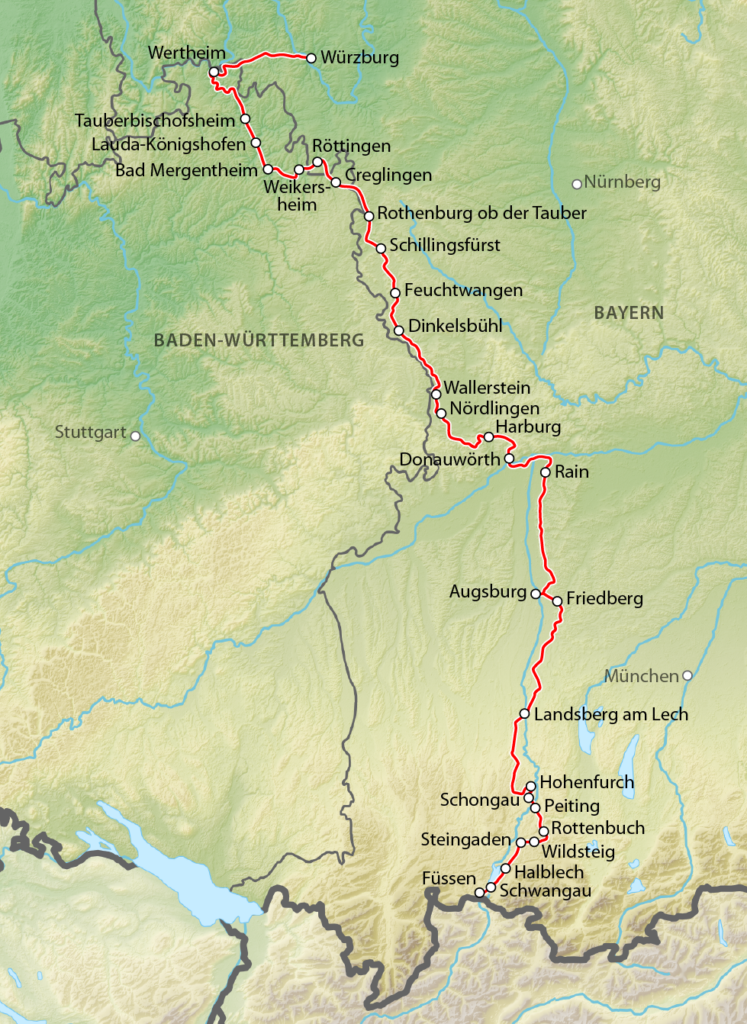
The Romantische Straße—Romantic Road—isn’t just Germany‘s most famous scenic route. It’s a 350-kilometer ribbon of everything travelers imagine when they picture southern Germany: medieval walled towns, rolling vineyards, baroque churches, half-timbered houses leaning over cobblestone squares, and castles perched on forested hillsides.
Running from Würzburg in Franconia south to Füssen in the Bavarian Alps, the Romantic Road was conceived in 1950 as a way to attract American tourists to a country rebuilding after the war. The marketing worked—and seven decades later, it remains one of Europe’s most traveled routes. But beyond the tour buses and souvenir shops, the road delivers genuine beauty and some of Germany’s most rewarding small-town stops.
The Northern Highlights: Würzburg to Dinkelsbühl
The route officially begins in Würzburg, where the UNESCO-listed Residenz palace sets a high baroque bar. From there, the road follows the Tauber River valley through wine country and into Franconia’s gentle hills. The first essential stop is Rothenburg ob der Tauber, Germany’s most perfectly preserved medieval town. Yes, it’s touristy—but walk the complete town wall circuit early in the morning or late afternoon, and you’ll understand why this place has captivated travelers for generations.
South of Rothenburg, Dinkelsbühl offers a quieter, equally beautiful alternative. Its ring of towers and gates encircles a town center that escaped wartime destruction, leaving an almost untouched ensemble of 16th- and 17th-century houses. The Georgskirche dominates the skyline, and the town’s annual Kinderzeche festival in July celebrates a legendary children’s plea that saved the town during the Thirty Years’ War.
The Central Stretch: Nördlingen and the Ries Crater
Nördlingen is the Romantic Road’s geological surprise. The entire town sits inside a massive meteorite crater—the Nördlinger Ries—created 15 million years ago when a one-kilometer asteroid slammed into what’s now Bavaria. You can climb the 90-meter Daniel tower at St. Georg’s Church for a panoramic view of the perfectly circular town walls, still complete and walkable. The night watchman still calls out the hours from the tower between 10 p.m. and midnight, a tradition unbroken since medieval times.
The Rieskrater Museum explains the impact event in fascinating detail, and NASA astronauts trained here in the 1970s before the Apollo moon missions because the crater’s geology so closely resembles lunar impact sites.
The Southern Finale: Augsburg to Füssen
As you continue south, the landscape begins to shift. Augsburg, Bavaria’s third-largest city, offers Renaissance grandeur—the Fuggerei social housing complex and the gilded Goldener Saal in the Rathaus are both worth a stop. But the drama builds as the Alps come into view.
Landsberg am Lech is an underrated gem with a gorgeous old town perched above the rushing Lech River. Then comes the Pfaffenwinkel—the “Priests’ Corner”—a region dense with baroque pilgrimage churches. The Wieskirche near Steingaden is the rococo masterpiece of the bunch, a UNESCO site that seems almost absurdly ornate for its rural setting.
The road ends in Füssen, a charming Bavarian town at the foot of the Alps. Most visitors use it as a base for Neuschwanstein and Hohenschwangau castles, but Füssen’s own Hohes Schloss and the medieval lanes of the Altstadt deserve time. The nearby Forggensee reservoir and the dramatic gorges of the Lech River make this far more than just a castle gateway.
Practical Tips for Driving the Romantic Road
The entire route can be driven in a single day, but you’d be racing past everything worthwhile. Three to five days allows for a relaxed pace with overnights in two or three towns. The official route is well-marked with brown “Romantische Straße” signs.
Spring and fall offer the best balance of good weather and manageable crowds. Summer brings tour buses, especially to Rothenburg and Neuschwanstein. Winter, particularly Advent season, transforms the towns into Christmas market wonderlands, though some attractions run on reduced hours.
You don’t need to follow every kilometer of the official route—some stretches are ordinary highway. Focus on the towns, and use the autobahn to skip between highlights if you’re short on time. Würzburg, Rothenburg, Dinkelsbühl, Nördlingen, and Füssen are the non-negotiables.
For those without a car, the Romantic Road Coach runs daily from April through October, offering hop-on, hop-off service between Frankfurt and Füssen with stops at all major towns. Deutsche Bahn trains serve most towns along the route, though connections can be slow and require transfers.
Accommodation books up quickly in summer and during Christmas market season, especially in Rothenburg and Füssen. Reserve ahead. Small family-run gasthofs in the smaller towns often offer the best combination of charm and value.
Want more stories like this delivered to your inbox? Subscribe to the Love Germany newsletter—one short story about Germany every day, from hidden-gem towns to the food, history, and culture that make this country unforgettable.
Tours & experiences in Germany


Powered by Viator. Some links are affiliate links — we may earn a small commission at no extra cost to you.