
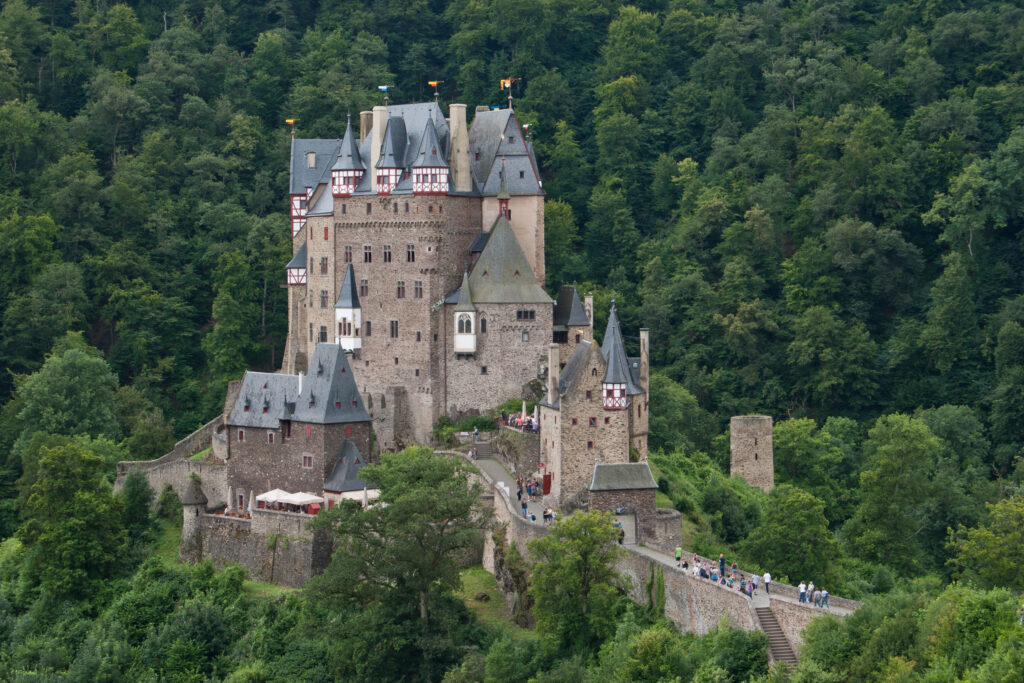
While most German castles fell to war, neglect, or the wrecking ball, Burg Eltz has stood intact for more than 850 years. Perched on a rocky outcrop above the Elzbach stream, surrounded by forest, this castle looks exactly as a medieval fortress should: towers rising at different heights, half-timbered upper stories, slate roofs weathered by centuries of rain.
The Eltz family has owned it since the 12th century. They still do. It’s never been destroyed, never been rebuilt in a different style, never turned into a ruin. What you see is the real thing.
Why Burg Eltz Feels Different
Unlike Neuschwanstein or Heidelberg, Burg Eltz isn’t perched on a mountain for all to see. You reach it by walking through a beech forest, following the stream, until the castle suddenly appears around a bend. The approach alone makes it worth the trip.
The castle is actually eight separate tower houses built over 500 years by three branches of the Eltz family who shared the property. Each branch added their own living quarters, creating the layered, organic architecture you see today. The result is a castle that grew like a medieval village, stacked vertically on a single rock.
Inside, the guided tour takes you through rooms that still hold original furnishings from the 15th to 19th centuries: carved wooden ceilings, tapestries, armor collections, and a treasury with gold and enamel work that would make any museum envious. The Rübenach Lower Hall, with its late-Gothic painted columns, is worth the visit alone.
How to Get There
Burg Eltz sits between the towns of Münstermaifeld and Moselkern, about 30 minutes from Koblenz. If you’re driving, park at the Antonius Chapel lot (parking fee applies) and either walk the 15-minute downhill path or take the shuttle bus that runs April through October.
The more atmospheric approach is from Moselkern train station on the Koblenz-Trier line. Follow the marked trail through the forest—about 45 minutes of gentle uphill walking on good paths. You’ll cross the stream on stepping stones and arrive at the castle from below, the classic view that’s been photographed a million times but never gets old.
Alternatively, hike the Eltzer Burgpanorama trail, a 13-kilometer loop from Moselkern that offers multiple viewpoints of the castle and the surrounding valleys. It’s well-signed and takes about four hours at a comfortable pace.
Visiting the Castle
Burg Eltz is open daily from April 1 through November 1, roughly 9:30 a.m. to 5:30 p.m. Tours are mandatory and available in German and English. They run continuously throughout the day and last about 40 minutes. Buy tickets at the castle entrance—they don’t sell out except on rare peak days in summer.
The treasury is self-guided and included in your ticket. Budget extra time for it; the collection of medieval and Renaissance goldwork, weapons, and reliquaries is exceptional.
There’s a small café near the entrance serving drinks, ice cream, and simple snacks. The castle shop sells wine from the Eltz family’s vineyards in the Rheingau—a nice souvenir that actually connects to the place.
When to Visit and What to Bring
May and September are ideal: fewer crowds than summer, good weather for the forest walk, and the leaves are either fresh green or starting to turn. October can be stunning if you catch the fall color, but the castle closes November 1, so don’t leave it too late.
Avoid summer weekends if you can. Weekday mornings, especially in April, May, or October, give you the castle almost to yourself. The forest walk is beautiful in any weather, but bring proper shoes—roots and stones make the path uneven in places.
Inside the castle, it’s cool year-round. The stone walls hold the chill even in summer. Bring a light jacket.
Combine It
Burg Eltz pairs naturally with a drive through the Moselle Valley. The castle is only a few kilometers from the river, and towns like Cochem, Beilstein, and Traben-Trarbach are all within a 30-minute drive. You can easily see the castle in the morning and spend the afternoon wine-tasting along the Moselle.
If you’re staying in Koblenz, the castle makes a perfect half-day trip. The city’s Deutsches Eck, where the Moselle meets the Rhine, and the Ehrenbreitstein Fortress offer a nice contrast to Burg Eltz’s intimate forest setting.
Burg Eltz isn’t the biggest or most famous castle in Germany. But it might be the one that best captures what a medieval fortress actually looked and felt like—lived in, defended, loved, and kept in the family for 34 generations. That’s rare.
Want more stories like this in your inbox? Subscribe to the Love Germany newsletter and get one short story about Germany every day—the places, the food, the culture, and the details that make it unforgettable.
Tours & experiences in Germany


Powered by Viator. Some links are affiliate links — we may earn a small commission at no extra cost to you.