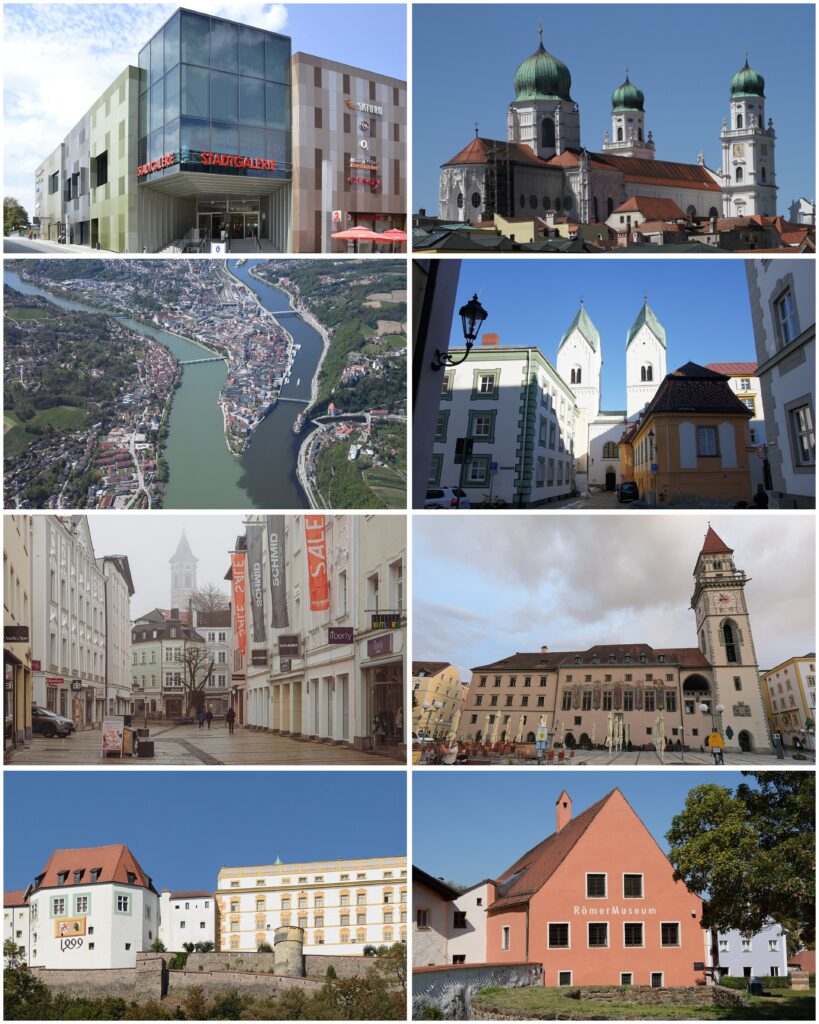
Passau doesn’t look like most German cities. Its pastel baroque facades and narrow Italian-style streets reflect centuries as a prince-bishopric with strong ties to the south. Wedged between three rivers at the Austrian border, this city of 50,000 punches above its weight in beauty and history.
The Danube, Inn, and Ilz converge here in a swirl of blue, green, and black water—a natural spectacle you can watch from the Dreiflüsseeck (Three Rivers Corner) viewing platform near the Veste Oberhaus fortress. The rivers define Passau’s geography: the old town occupies a narrow peninsula between the Danube and Inn, with steep hills rising on both sides.
The Baroque Old Town
St. Stephen’s Cathedral dominates the Altstadt with the largest organ outside of Italy—17,974 pipes across 233 registers. The interior is pure Italian baroque, designed by Carlo Lurago after a 17th-century fire destroyed the Gothic original. Free organ concerts happen daily at noon from May through October, and the acoustics are remarkable.
Walk the cobbled lanes between Residenzplatz and the riverfront. The pastel townhouses, arcaded courtyards, and frescoed facades reflect Passau’s position as a wealthy trading hub and ecclesiastical power. The Altes Rathaus (Old Town Hall) sits directly on the Danube, its tower marking flood levels dating back centuries—the 2013 flood reached an astonishing 12.89 meters.
Cross the Inn River via the Innsteg footbridge for the best old town views. From the Austrian side, you see the full sweep of the peninsula with its church spires and riverside promenade.
Veste Oberhaus and the View
The fortress above Passau has watched over the rivers since 1219. It’s a 20-minute uphill walk from the old town (follow signs from Residenzplatz) or a short shuttle bus ride in summer. The fortress houses a regional museum covering everything from medieval bishop-princes to Danube shipping.
But most visitors come for the view from the observation tower. The three rivers, the old town below, the Austrian hills beyond the Inn, and the Bavarian Forest to the north—it’s one of southern Germany‘s finest panoramas. The fortress beer garden makes a good stop for lunch with a view.
The Danube Cycle Path
Passau marks kilometer 2,200 of the Danube Cycle Path, Europe’s most popular long-distance cycling route. Thousands of cyclists pass through each year, either starting the downstream ride to Vienna and Budapest or finishing the upstream journey from the Black Forest.
Even if you’re not cycling the full route, rent a bike and ride west toward Engelhartszell, Austria (about 15 kilometers). The path follows the river through the narrow Danube valley with forested slopes rising on both sides. You’ll pass the baroque Mariahilf pilgrimage church perched on a cliff above the Austrian bank—235 covered steps lead up from the riverside if you want the climb.
Practical Details
Passau sits on the main rail line from Munich to Vienna. Direct trains from Munich take about 2.5 hours; from Regensburg it’s 90 minutes. The Hauptbahnhof is about a 10-minute walk from the old town center.
River cruise ships dock along the Danube promenade daily from April through October—Passau is a major port on the Danube cruise circuit between Regensburg and Vienna. If you’re not on a cruise, the local Donauschifffahrt boats offer short trips through the Three Rivers section or longer excursions to Linz.
Visit in late spring (May and June) or early autumn (September) for good weather without peak summer crowds. The Christmas market in December fills the cathedral square, though it gets cold and sometimes icy on the rivers.
For accommodations, stay in the Altstadt if you can—hotels like Hotel Wilder Mann and Hotel König right on the riverfront put you steps from everything. Passau is compact enough to explore on foot in a day, but it deserves an overnight to catch the evening light on the rivers and a morning organ concert in the cathedral.
Ready for more stories from Germany’s corners? Subscribe to the Love Germany newsletter—one short story a day, straight to your inbox.
Tours & experiences in Germany


Powered by Viator. Some links are affiliate links — we may earn a small commission at no extra cost to you.