
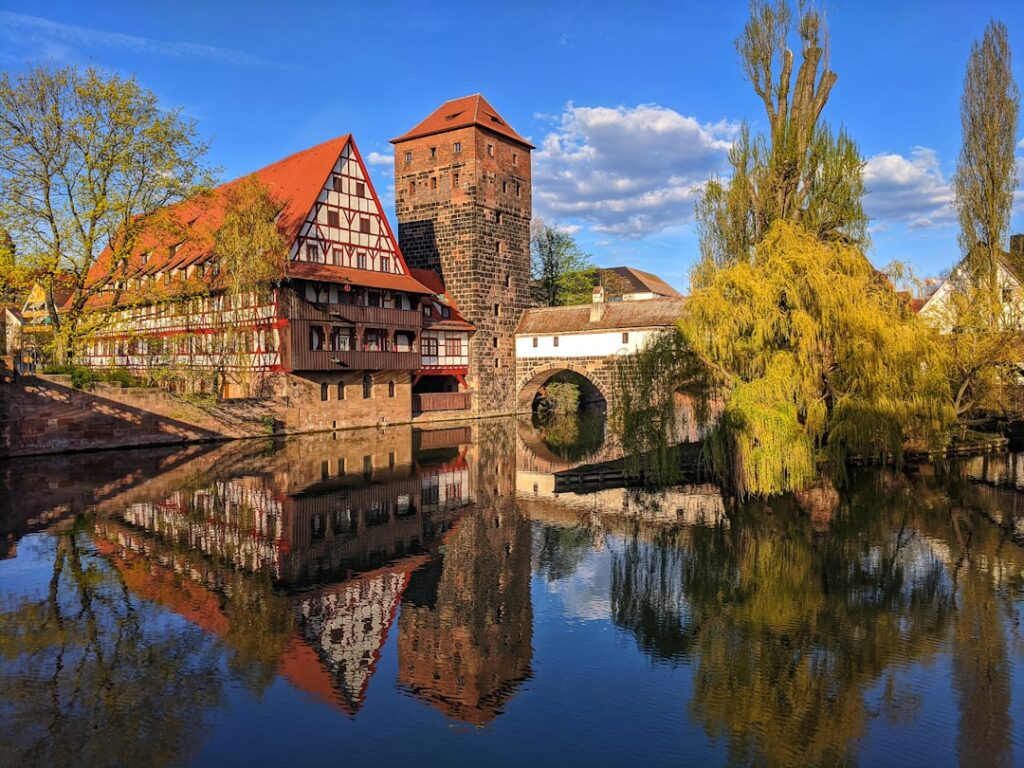
Rising above the Pegnitz River in northern Bavaria, Nuremberg’s Altstadt (Old Town) is a captivating blend of medieval grandeur and sobering historical significance. Despite suffering devastating destruction during World War II, this remarkable city has meticulously rebuilt its historic core, creating one of Germany’s most atmospheric urban destinations. From the imposing Imperial Castle that dominated Holy Roman Empire politics to the cobblestone squares where Christmas markets have enchanted visitors for centuries, Nuremberg offers travelers an authentic journey through German history spanning nearly a millennium.
As Bavaria’s second-largest city, Nuremberg seamlessly balances its medieval charm with modern vitality, making it an essential stop for anyone seeking to understand Germany’s complex past while enjoying world-class museums, traditional Franconian cuisine, and genuinely welcoming Bavarian hospitality.
The Imperial Castle and Medieval Fortifications
Dominating Nuremberg’s skyline, the Kaiserburg (Imperial Castle) is the crown jewel of the Old Town and one of Germany’s most important medieval fortresses. Every Holy Roman Emperor resided here between 1050 and 1571, making it a genuine seat of imperial power. The castle complex consists of three sections: the Imperial Castle proper, the Burggrave’s Castle, and the municipal buildings at the eastern end.
Begin your visit at the Palas (Great Hall) with its Romanesque double chapel, then climb the Sinwell Tower for panoramic views extending across the red-roofed Old Town to the surrounding Franconian countryside. The Deep Well, descending an astounding 164 feet through solid rock, demonstrates medieval engineering prowess. Don’t miss the Imperial Castle Museum, which displays medieval weapons, armor, and fascinating details about castle life during the empire’s height.
The castle’s gardens provide a peaceful retreat and exceptional photo opportunities, especially during spring when flowers bloom against the backdrop of medieval walls. Allow at least two hours to explore the entire complex thoroughly, and consider purchasing the combined ticket that includes access to all sections plus the museums.
Historic Heart: Main Market Square and Surrounding Treasures
The Hauptmarkt (Main Market Square) forms the vibrant center of Old Town life, home to daily markets selling Franconian specialties, flowers, and local produce. The square’s showpiece is the 62-foot-tall Schöner Brunnen (Beautiful Fountain), a 14th-century Gothic monument adorned with 40 colorful figures representing the Holy Roman Empire’s worldview. According to local tradition, spinning the brass ring on the fountain’s golden gate three times brings good luck—you’ll spot tourists and locals alike performing this ritual.
Overlooking the square stands the Frauenkirche (Church of Our Lady), a Gothic masterpiece built between 1352 and 1362. Visit at noon to witness the Männleinlaufen, a mechanical clock where seven electors parade before Emperor Charles IV, commemorating the Golden Bull of 1356. The church’s interior, though simpler than its exterior suggests, contains beautiful stained glass and a reverent atmosphere.
Just steps away, the Handwerkerhof (Craftsmen’s Courtyard) near the main train station recreates a medieval village within the Old Town walls. This charming enclave houses artisans practicing traditional crafts—leatherworking, toy-making, and pottery—plus restaurants serving authentic Nuremberg bratwurst and lebkuchen (gingerbread). It’s tourist-oriented but genuinely well-executed and perfect for souvenir shopping.
Confronting History: World War II and the Nuremberg Trials
Nuremberg’s role in 20th-century history cannot be overlooked. The Nazi Party held its massive propaganda rallies here, and later, the Allied forces chose the city for the landmark war crimes trials that helped establish modern international law. The Documentation Center Nazi Party Rally Grounds, located southeast of the Old Town at the partially preserved rally grounds, provides essential historical context through its powerful permanent exhibition “Fascination and Terror.”
In the Old Town itself, visit Courtroom 600 in the Palace of Justice, where the Nuremberg Trials took place in 1945-1946. This working courtroom (closed during active trials) contains an exhibition about the proceedings that prosecuted major Nazi war criminals. The somber experience offers crucial perspective on justice, accountability, and Germany’s confrontation with its darkest chapter.
The balance between Nuremberg’s medieval splendor and this difficult history creates a uniquely meaningful travel experience, reminding visitors that understanding the past—both glorious and terrible—enriches our present.
Planning Your Visit: Practical Information and Insider Tips
Nuremberg is easily accessible by train, with frequent ICE high-speed connections from Munich (one hour), Frankfurt (two hours), and Berlin (four hours). The Hauptbahnhof (main station) sits immediately adjacent to the Old Town walls, making arrival effortlessly convenient. Once inside the Old Town, everything is walkable, though comfortable shoes are essential for navigating cobblestone streets and castle hills.
The best time to visit is May through September for pleasant weather and outdoor dining, or during the famous Christkindlesmarkt (late November through Christmas Eve), when the Main Market Square transforms into Germany’s most beloved Christmas market. Be warned: accommodation prices soar and crowds intensify during the market period, so book well in advance.
For authentic Nuremberg cuisine, seek out traditional Franconian restaurants serving Nürnberger Rostbratwurst—smaller, thinner bratwurst grilled over beechwood fires and typically served six or twelve at a time with sauerkraut and horseradish. Bratwursthäusle near St. Sebald Church has been serving these since 1419. Don’t leave without trying lebkuchen from a traditional bakery; Schmidt Lebkuchen-Schmidt offers excellent quality and historic atmosphere.
Purchase the Nuremberg Card (available for 24 or 48 hours) for free public transportation and admission to all municipal museums, including the castle, toy museum, and Documentation Center. The card provides excellent value for museum enthusiasts and pays for itself quickly.
Finally, venture beyond the main squares to discover quieter corners like the Weißgerbergasse, a perfectly preserved street of colorful half-timbered houses, or stroll along the Pegnitz River at sunset when golden light illuminates the medieval bridges and waterfront homes, revealing why Nuremberg captivates travelers seeking authentic German history and charm.
Tours & experiences in Germany


Powered by Viator. Some links are affiliate links — we may earn a small commission at no extra cost to you.