
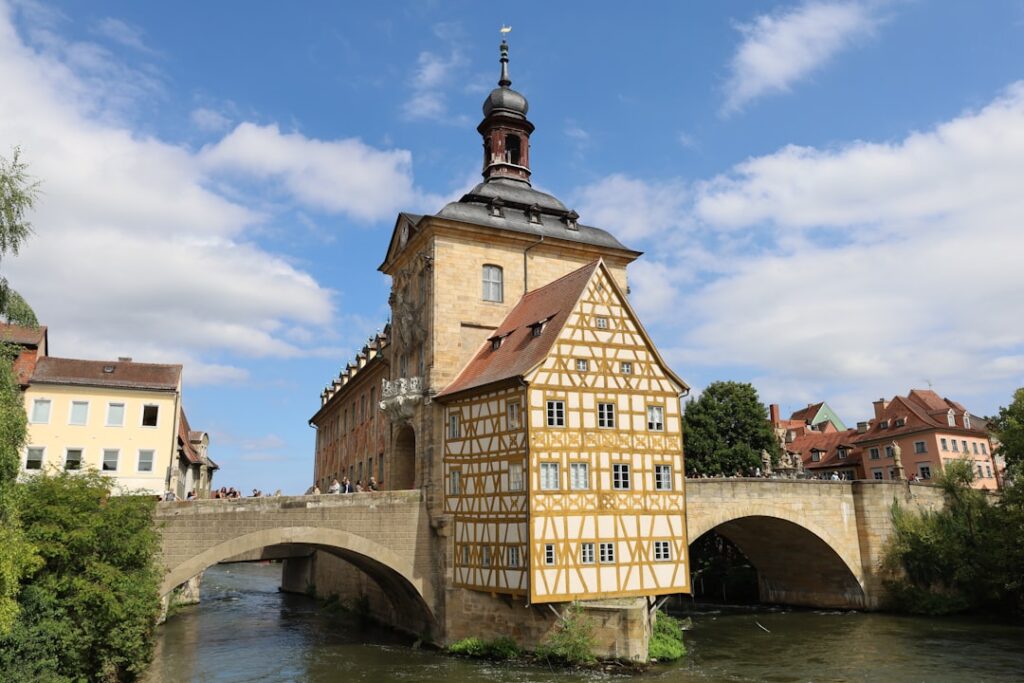
While many of Germany’s medieval towns have been heavily reconstructed after wartime damage, Bamberg stands as a rare exception—an extraordinarily well-preserved medieval city that miraculously survived World War II intact. Built across seven hills like Rome, this UNESCO World Heritage Site in Upper Franconia offers visitors an authentic journey through a thousand years of architectural history, complemented by a unique brewing culture and some of Bavaria’s finest cuisine.
Bamberg’s charm lies in its completeness. With over 2,400 protected buildings spanning Romanesque, Gothic, Baroque, and Renaissance periods, the entire Old Town feels like a living museum where history isn’t reconstructed—it simply never left. Add to this the city’s famous Rauchbier (smoked beer), picturesque canals, and stunning hilltop views, and you have one of Germany’s most rewarding destinations for travelers seeking authentic medieval atmosphere without the crowds of more famous tourist magnets.
The Old Town: A Medieval Cityscape Frozen in Time
Bamberg’s Old Town divides naturally into three historic districts, each with its own character. The Island District, nestled between two arms of the Regnitz River, centers on the iconic Old Town Hall (Altes Rathaus)—a architectural wonder built literally in the middle of the river on an artificial island. Legend says the bishop refused to give the citizens land for a town hall, so they created their own island. The building’s facade features stunning frescoes and a Rococo council chamber that seems to defy its watery location.
From here, wander through narrow cobblestone lanes lined with half-timbered houses leaning at improbable angles. The Gärtnerstadt (Market Gardeners’ District) showcases the homes of Bamberg’s historic horticultural community, where families still cultivate traditional vegetable gardens and grow the famous Bamberg onion, a sweet variety protected by the European Union. Little Venice (Klein Venedig), a row of former fishermen’s houses along the Regnitz, provides one of the city’s most photographed vistas, especially beautiful when viewed from the Untere Brücke at sunset.
The Cathedral and Imperial Quarter
Dominating the hilltop Berg District, Bamberg Cathedral (Bamberger Dom) ranks among Germany’s most significant Romanesque buildings. Founded in 1002 by Emperor Henry II, the cathedral houses the only papal grave north of the Alps (Pope Clement II) and the famous Bamberg Rider, a mysterious 13th-century equestrian statue that has captivated art historians for centuries. The cathedral’s four towers create Bamberg’s distinctive skyline, visible throughout the city.
Adjacent to the cathedral, the Alte Hofhaltung, a medieval imperial palace complex with a beautiful Renaissance courtyard, hosts the Historical Museum. Across the square, the sumptuous Neue Residenz palace, former home to Bamberg’s prince-bishops, offers opulent state rooms and the stunning Rose Garden terrace, providing panoramic views over the city’s red rooftops—bring your camera for this vista.
Don’t miss St. Michael’s Abbey, crowning another of Bamberg’s hills. This former Benedictine monastery features a remarkable baroque church ceiling painted with over 600 medicinal plants and herbs, and the terraced monastery gardens offer yet another spectacular city viewpoint.
Rauchbier and Franconian Brewing Traditions
Bamberg’s beer culture is legendary, and utterly unique. The city boasts eleven breweries within its limits, more per capita than virtually anywhere in the world, including nine traditional brewery-taverns (Hausbrauereien) where beer is brewed and served on-site. The city’s specialty is Rauchbier—smoked beer—made with malt dried over beechwood fires, creating a distinctive smoky, bacon-like flavor that’s polarizing but unforgettable.
Schlenkerla, located in a building dating to 1405, serves the most famous Rauchbier and offers hearty Franconian dishes in atmospheric medieval cellars. For first-timers nervous about smoked beer, try it with the house-smoked pork or onion dishes—the pairing transforms the experience. Spezial and Greifenklau also brew excellent versions. If smoked beer isn’t your preference, Fässla, Kaiserdom, and Keesmann offer outstanding traditional lagers and seasonal brews.
Practical Information and Insider Tips
Bamberg lies about 40 miles north of Nuremberg in northern Bavaria. The city is easily reached by direct trains from Nuremberg (40-60 minutes), Munich (2-2.5 hours), and Frankfurt (2.5-3 hours). The compact Old Town is entirely walkable, and the train station sits just a 15-minute walk from the center. If driving, park at one of the designated lots on the Old Town’s periphery, as the medieval core is largely pedestrianized.
The best time to visit is May through September, when outdoor beer gardens flourish and the Rose Garden blooms spectacularly. However, Bamberg’s Christmas market, spread across multiple squares, ranks among Bavaria’s most atmospheric. Weekdays are noticeably less crowded than weekends, particularly important for photographing landmarks without tourist hordes.
Allow a full day at minimum, though two days permits a more relaxed pace and time to properly explore the brewing culture. Begin early at the cathedral and Imperial quarter before crowds arrive, then descend to the Island District and riverside areas in the afternoon. Book brewery-tavern tables in advance for dinner, especially on weekends.
For the quintessential Bamberg experience, climb to the Altenburg fortress ruins above the city for sunset—the 20-minute walk rewards you with sweeping panoramas and a beer garden at the summit. Purchase the Bamberg Card for free public transportation and museum discounts if planning multiple attractions. Most importantly, don’t rush—Bamberg reveals its magic to those who wander slowly through its lanes, beer stein in hand, discovering hidden courtyards and unexpected architectural treasures around every corner.
Tours & experiences in Germany


Powered by Viator. Some links are affiliate links — we may earn a small commission at no extra cost to you.