
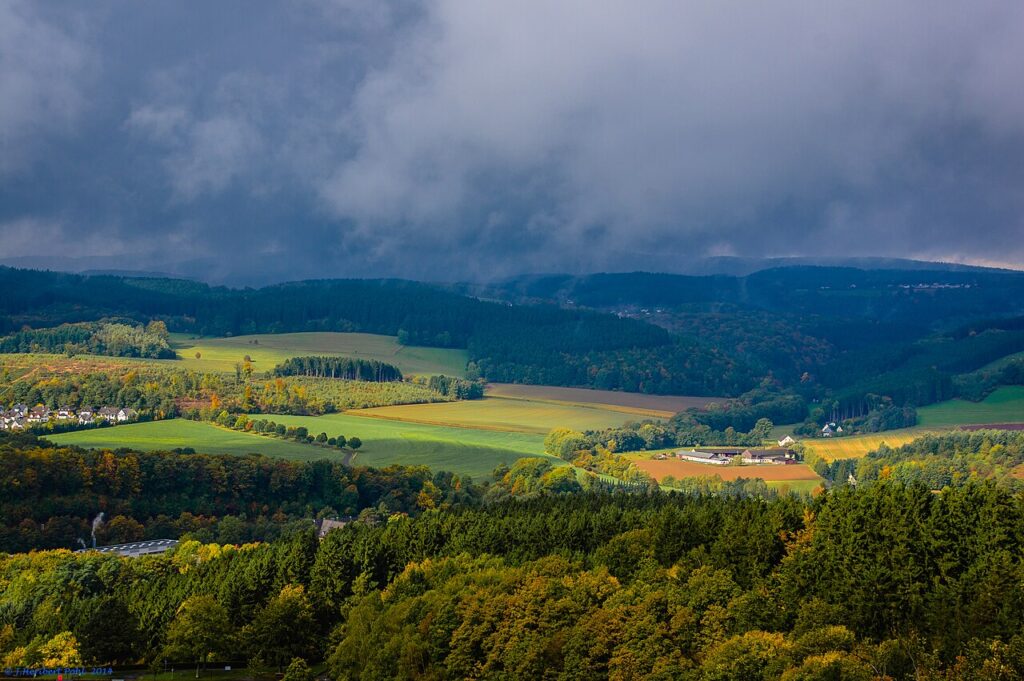
The Sauerland doesn’t make it onto many international itineraries, and that’s precisely its appeal. This rolling, forested upland in North Rhine-Westphalia sits just beyond the Ruhr Valley‘s industrial sprawl, offering hiking trails, half-timbered villages, and some of Germany’s most impressive cave systems—all without the crowds you’ll find in Bavaria or the Black Forest.
Locals from Dortmund, Cologne, and Düsseldorf have long treated the Sauerland as their weekend escape. For travelers looking beyond Germany’s greatest hits, it’s a chance to see how Germans vacation when they’re not performing for tourists.
Winterberg and the High Country
Winterberg, the region’s highest town at 2,200 feet, transforms into Germany’s busiest ski resort each winter. Don’t expect Alpine drama—the runs are gentle, the vertical drop modest—but the infrastructure is solid, with night skiing and snow-making equipment that keeps things running from December through March.
Summer is when Winterberg truly shines. The Rothaarsteig, a 154-mile hiking trail that traverses the Sauerland’s spine, passes directly through town. Even a short section—say, the eight-mile stretch to Küstelberg—offers deep forest, rocky outcrops, and views across the valleys that feel far removed from the industrial Ruhr below.
Mountain bikers come for the Trailpark, a purpose-built network of single-track trails that range from beginner-friendly flow trails to technical downhill runs. Bike rental shops line the main street, and the lifts run all summer.
The Caves of Attendorn and Balve
The Sauerland sits on a limestone plateau, and water has been carving its interior for millions of years. The result: some of Germany’s most extensive cave systems, open to visitors year-round.
The Atta Cave near Attendorn is the showpiece—Germany’s largest dripstone cave, with chambers that stretch more than half a mile underground. The guided tours run hourly and take about forty minutes. You’ll walk past stalactites the size of church organs, underground pools, and formations that look like frozen waterfalls. The temperature stays at a constant 48°F, so bring a jacket even in July.
Balve Cave, northwest of Attendorn, is less about geological spectacle and more about scale. It’s one of Europe’s largest cave entrances, and since the 1950s, it’s been used as a concert venue. If you’re visiting in summer, check the schedule—hearing classical music or rock in a natural amphitheater carved from rock is an experience you won’t replicate elsewhere.
Half-Timbered Towns Worth a Stop
Arnsberg, the Sauerland’s unofficial capital, clusters around a bend in the Ruhr River. The old town rises up the hillside in tiers of half-timbered houses, topped by the ruins of a castle that once governed the region. It’s compact enough to see in an afternoon—walk the Ruhr promenade, climb to the Schlossruine for the view, and stop at one of the bakeries on Alter Markt for a slice of Sauerländer Pflasterkuchen, a dense almond cake that’s been baked here since the 18th century.
Schmallenberg, deeper into the hills, is smaller and quieter. The town center is a textbook example of Sauerland architecture: slate-roofed timber frames, narrow lanes, and a church steeple that’s visible from every approach. It’s a good base for hiking—trails radiate out in every direction, including a segment of the Rothaarsteig.
Practical Tips for Visiting
The Sauerland is easiest to explore by car. Trains connect the larger towns—Arnsberg and Winterberg both have stations—but getting to trailheads and smaller villages requires wheels. The drive from Cologne or Dortmund takes about an hour.
Accommodation tends toward family-run guesthouses and small hotels rather than chains. Book ahead during winter ski season and summer weekends, when Ruhr families descend en masse.
Food here is hearty and old-fashioned. Look for Potthucke (a baked potato and sausage dish), Panhas (a fried meat loaf made from buckwheat and pork), and Pumpernickel bread, which originated in nearby Westphalia. Wash it down with a Warsteiner or Veltins—both breweries are Sauerland natives.
If you’re serious about hiking, pick up a map of the Rothaarsteig or the Sauerland-Höhenflug, a 155-mile ridge trail that connects Hagen to Korbach. Both are well-marked, with shelters and guesthouses spaced at walkable intervals.
The Sauerland doesn’t try to be dramatic. It’s green, rolling, and unpretentious—a place where Germans go to breathe air that doesn’t smell like diesel and walk trails that don’t require crampons. For travelers willing to look beyond the Alps, it’s a refreshing change of altitude.
Want more stories like this? Subscribe to the Love Germany newsletter—one short story a day, straight to your inbox, about the Germany you won’t find in the guidebooks.
Tours & experiences in Germany


Powered by Viator. Some links are affiliate links — we may earn a small commission at no extra cost to you.