
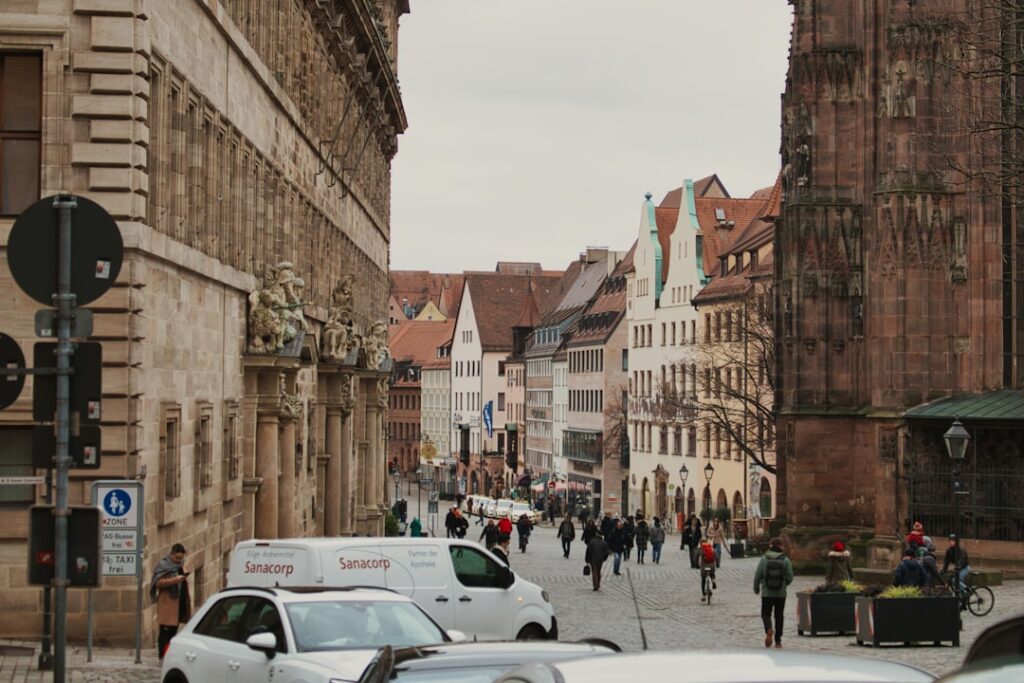
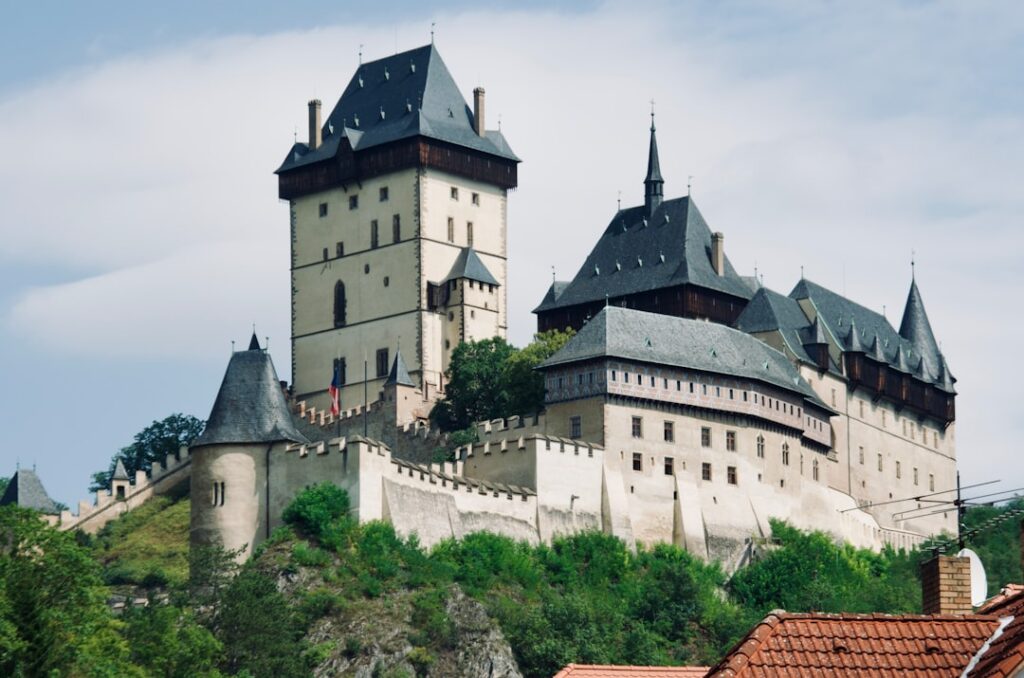
For centuries, the Holy Roman Empire’s most sacred treasures moved between strongholds, seeking protection from war, fire, and conquest. Among the empire’s most fortified sanctuaries, two castles stand out: Nuremberg’s Kaiserburg, the traditional guardian of the Imperial Regalia, and Karlštejn Castle, the Bohemian fortress built explicitly to house Christendom’s holiest relics.
The connection between these two citadels runs deep through medieval history. Charles IV, King of Bohemia, founded Karlštejn Castle in 1348 in the forests south of Prague with a singular purpose: to create an impregnable treasury for crown jewels and sacred relics. Charles moved imperial regalia and relics to Karlštejn in 1349-1350, while still King of Bohemia and King of the Romans, before his imperial coronation in 1355. The castle’s Chapel of the Holy Cross, completed in 1365, featured walls encrusted with over 2,200 semi-precious stones and 129 painted panels—a jewel box designed to house jewels.
Nuremberg, meanwhile, had served as the traditional repository for the Imperial Regalia since 1424, when Emperor Sigismund—Charles IV’s son—decreed that the crown, sceptre, and orb should remain permanently in the city’s Heilig-Geist-Spital (Hospital of the Holy Spirit). The Free Imperial City’s central location and powerful fortifications made it ideal for safeguarding the symbols of imperial authority.
The regalia remained in Nuremberg until 1796, when French Revolutionary forces threatened the city. The treasures were then transported to Vienna, where they have remained ever since.
Charles IV’s Dual Legacy
Charles IV himself embodied the Nuremberg-Bohemia connection. As King of Bohemia and Holy Roman Emperor, he transformed both realms. He elevated Prague to an imperial capital and architectural jewel, while simultaneously strengthening Nuremberg’s position as the empire’s “unofficial capital,” hosting imperial diets and serving as the legal home of the regalia.
The emperor’s Golden Bull of 1356, issued from both Nuremberg and Metz, decreed that each newly elected Holy Roman Emperor must hold his first imperial diet in Nuremberg—cementing the city’s constitutional importance. Meanwhile, Karlštejn Castle became the physical manifestation of imperial sacral authority, its soaring towers visible for miles across the Bohemian countryside.
Architectural Echoes
Both fortresses share Gothic architectural DNA from the mid-14th century. Nuremberg’s Kaiserburg, expanded significantly under Charles IV, features the Heidenturm (Heathen Tower) and Sinwell Tower that dominate the city skyline much as Karlštejn’s Great Tower commands the Berounka valley. Both castles employed similar defensive innovations: multiple curtain walls, strategic hilltop positions, and separate residential and ceremonial spaces that reflected imperial protocol.
Today, visitors to Nuremberg’s Germanisches Nationalmuseum can view replica imperial regalia in the city that once guarded the originals for four centuries. The authentic pieces remain in Vienna’s Hofburg, returning to Nuremberg only once—for a 1938 Nazi propaganda exhibition. Meanwhile, Karlštejn Castle draws over 200,000 visitors annually to see the chapel that once held not only Bohemian crown jewels but also fragments of the True Cross, thorns from Christ’s crown, and other relics that legitimized Charles IV’s reign.
The story of these two castles illuminates how medieval power required both military might and sacred symbolism—stone walls to protect golden crowns, and gilded chapels to sanctify earthly rule. From Franconia to Bohemia, the Holy Roman Empire’s authority rested quite literally on movable treasures and the fortresses built to shelter them.
Tours & experiences in Germany


Powered by Viator. Some links are affiliate links — we may earn a small commission at no extra cost to you.