
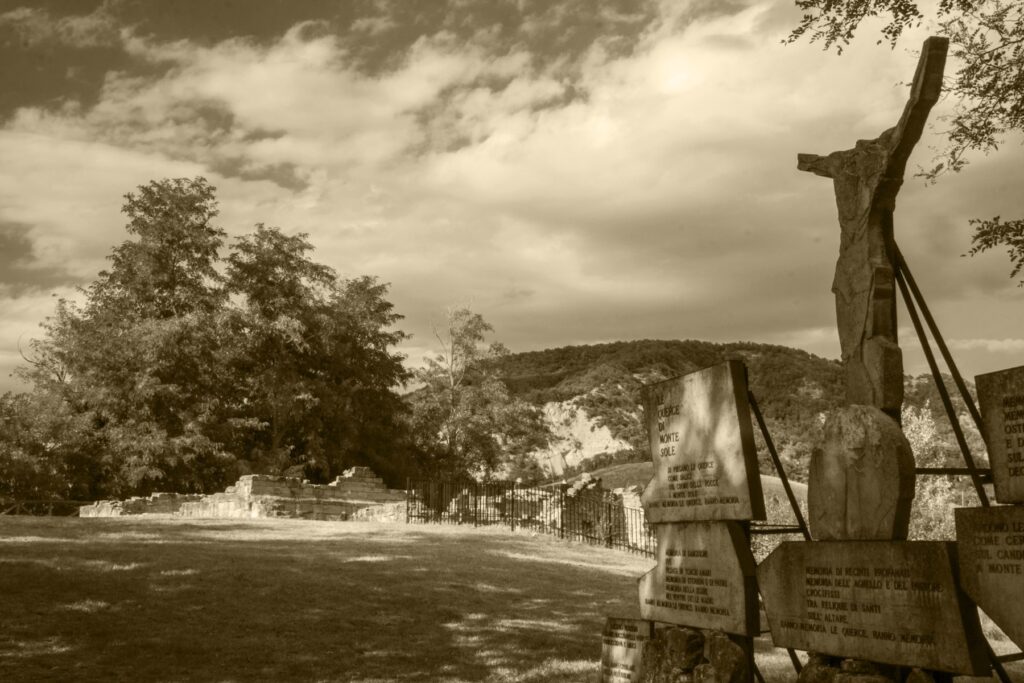
In the hills south of Bologna, where the valleys of the Reno and Setta rivers meet, stands the village of Marzabotto and the heights of Monte Sole. Today it is a place of profound quiet, marked by the Parco Storico di Monte Sole, a memorial park that preserves the memory of one of the Second World War’s most devastating civilian massacres on Italian soil—a tragedy inextricably linked to Germany.
Between 29 September and 5 October 1944, units of the 16th SS Panzergrenadier Division “Reichsführer-SS” swept through the Monte Sole area in a brutal anti-partisan operation. Over the course of those days, German forces killed at least 770 civilians, including entire families, children, and elderly residents sheltering in churches. The villages of Marzabotto, Grizzana, and Monzuno were devastated.
The massacre at Monte Sole, often called the Marzabotto massacre, stands as one of the largest single atrocities committed by German forces in Western Europe during the war. It was not a battle. It was systematic violence against unarmed people, many of whom had no connection to the partisan resistance that Germany sought to crush.
Justice Delayed, Memory Preserved
For decades after the war, the perpetrators faced no consequences. Documents relating to the massacre were hidden in a filing cabinet—the so-called “Cabinet of Shame”—in a Rome military prosecutor’s office, only rediscovered in 1994. Trials finally began in the 2000s. Several former SS officers were convicted in absentia by Italian courts, though Germany refused extradition on constitutional grounds.
The legal and diplomatic tension surrounding these convictions has been a recurring point of friction between Germany and Italy, particularly in communities like Marzabotto where survivors and descendants still live. Yet the relationship is not only one of accusation. Germany has also been a partner in memory. The Parco Storico di Monte Sole, established in 1989, receives support from German educational and remembrance organizations. German school groups regularly visit Monte Sole as part of programs aimed at confronting the Nazi past.
A Landscape of Remembrance Near Bologna
The hills around Monte Sole are the same hills that cradle the town of Savigno above Bologna, where traditional Emilian life and cuisine have endured across generations. The proximity is geographic and emotional. The massacre shaped the identity of the entire Apennine region south of Bologna, a place where memory, resilience, and reconciliation are woven into the landscape.
Visitors to the area today will find not only memorials and ruins, but also a living countryside. The Scuola di Pace di Monte Sole, a peace school founded in 2002, works with international partners—including German institutions—to teach conflict resolution, human rights, and historical memory. It is a place where the children of victims and the children of perpetrators have met, where German and Italian students study together.
Monte Sole is a German story as much as it is an Italian one. It is a story Germany cannot forget, and one that Italy will not let fade. The hills remember, and in remembering, they teach.
Tours & experiences in Germany


Powered by Viator. Some links are affiliate links — we may earn a small commission at no extra cost to you.