
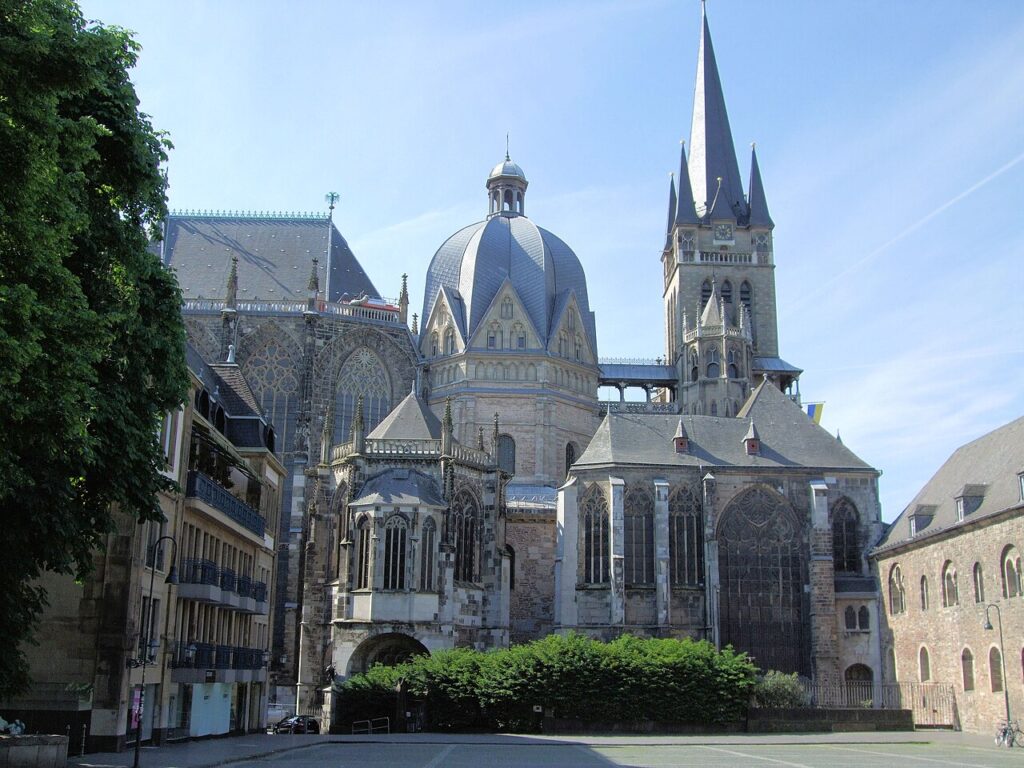
Aachen Cathedral doesn’t look like other German churches. Its heart is an octagonal Byzantine chapel built in 796, commissioned by Charlemagne himself when Aachen was the capital of his empire. Step inside, and you’re standing in the oldest cathedral north of the Alps still in use—a building that’s witnessed more coronations, pilgrimages, and power plays than almost anywhere else in Europe.
The cathedral is a living monument to the Holy Roman Empire. Between 936 and 1531, thirty German kings climbed the stone steps to Charlemagne’s marble throne in the upper gallery, where they were crowned and received the imperial regalia. No other building in Germany has played such a central role in shaping the country’s medieval identity.
The Octagon and Charlemagne’s Throne
The Palatine Chapel—the octagonal core of the cathedral—was revolutionary for its time. Charlemagne brought marble columns from Rome and Ravenna, and Byzantine architects designed a soaring space crowned by a dome that still impresses today. The mosaics glitter gold in the half-light, and the central chandelier, a gift from Emperor Frederick Barbarossa in the 12th century, hangs like a ring of fire.
Upstairs in the gallery sits Charlemagne’s marble throne, plain and severe. It’s not ornate—just six slabs of white marble forming a seat—but its simplicity is the point. This was where kingship began. You can visit the throne as part of a guided tour; it’s not accessible on your own, but the 45-minute tour (available in English) is worth every minute.
Charlemagne himself is entombed here, though his bones were moved to the gilded shrine behind the high altar in 1215. The Karlsschrein, a masterpiece of medieval goldsmithing, holds what’s said to be his remains, and it’s one of the most lavish reliquaries in Europe.
The Gothic Choir and Treasury
In 1355, Aachen added a soaring Gothic choir to the east end of the octagon—a glass hall flooded with light, built to house pilgrims flocking to see the cathedral’s sacred relics. The windows stretch nearly 27 meters high, and the effect is breathtaking: a jewel box of stained glass that contrasts dramatically with the heavy Byzantine core.
Don’t miss the cathedral treasury, one of the richest in Europe. It’s housed in a separate building just off the cloister and holds the Cross of Lothar, the bust reliquary of Charlemagne, and the Proserpina Sarcophagus, which once held the emperor’s body. The ivory situla, carved in the 10th century, is another highlight—an object so beautiful it’s hard to believe it’s more than a thousand years old.
Entry to the treasury costs €6 and is absolutely worth it. Photography isn’t allowed, so take your time and absorb the details.
Visiting Aachen Cathedral
The cathedral sits in the heart of Aachen’s old town, a short walk from the Markt and the Rathaus. It’s open daily, and entry to the octagon and choir is free, though you’ll need to book a guided tour (€5) to see Charlemagne’s throne. Tours run several times a day in German, with English tours typically available in the afternoon—check the cathedral’s official website or ask at the visitor desk near the entrance.
The best time to visit is mid-morning on a weekday, when the light pours through the Gothic choir and the crowds are thinner. The cathedral can be packed during summer and around Christmas, especially when pilgrimage groups arrive.
Aachen is easily reached by train from Cologne (one hour) or Düsseldorf (90 minutes), and the cathedral is a five-minute walk from the Hauptbahnhof. If you’re exploring the city, the old town tour offered by Aachen old town tour – GERMAN (public) is a great way to see the cathedral in context with the Rathaus, thermal springs, and medieval lanes that surround it.
Why Aachen Matters
Aachen Cathedral is more than an architectural marvel—it’s the physical embodiment of the idea of a united Christian Europe under one emperor. Charlemagne built it to rival Rome and Byzantium, and for centuries it succeeded. To stand in the octagon is to feel the weight of that ambition, the cold marble of the throne, and the golden shimmer of an empire that stretched from the Pyrenees to the Elbe.
It’s a place where history isn’t abstract. It’s in the stone, the glass, and the silence between the arches.
Want more stories like this delivered to your inbox? Subscribe to the Love Germany newsletter—one short story a day, straight from the heart of Germany.
Tours & experiences in Germany


Powered by Viator. Some links are affiliate links — we may earn a small commission at no extra cost to you.