
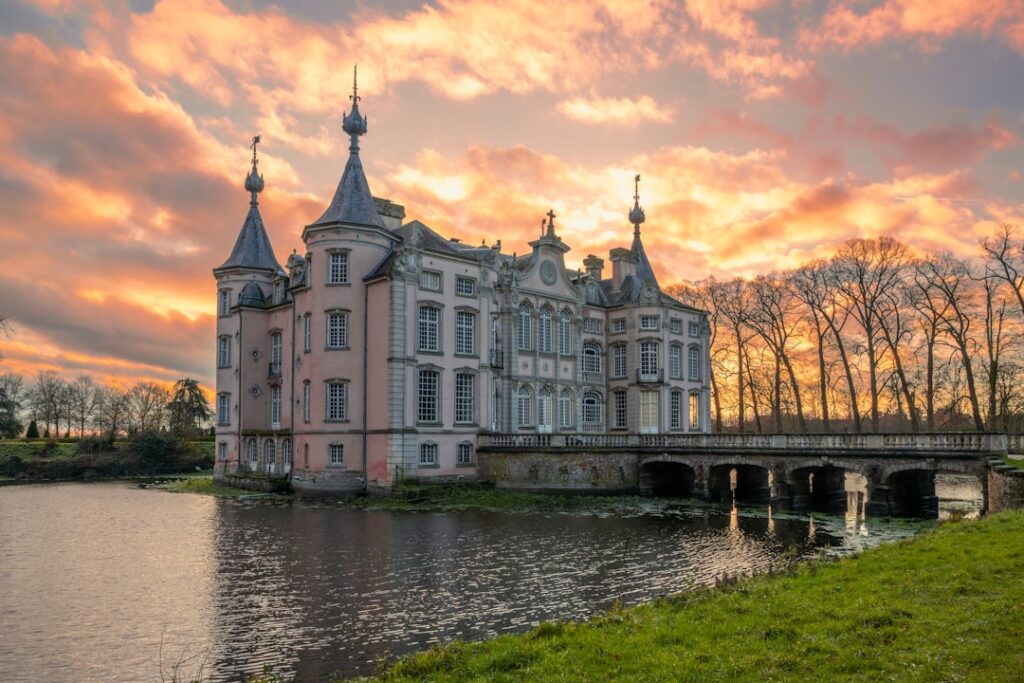
Schloss Schwerin rises from a small island in Lake Schwerin like something from a storybook. With its golden domes, slender towers, and ornate Renaissance facades reflected in the water, this palace in Mecklenburg-Vorpommern rivals any of Bavaria’s castles for sheer visual drama. Yet it remains refreshingly uncrowded, known mainly to Germans and overlooked by most international visitors rushing between Berlin and the Baltic coast.
The palace served as the seat of Mecklenburg’s dukes for centuries, and today houses the state parliament alongside a museum showcasing aristocratic life. But what makes Schwerin special isn’t just the architecture—it’s the setting, the gardens, and the quiet pleasure of discovering a world-class palace without the tour bus crowds.
A Palace Built on Water
The current palace dates primarily from the mid-1800s, when Grand Duke Friedrich Franz II commissioned a massive renovation that transformed a medieval fortress into a romantic historicist showpiece. The architect, Georg Adolph Demmler, drew inspiration from the Loire Valley châteaux, particularly Chambord, while incorporating elements of northern German Renaissance design.
The result is a building of almost excessive ornament: 653 rooms, countless turrets and towers, gleaming copper domes, and elaborate terracotta decorations. The palace sits on Schlossinsel, a tiny island connected to the city center by two bridges and to the palace gardens by a third. This island location gives Schwerin its distinctive character—you approach it across water, and it seems to float above the lake.
Inside, the museum occupies the historic state rooms. The Throne Room impresses with its neo-Renaissance splendor, while the Ancestors Gallery stretches through several rooms displaying portraits of Mecklenburg’s ruling family. The palace also claims a resident ghost, the Petermännchen, a helpful spirit said to wear 17th-century clothing and carry a ring of keys.
The Gardens: Three Styles, One Vision
The palace gardens sprawl across multiple islands and shorelines, encompassing three distinct landscapes. The Burggarten, on the palace island itself, offers intimate Baroque parterres with carefully clipped hedges and seasonal plantings. Cross the bridge to the south and you enter the Schlossgarten, a sweeping English-style landscape park designed by Peter Joseph Lenné in the 1850s.
Here, winding paths lead through mature trees, past ornamental lakes, and to perfectly positioned viewpoints framing the palace. The Cross Canal runs through the garden, lined with linden trees and crossed by delicate bridges. In summer, the lawns fill with locals picnicking and reading, treating the former ducal grounds like their own backyard.
The third garden area, the Burgsee, wraps around the eastern shore with more naturalistic plantings and excellent walking paths. Together, the gardens cover more than a square kilometer—bring comfortable shoes and leave time to explore beyond the palace itself.
Visiting Schwerin
Schwerin lies about 90 minutes east of Hamburg and two hours northwest of Berlin by regional train. The palace sits a pleasant 15-minute walk from the Hauptbahnhof through the old town’s cobbled streets, or you can take bus 10 or 11 directly to Schloss.
The palace museum opens Tuesday through Sunday from April through mid-October, with reduced winter hours. Tickets cost around €8.50 for adults. English information sheets are available at the entrance, though most signage remains in German. Plan for at least 90 minutes inside, more if you want to linger in the state rooms or climb the tower for lake views.
The gardens are free and open daily year-round. Early morning offers the best light for photography, with the rising sun illuminating the palace’s western facade. Late afternoon in summer brings golden hour perfectly timed with the warmth of the terracotta details.
Beyond the Palace
Schwerin itself deserves exploration. The Altstadt (old town) preserves half-timbered houses, a impressive Gothic cathedral, and the Mecklenburgisches Staatstheater, one of northern Germany’s finest neoclassical theaters. The market square hosts a farmers market on Tuesdays and Thursdays, ideal for assembling a picnic for the palace grounds.
Lake Schwerin invites activity: rental boats depart from landings near the palace, and a passenger ferry makes a scenic loop connecting the palace gardens with lakeside neighborhoods. In summer, swimming beaches around the lake offer a refreshing counterpoint to cultural sightseeing.
For a meal with a view, the restaurant in the palace’s former orangery serves regional Mecklenburg cuisine with outdoor seating facing the water. Alternatively, the old town has numerous cafés where you can try Mecklenburger Rippenbraten (pork ribs) or fresh fish from the Baltic coast an hour north.
Schwerin rewards slow exploration. It’s the kind of place where you arrive for the palace and stay for the atmosphere—the quiet lakeside paths, the unhurried rhythm, the satisfaction of finding beauty without having to share it with tour groups. If you’re traveling between Berlin and the Baltic coast or making a day trip from Hamburg, Schloss Schwerin offers one of northern Germany’s most enchanting palace experiences.
Want more stories from Germany’s most beautiful corners? Subscribe to the Love Germany newsletter and receive one short story a day, delivered to your inbox each morning.
Tours & experiences in Germany


Powered by Viator. Some links are affiliate links — we may earn a small commission at no extra cost to you.