
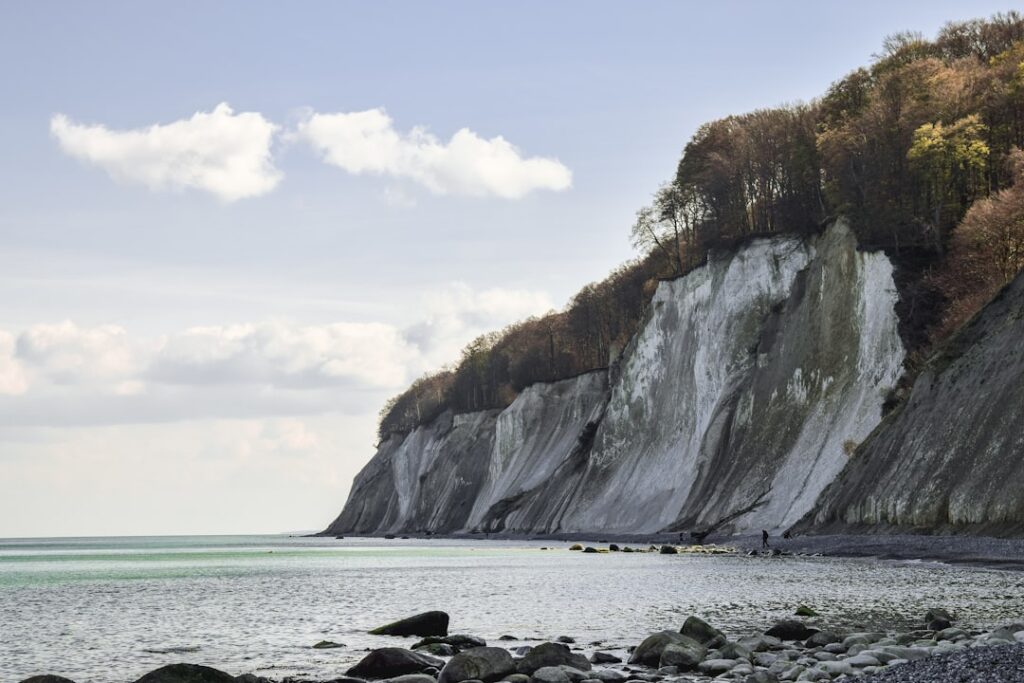

Rügen Island rises from the Baltic Sea off Germany’s northeastern coast like a natural sculpture garden, where brilliant white chalk cliffs plunge into turquoise waters and century-old beech forests tumble toward sandy beaches. This is Germany’s largest island, yet it remains refreshingly uncrowded outside peak summer weeks—a place where you can walk coastal trails in near-solitude and discover beach resorts frozen in Belle Époque elegance.
Connected to the mainland by the Rügen causeway near Stralsund, the island spans 926 square kilometers of diverse landscapes: dramatic coastal bluffs, sheltered bays, ancient forests, and the distinctive white timber resort architecture that defines the Baltic coast.
Jasmund National Park and the Königsstuhl
The icon of Rügen—and perhaps the entire German Baltic—is the Königsstuhl, or King’s Chair, a 118-meter chalk cliff that towers above the sea in Jasmund National Park. Caspar David Friedrich immortalized these cliffs in his 1818 painting Chalk Cliffs on Rügen, and the view remains as breathtaking today.
The Hochuferweg cliff-top trail runs 10 kilometers from Sassnitz to Lohme, threading through UNESCO-protected beech forests before emerging at viewpoints where the white cliffs contrast dramatically with the deep blue Baltic. Start early in the morning to beat the tour groups, and wear sturdy shoes—the trail includes steep wooden staircases and can be muddy after rain.
The Königsstuhl Visitor Center charges a modest admission fee and offers the safest viewing platform. For a more intimate experience, walk 500 meters north to the Victoria-Sicht viewpoint, where a smaller platform provides equally stunning vistas without the crowds.
Below the cliffs, you can walk the narrow beach at low tide, collecting fossils and amber among the chalk stones. Check tide times before descending—the beach disappears at high tide.
Binz and the Baltic Beach Resorts
Rügen’s south coast is lined with Seebäder—seaside resorts that flourished in the late 19th century when Baltic bathing became fashionable among German aristocracy and wealthy Berliners. Binz is the largest and most elegant, its seafront promenade lined with meticulously restored Bäderarchitektur: white wooden villas with ornate balconies, turrets, and gingerbread trim.
The town’s pier stretches 370 meters into the Baltic and hosts regular passenger ferries to Sassnitz and other coastal towns. Behind the beach, Hauptstraße offers boutiques, seafood restaurants, and cafés serving Sanddornsaft—sea buckthorn juice, a tangy local specialty rich in vitamin C.
Neighboring Sellin boasts an even more photogenic pier, rebuilt in 1998 to match its 1906 predecessor, complete with a two-story restaurant pavilion. The town sits atop coastal bluffs, connected to the beach by a historic wooden staircase.
For a quieter experience, head to Göhren on the eastern peninsula, where beaches stretch wider and the atmosphere feels more family-oriented than fashionable.
Cape Arkona and Rügen’s Northern Tip
Germany’s northernmost point (excluding the offshore islands) sits at Cape Arkona, where two lighthouses stand beside the remains of a Slavic temple fortress. The older Schinkel Tower, designed by Karl Friedrich Schinkel in 1827, now houses a small museum. Its companion lighthouse, built in 1902, still guides Baltic shipping.
Between them lie the earthwork remains of Jaromarsburg, a sacred site of the Slavic Rani tribe destroyed by Danish forces in 1168. Information panels explain the archaeological discoveries, including evidence of a massive wooden temple to the god Svantovit.
The cape’s dramatic 45-meter cliffs are gradually eroding—the Baltic claims several meters each decade—giving the landscape an edge-of-the-world atmosphere. A coastal path leads east to the fishing village of Vitt, tucked into a small valley, where thatched-roof cottages and a tiny octagonal chapel seem unchanged since the 19th century.
Cars are banned from the cape itself; park in Putgarten village and walk the final kilometer, or take a horse-drawn carriage along the cobbled road.
Practical Information for Visiting Rügen
Rügen is accessible by train from Berlin via Stralsund (approximately 3.5 hours), or by car across the causeway. The island has an excellent narrow-gauge steam railway, the Rasender Roland, which chugs between Putbus and Göhren, stopping at the major beach resorts—a delightful way to tour the southeast coast.
Visit between May and September for beach weather and long Baltic daylight. June offers the best balance of mild temperatures and fewer crowds than July and August. September brings autumn colors to the beech forests and still-pleasant swimming temperatures.
The island can feel busy during German school holidays, but you’ll find solitude year-round on the trails through Jasmund or along the western Bodden coast, where shallow lagoons attract migrating birds.
For dining, seek out restaurants serving fresh Baltic herring and Bismarckhering (marinated herring), along with seasonal game from Rügen’s forests. The island’s microbreweries produce excellent craft beers to accompany seafood platters.
Whether you’re hiking the chalk cliffs, lounging in a Strandkorb beach chair, or exploring fishing villages, Rügen reveals a side of Germany far removed from Alpine peaks and Rhine castles—a place where the Baltic shapes everything from architecture to daily life. Subscribe to the Love Germany newsletter for one short story about Germany’s hidden corners delivered to your inbox each day.
Tours & experiences in Germany


Powered by Viator. Some links are affiliate links — we may earn a small commission at no extra cost to you.