
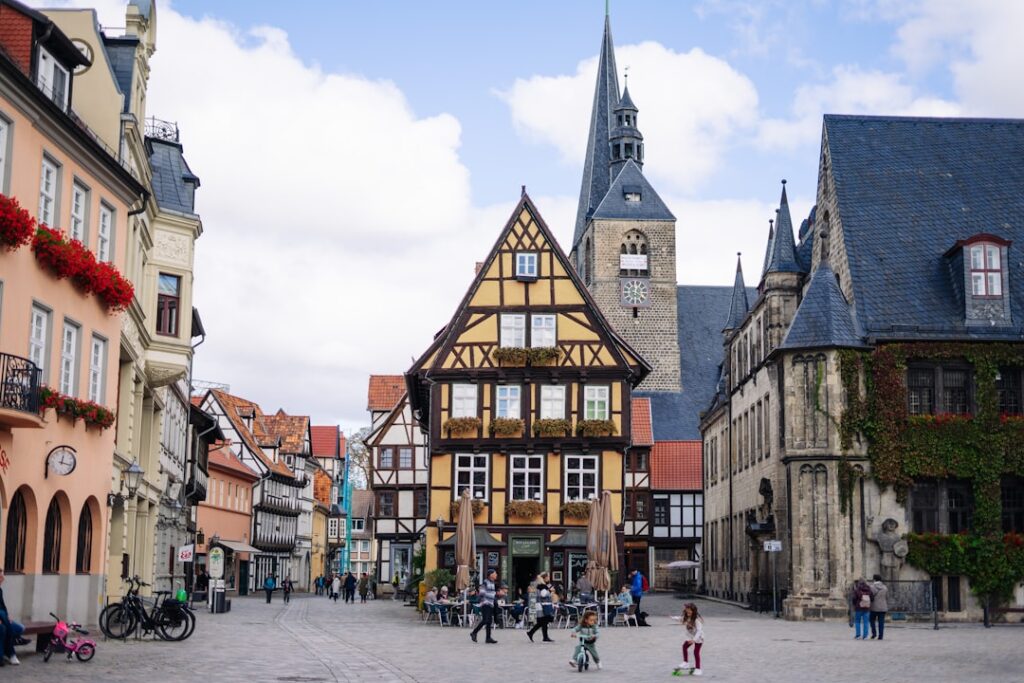
Tucked into the northern foothills of the Harz Mountains, Quedlinburg is one of Germany‘s most spectacular medieval towns—and somehow, it remains blissfully under the radar. With more than 1,300 half-timbered houses spanning six centuries, this UNESCO World Heritage Site offers an architectural journey through time that rivals Rothenburg but without the crowds.
The town’s origins stretch back to 922 when King Heinrich I established a royal residence here. Today, walking its cobblestone lanes feels like wandering through an open-air museum where every corner reveals another impossibly picturesque façade.
The Old Town: Six Centuries of Half-Timbered Architecture
Quedlinburg’s Altstadt is a masterclass in Fachwerk (half-timbered) construction. Unlike many German towns rebuilt after World War II, Quedlinburg survived virtually unscathed, preserving buildings from the 14th through 19th centuries in their original form.
Start at the Marktplatz, where the Renaissance-era Rathaus (town hall) stands surrounded by gabled merchants’ houses. The statue of Roland in front symbolizes the town’s medieval trading rights. From here, wander down Breite Strasse and Wordgasse, where houses lean at gentle angles, their wooden beams carved with everything from biblical scenes to cheeky folk sayings.
Don’t miss the Ständerbau at Wordgasse 3, built around 1310—it’s one of Germany’s oldest half-timbered houses still standing. The Klopstockhaus on Schlossberg 12, birthplace of poet Friedrich Gottlieb Klopstock, showcases typical 16th-century townhouse architecture and now operates as a small museum.
For the best overview of this architectural wonderland, climb Münzenberg hill. The abandoned St. Marien convent church at the summit offers panoramic views across the sea of terracotta roofs and timber frames.
The Castle Hill and Abbey Church
Looming above the town, Quedlinburg’s Schlossberg (Castle Hill) has been a seat of power for over a millennium. The crown jewel here is the Stiftskirche St. Servatius, a Romanesque basilica that served as the burial place of King Heinrich I and his wife, Queen Mathilde.
The church’s treasury holds stunning medieval artifacts, including 10th-century reliquaries and illuminated manuscripts. The crypt, with its massive stone pillars and vaulted ceiling, is particularly atmospheric—this is where Heinrich I was originally laid to rest.
Adjacent to the church, the Renaissance-era castle now houses a museum exploring the town’s history from its royal beginnings through its time as a powerful member of the Hanseatic League.
The climb up Schlossberg takes about ten minutes from the Marktplatz via steep cobbled lanes, but the views and the weight of history make every step worthwhile.
Best Time to Visit and Practical Tips
Quedlinburg shines in late spring and early autumn when the weather is mild and day-trippers from Berlin are fewer. The town hosts an Advent market in early December that transforms the Marktplatz into a cozy Christmas village, complete with mulled wine and local crafts—far more intimate than the massive markets in larger cities.
The town is easily reached by train from Berlin (about 2.5 hours with one change in Magdeburg) or Hanover (around 2 hours). It also makes an excellent base for exploring the Harz Mountains, with hiking trails and the narrow-gauge steam railway to the Brocken summit just a short drive away.
Quedlinburg is small enough to explore thoroughly in a day, but consider staying overnight at one of the historic guesthouses tucked into those ancient half-timbered buildings. Waking up to medieval lanes without a tour bus in sight is an experience worth having.
The tourist information office on Markt 4 offers guided walking tours in German and English during the summer months. Otherwise, simply getting lost in the tangle of narrow streets is the best way to appreciate this living monument to German craftsmanship.
Where to Eat and Drink
Quedlinburg’s dining scene celebrates both Harz Mountain traditions and Saxony-Anhalt specialties. Try Harzer Käse, a pungent sour-milk cheese typically served with onions and caraway seeds, or hearty Harzer Schmorwurst, a slowly braised sausage.
Brauhaus Lüdde on Blasiikirchof serves locally brewed Püffken beer in a 400-year-old timber-frame building. The atmosphere alone—low beamed ceilings, creaking floors—is worth the visit, but the Schnitzel and seasonal game dishes are excellent too.
For coffee and cake, head to Café & Pension am Finkenherd, where the Baumkuchen (a traditional layered cake cooked on a rotating spit) pairs perfectly with views over the rooftops toward the castle.
Quedlinburg proves that Germany’s most enchanting destinations aren’t always the ones in every guidebook. This is a town for travelers who want to experience medieval Germany as it actually was—beautifully preserved, deeply authentic, and refreshingly uncrowded.
Want more insider tips on Germany’s hidden gems and classic destinations? Subscribe to the Love Germany newsletter and get one short story a day, exploring the country beyond the guidebooks.
Tours & experiences in Germany


Powered by Viator. Some links are affiliate links — we may earn a small commission at no extra cost to you.