
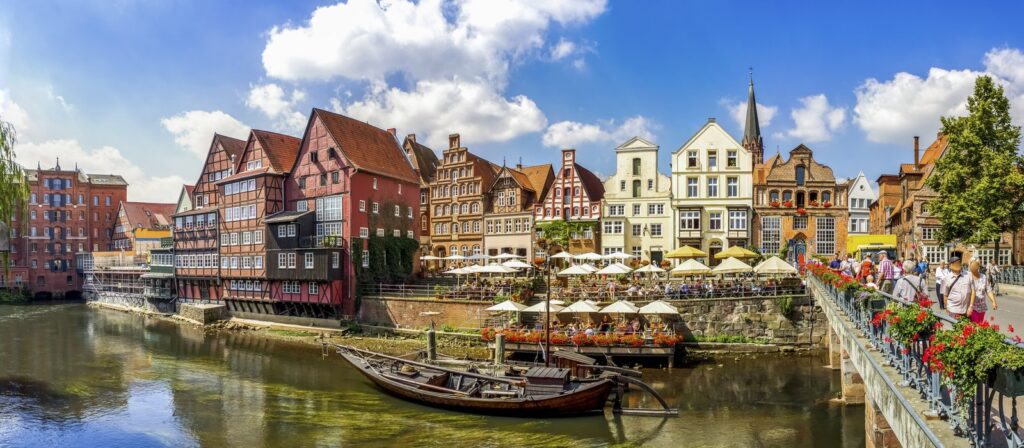
Lüneburg sits on a geological anomaly: a salt dome that humans have been mining since the 10th century. The wealth that came out of the ground built one of northern Germany’s most intact medieval townscapes, complete with leaning buildings, stepped gables, and churches that show off what Hanseatic merchants could afford when the money was rolling in. Today, the salt is gone, the mines are museums, and the town belongs to students, shoppers, and travelers looking for brick Gothic architecture without the crowds of Lübeck or Hamburg.
The Am Sande Square and the Rathaus
The heart of Lüneburg is Am Sande, a wide, slightly sloping square lined with gabled houses in shades of red, white, and ochre. The south end is anchored by the Rathaus, a Gothic and Renaissance pile that has been the seat of government since the 13th century. Inside, the Große Ratsstube is a council chamber paneled in oak and painted with allegories of justice and virtue. The Rathaus offers guided tours that take you through rooms most visitors never see, including the Fürstensaal and the vaulted Gerichtslaube. Check the official site for schedules and booking.
Across the square, the Johann-Sebastian-Bach-Platz leads to St. Johanniskirche, a brick basilica with a tower that leans more than five feet off vertical. The tilt is a result of centuries of underground salt mining, which hollowed out pockets beneath the old town and caused buildings to shift and settle. Inside, the church holds a baroque organ that Bach himself examined in 1720, and the altar is flanked by 14th-century stained glass.
The Deutsches Salzmuseum
Lüneburg’s salt made it rich, and the Deutsches Salzmuseum tells the story. Housed in a former salt warehouse near the Ilmenau River, the museum walks you through a thousand years of extraction, trade, and taxation. You’ll see the wooden machinery that lifted brine from deep wells, the pans where it was boiled down to crystals, and the contracts that governed its sale across northern Europe. The museum also explains why so many of Lüneburg’s buildings lean: the underground cavities left by salt mining caused subsidence across the old town, and some streets still show a noticeable slope.
The museum’s outdoor section includes a reconstructed graduation tower, a timber-framed structure where brine was sprayed over bundles of blackthorn to increase salinity through evaporation. It’s a piece of industrial archaeology that once defined the town’s skyline.
The Old Harbor and the Lüne Abbey
A ten-minute walk south along the Ilmenau brings you to the Alter Hafen, a small harbor where barges once loaded salt for shipment to the Baltic. The crane and warehouses are still standing, now converted to apartments and a brewery. The waterfront path continues south to the Kloster Lüne, a Benedictine convent founded in 1172 and still home to an active religious community. The cloister is open for guided tours that show off medieval frescoes, Gothic woodwork, and a collection of textiles embroidered by nuns over six centuries. The tapestries are some of the finest examples of needlework in northern Germany.
Back in the old town, the streets between Am Sande and the river are lined with half-timbered houses, many of them dating to the 15th and 16th centuries. The lanes around the Kalkberg, a chalk hill at the northern edge of the old town, are especially well preserved. The hill itself was quarried for lime, and what’s left is a park with views over the rooftops.
Getting There and When to Visit
Lüneburg is 50 kilometers south of Hamburg, with direct regional trains from Hamburg Hauptbahnhof taking about 30 minutes. The station is a 15-minute walk from Am Sande, or you can take a local bus. If you’re driving, the A39 and A250 connect Lüneburg to the autobahn network, and parking is available at the edge of the old town.
The town is open year-round, but spring and early summer are ideal for walking along the Ilmenau and exploring the Lüneburger Heide, which blooms purple with heather in August and September. The Christmas market fills Am Sande in December, and the Rathaus lights up after dark.
Lüneburg is compact enough to see in a day, but an overnight stay lets you take in the evening light on the brick facades and have dinner at one of the student-friendly restaurants around the university quarter. We send one short story a day about places like this. Subscribe to the Love Germany newsletter and get the country’s best travel writing in your inbox every morning.
Tours & experiences in Germany


Powered by Viator. Some links are affiliate links — we may earn a small commission at no extra cost to you.