
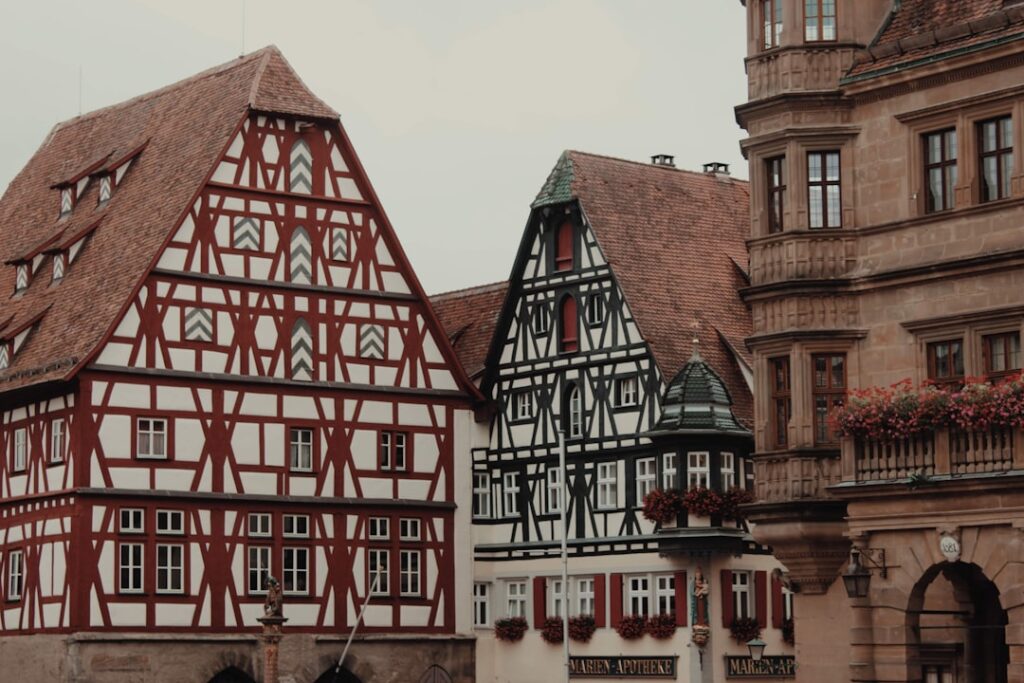
Germany has more than two million Fachwerkhäuser—half-timbered buildings—scattered across the country, many dating back four or five centuries. These structures, with their exposed oak frames filled with wattle-and-daub or brick, define entire town centers from Celle in the north to Miltenberg in Bavaria. They’re not just pretty facades. They’re engineered masterpieces that have survived wars, fires, and floods.
If you want to see the finest timber-frame architecture in Germany, you need to know where to look and what you’re actually seeing. This guide will help you do both.
The Deutsche Fachwerkstraße: Germany’s Timber-Frame Road
The German Timber-Frame Road (Deutsche Fachwerkstraße) is a 1,800-mile network of scenic routes connecting more than a hundred historic towns across seven German states. It’s divided into regional sections, each with its own character.
The Lower Saxon route runs from the Elbe to the Weser, passing through Stade, Celle, and Einbeck. Celle alone has more than 400 timber-frame houses, including the stunning Hoppener Haus from 1532 with its intricate carved beams. Einbeck, famous for its strong bock beer, has over 120 painted facades that once advertised the wealth of medieval brewers.
In Hesse and Thuringia, the route takes you through Alsfeld, where the town hall looks like an illustration from a fairy tale, and Schmalkalden, where Martin Luther once debated. The Franconian section includes gems like Kronach and Bad Windsheim, home to an entire open-air museum of relocated timber-frame buildings.
You don’t need to drive the entire route. Pick a region that interests you and spend two or three days exploring by car or regional train. The towns are compact and walkable once you arrive.
Reading the Beams: What the Patterns Tell You
Not all timber framing looks the same. The patterns and construction techniques vary by region and century, and once you know what to look for, you can start to date buildings just by their facades.
The Alemannic style, common in Baden-Württemberg and southern Hesse, features long diagonal braces and minimal decoration. The Franconian style uses closely spaced vertical posts with decorative Andreaskreuze (St. Andrew’s crosses) and carved corner posts called Mannfiguren—literally “man figures.” In Lower Saxony, you’ll see Niederdeutsches Hallenhaus designs, where the entire structure—living quarters, barn, and storage—sits under one massive roof.
Colors matter too. In Alsfeld and parts of Hesse, buildings are painted in bright reds, greens, and blues. In Franconia, white plaster between dark beams is traditional. Some towns, like Miltenberg on the Main River, mix both styles along a single street.
Look for carved beam ends and inscriptions. Many builders signed their work with dates, biblical verses, or proverbs. One favorite, found throughout Germany: “Alle Ding’ mit Maß und Ziel”—”All things in measure and moderation.”
Five Towns Worth the Detour
Quedlinburg, a UNESCO World Heritage site in Saxony-Anhalt, has more than 1,300 timber-frame houses spanning six centuries. Walk up the cobbled Schlossberg to the Romanesque abbey church, then wander the Altstadt to see buildings from every era of German construction.
Miltenberg on the Main River is often called the “Pearl of the Main Valley.” The market square is anchored by the 1590 Marktplatz fountain and surrounded by leaning, crooked houses that somehow still stand. The Hotel zum Riesen claims to be Germany’s oldest inn, with a guest book dating to 1411.
Limburg an der Lahn combines timber framing with a stunning hilltop cathedral. The old town cascades down toward the Lahn River in layers of multicolored facades. It’s an easy day trip from Frankfurt, less than an hour by regional train.
Goslar, another UNESCO town at the edge of the Harz Mountains, mixes timber with stone and slate. The Brusttuch, a 1526 guildhall, and the Kaiserworth, a former merchant house, are among the most photographed buildings in northern Germany.
Rothenburg ob der Tauber is the most visited timber-frame town in Germany for good reason. Yes, it’s touristy, but the walls, towers, and Plönlein—the famous fork in the road—are genuinely spectacular. Visit early in the morning or late in the afternoon to avoid the crowds.
Practical Tips for Visiting
Most timber-frame towns are small, so parking in town centers is limited and often restricted to residents. Use the Parkplatz signs directing you to lots on the outskirts, usually within a five-minute walk of the old town.
If you’re traveling by train, regional lines serve nearly all of these towns. The Deutsche Bahn regional day passes (Länder-Tickets) are excellent value if you’re exploring several towns in one state.
Spring and fall are the best seasons. Towns are quieter than in summer, and the light is ideal for photography. Many towns host Christmas markets in December, which transform the half-timbered market squares into something out of a medieval painting.
Wear comfortable shoes. Cobblestones and uneven streets are charming but unforgiving.
Germany’s timber-frame towns aren’t just relics. They’re living communities where people still cook dinner, run bakeries, and hang laundry in buildings that have stood for half a millennium. Take your time, look up, and notice the details. Subscribe to the Love Germany newsletter for one short story a day about the places, traditions, and tastes that make Germany unforgettable.
Tours & experiences in Germany


Powered by Viator. Some links are affiliate links — we may earn a small commission at no extra cost to you.