
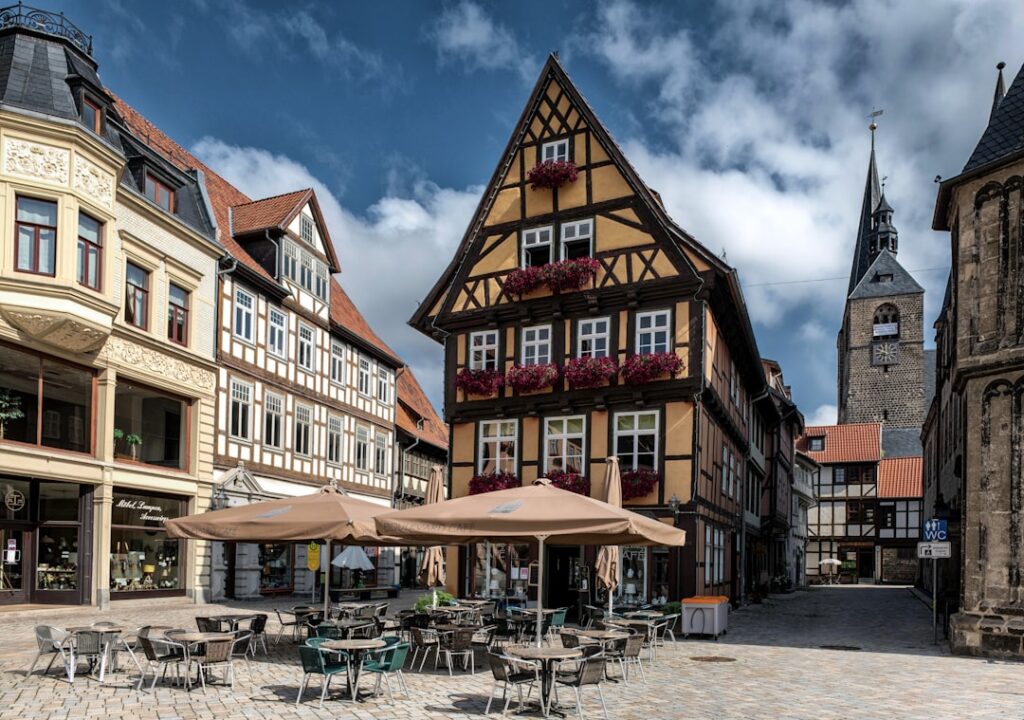
Quedlinburg sits at the northern edge of the Harz Mountains like a medieval town that simply refused to modernize. With more than 2,000 timber-frame houses—one of the largest concentrations in Germany—and a UNESCO World Heritage designation that recognizes its thousand-year history, this Saxony-Anhalt gem makes an unforgettable day trip from Berlin, Leipzig, or anywhere in the Harz region.
Unlike Rothenburg or other heavily touristed towns, Quedlinburg retains an authentic, lived-in quality. Locals still occupy the crooked houses. The cobblestones are uneven and genuine. And on a quiet morning in the Altstadt, you might have entire streets to yourself.
The Castle Hill and Stiftskirche
Start at the Schlossberg, the castle hill that towers over the old town. This is where Henry I, the first Saxon king of Germany, established a royal residence in the 10th century. His widow, Queen Mathilde, founded a convent here that became one of the most powerful religious institutions in medieval Germany.
The Romanesque Stiftskirche St. Servatius, built between 1070 and 1129, dominates the hilltop. Inside, the church treasury holds some of the finest liturgical artifacts in Germany, including the 10th-century Servatius reliquary and illuminated manuscripts that once belonged to the abbesses who ruled Quedlinburg for centuries. The crypt, with its cushion capitals and vaulted ceiling, is pure Romanesque beauty.
From the terrace beside the church, you get sweeping views over the tile roofs of the old town, the surrounding Harz foothills, and—on clear days—the Brocken, the highest peak in northern Germany.
Wandering the Old Town’s Timber-Frame Streets
Descend from the castle hill into the Altstadt, and you’re walking through eight centuries of German building history. The oldest surviving timber-frame house in Germany stands at Wordgasse 3—built around 1310, its oak beams have weathered more than 700 winters.
Stroll down Breite Strasse, the main thoroughfare, where Renaissance merchant houses lean companionably against their neighbors. Turn into Pölkenstrasse or Schuhof, and the streets narrow to lanes barely wide enough for a single car. Every corner reveals another carved beam, another painted facade, another ironwork sign hanging above a doorway.
The Finkenherd, a small square south of the castle hill, clusters some of the town’s finest houses around a Renaissance well. In summer, the outdoor cafes here are perfect for a coffee break surrounded by gables and geraniums.
The Market Square and Rathaus
Quedlinburg’s Marktplatz has been the town’s commercial heart since the Middle Ages. The Renaissance Rathaus, built in the 1610s, presides over the square with its ornate facade and Roland statue—a symbol of market rights and civic independence.
On the square’s eastern side, the gilt statue of Roland stands nearly eight meters tall, one of the finest examples of this peculiarly German monument type. Market days—Wednesday and Saturday mornings—bring farmers from the surrounding Harz villages with vegetables, honey, and Harzer cheese, the pungent regional specialty.
Duck into the Marktkirche St. Benedikti if it’s open. This Gothic hall church replaced an earlier Romanesque basilica, and its twin towers frame views down nearly every street in the old town.
Practical Details
Quedlinburg sits about 60 kilometers southwest of Magdeburg and 75 kilometers from Halle. By train, it’s roughly two hours from Berlin (with one change, usually in Magdeburg) and 90 minutes from Leipzig. The station is a 15-minute walk from the Altstadt, or you can catch a local bus.
Park outside the old town if you’re driving—the historic center is largely pedestrianized, and the narrow lanes aren’t kind to modern cars. The parking area near the castle hill (Schlossberg Parkplatz) is your best bet.
Budget three to four hours minimum to see the castle hill, wander the streets, and have lunch. A full day allows time for the town museums—the Klopstock Museum (birthplace of the 18th-century poet) or the Fachwerkmuseum Ständerbau, which explains timber-frame construction inside a 14th-century house.
Spring and fall are ideal for visiting. Summer brings tour groups, especially on weekends. Winter, particularly during Advent, transforms Quedlinburg into a Christmas-card scene, with markets on the Marktplatz and the Schlossberg lit by candlelight.
Where to Eat
For lunch, head to Brauhaus Lüdde on Blasiistrasse, where they’ve been brewing since 1807. The Harzer Schnitzel—a local variation topped with fried egg and anchovies—pairs well with their unfiltered Pilsner. Alternatively, Café & Restaurant Vincent on Markt offers lighter fare with outdoor seating facing the Roland statue.
If you’re making a longer visit, the town has several small hotels and guesthouses within restored timber-frame buildings—sleeping under 400-year-old beams adds to the experience.
Quedlinburg doesn’t shout for attention. It simply exists, beautifully preserved, quietly confident in its centuries of history. For travelers who want Germany beyond the obvious highlights, it’s exactly the kind of discovery that stays with you long after you’ve left the crooked streets behind.
Want more Germany stories like this? Subscribe to the Love Germany newsletter and get one short story about Germany delivered to your inbox every day—the towns, tastes, and traditions that make this country unforgettable.
Tours & experiences in Germany


Powered by Viator. Some links are affiliate links — we may earn a small commission at no extra cost to you.