
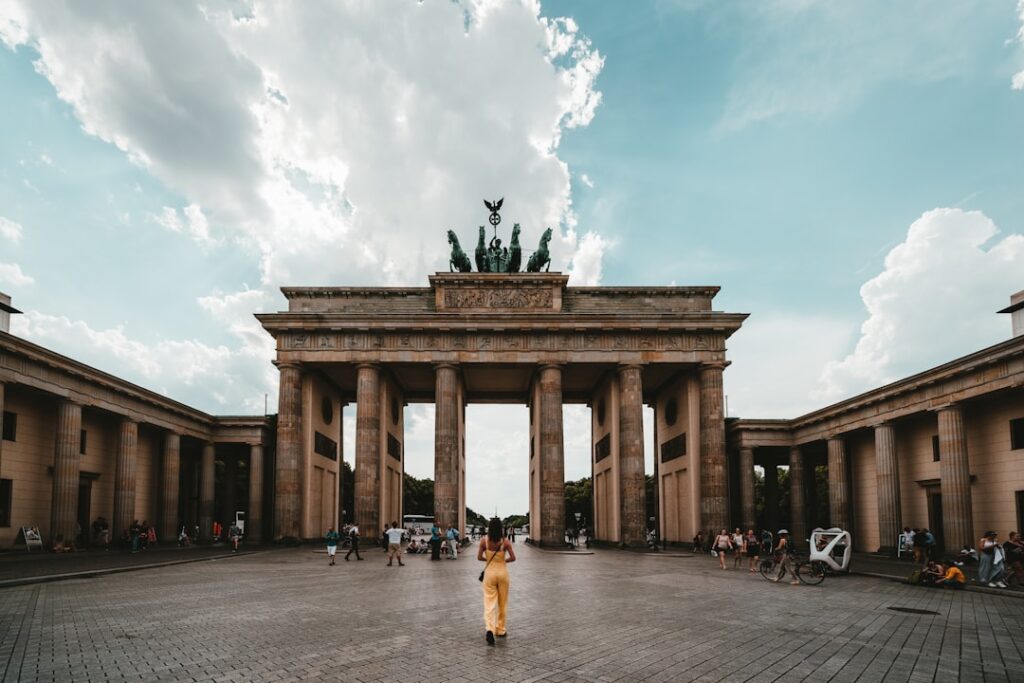
Standing majestically at the western end of Unter den Linden boulevard, the Brandenburg Gate is more than just Berlin’s most recognizable landmark—it’s a powerful symbol of Germany’s tumultuous past and hopeful future. This neoclassical triumphal arch has witnessed Napoleon’s armies, Nazi rallies, the Cold War’s division of a city, and the jubilant celebrations of reunification. Today, it stands as an enduring icon of peace, unity, and the resilience of the human spirit.
Built between 1788 and 1791 by architect Carl Gotthard Langhans for King Frederick William II of Prussia, the Brandenburg Gate was inspired by the Propylaea, the monumental gateway to the Acropolis in Athens. The sandstone structure rises 26 meters high and features twelve Doric columns that create five passageways. Crowning the gate is the Quadriga, a magnificent sculpture of the goddess of victory driving a four-horse chariot, created by Johann Gottfried Schadow. This copper statue has its own dramatic history—Napoleon carted it off to Paris as war booty in 1806, only for it to be triumphantly returned to Berlin in 1814.
A Monument That Witnessed History
Few structures have stood at the crossroads of history quite like the Brandenburg Gate. During the Cold War, when the Berlin Wall snaked through the city from 1961 to 1989, the gate found itself stranded in the forbidden zone, inaccessible from either East or West Berlin. It became a poignant symbol of a divided nation, visible but unreachable. When the Wall finally fell on November 9, 1989, more than 100,000 people gathered at the Brandenburg Gate in scenes of jubilation broadcast around the world. Today, the gate stands in the reunified city as a testament to freedom and democracy.
The area immediately surrounding the Brandenburg Gate, Pariser Platz, has been meticulously reconstructed to echo its pre-war elegance. The square is now flanked by embassies, the luxurious Hotel Adlon Kempinski (where Michael Jackson famously dangled his baby from a balcony), and the Academy of Arts. This careful restoration allows visitors to experience the grandeur that once defined imperial Berlin.
What to See and Do
The Brandenburg Gate is best experienced on foot. Walk through the central archway—once reserved exclusively for royalty—and take time to appreciate the Quadriga from different angles. The sculpture’s details are remarkable, from the flowing robes of Victoria to the powerful musculature of the horses. Visit both during the day and after dark, when dramatic lighting transforms the honey-colored sandstone into a glowing beacon.
Just south of the gate lies the sobering Memorial to the Murdered Jews of Europe, designed by architect Peter Eisenman. This field of 2,711 concrete stelae creates a disorienting, wave-like landscape that powerfully commemorates the six million Jewish victims of the Holocaust. The underground information center provides essential historical context and should not be missed.
To the north, you’ll find the Reichstag Building with its stunning glass dome designed by Norman Foster. Free tours are available, but advance registration is essential—book several weeks ahead through the Bundestag website. The 360-degree views from the dome’s spiral walkway are exceptional, and the audioguide explains both the building’s architecture and the surrounding cityscape.
The Tiergarten, Berlin’s vast central park, extends westward from the gate. This former royal hunting ground offers 520 acres of walking paths, beer gardens, and meadows—perfect for a relaxing stroll after sightseeing. The Victory Column (Siegessäule) stands in the park’s center, offering another excellent viewpoint over the city.
Getting There and Practical Information
The Brandenburg Gate is extraordinarily accessible. The U-Bahn station Brandenburger Tor (U5 line) deposits you directly at Pariser Platz. Alternatively, the S-Bahn station Brandenburger Tor (S1, S2, S25, and S26 lines) is just a short walk away. Multiple bus lines also stop nearby, including the 100 and 200, which are regular buses that double as inexpensive sightseeing routes through Berlin’s center.
The monument itself is free to visit and accessible 24 hours a day, every day of the year. There’s no admission fee, no tickets required, and no queues to navigate—you can simply walk up and experience it. The Room of Silence, located in the northern guardhouse, offers a quiet space for reflection away from the crowds.
The best times to visit depend on what you’re seeking. Early morning, particularly on weekdays, offers the most peaceful experience with fewer tour groups. Late afternoon provides beautiful lighting for photographs, especially in the golden hour before sunset. For a different perspective, visit at night when the gate is illuminated and crowds have thinned.
Insider Tips
While the Brandenburg Gate draws visitors year-round, certain times offer special experiences. New Year’s Eve transforms the area into one of Europe’s largest outdoor parties, with over one million people gathering for celebrations along the “Party Mile” from the Brandenburg Gate to the Victory Column. Summer brings outdoor concerts and cultural events to Pariser Platz.
For the best photographs, position yourself slightly to the east along Unter den Linden boulevard, where you can capture the gate with minimal crowds in your frame. Professional photographers favor the early morning light from the eastern side and the sunset glow from the west.
Combine your visit with a walking tour of Berlin’s historic center. Many excellent free walking tours depart from Pariser Platz daily—these provide invaluable context about the gate’s history and the surrounding area. Just remember to tip your guide appropriately at the tour’s conclusion.
The Brandenburg Gate isn’t just a monument to observe from a distance—it’s a living part of Berlin’s urban fabric. Walk through it, touch its columns, sit on the steps of the Memorial to the Murdered Jews of Europe, and reflect on the weight of history this place carries. In doing so, you’ll understand why this neoclassical gateway remains the symbolic heart of not just Berlin, but all of Germany.
Tours & experiences in Germany


Powered by Viator. Some links are affiliate links — we may earn a small commission at no extra cost to you.