
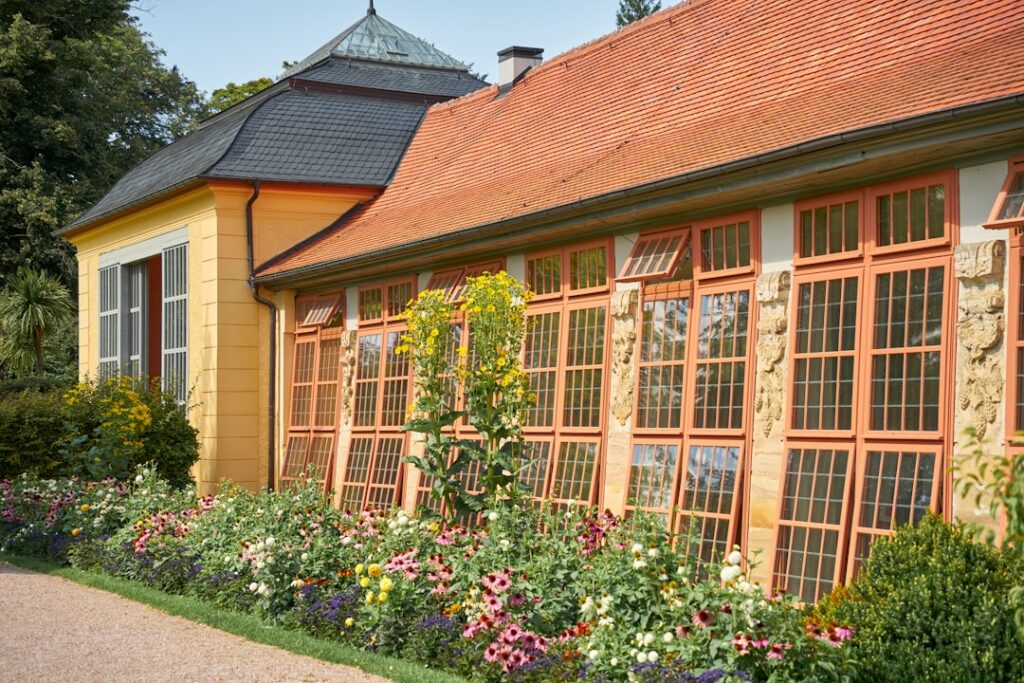
Weimar feels like a secret the rest of Germany has been keeping. With just 65,000 residents, this Thuringian city has shaped European thought more than most capitals. Goethe lived here for 50 years. Schiller wrote his greatest plays here. The Bauhaus movement was born within these streets. And somehow, Weimar remains refreshingly free of tour-bus chaos.
You can walk across the historic center in twenty minutes, yet you could spend days exploring its layered cultural legacy. This is where German Classicism reached its peak, where the doomed Weimar Republic took its name, and where modernist design changed the world.
Goethe’s Weimar: A Literary Pilgrimage
Start at Goethe’s Residence on Frauenplan, where Germany’s greatest writer lived from 1782 until his death in 1832. The house feels remarkably intimate—his study desk still holds his geological specimens, his library contains 5,400 volumes, and you can stand in the exact room where he completed Faust. The yellow drawing room, where he received guests, captures the essence of Enlightenment conversation culture.
Walk ten minutes north to Goethe’s Garden House in Park an der Ilm, his first Weimar residence and creative refuge. This modest cottage beside the Ilm River is where he wrote early versions of Iphigenie and countless poems. The park itself, which Goethe helped design, stretches along the river for two kilometers—perfect for an afternoon stroll through landscaped nature that bridges the formal and the wild.
Schiller’s House on Schillerstraße is smaller but equally moving. He lived here only three years before his death in 1805, writing Wilhelm Tell and finishing Demetrius in the upstairs study. The desk faces away from the window—Schiller preferred to write without distraction.
The Bauhaus Legacy
In 1919, architect Walter Gropius founded the Bauhaus school in Weimar, merging fine arts and crafts into a revolutionary design philosophy. The Bauhaus Museum Weimar, opened in 2019, displays the world’s oldest Bauhaus collection: Marcel Breuer’s tubular steel furniture, Marianne Brandt’s metal teapots, and Paul Klee’s teaching materials. The building itself—a concrete and glass cube—embodies Bauhaus principles of form following function.
The original Bauhaus University main building on Geschwister-Scholl-Straße still operates as an art school. You can visit the former workshops where students experimented with typography, textiles, and metalwork that would define 20th-century aesthetics. The Haus am Horn, built in 1923 as the Bauhaus model house, shows how the movement translated theory into livable space—fitted kitchen, built-in storage, geometric simplicity.
Beyond the Famous Names
Weimar’s cultural wealth extends beyond Goethe and Bauhaus. The Herzogin Anna Amalia Bibliothek, a Rococo marvel rebuilt after a devastating 2004 fire, houses 1 million volumes in rooms that look like Baroque jewel boxes. The oval Rococo Hall, added in 1766, ranks among Europe’s most beautiful libraries. Book your timed entry ticket weeks ahead—only 290 visitors are admitted daily.
The Stadtschloss (City Palace) combines Renaissance and Neo-Classical elements, its galleries displaying works by Cranach the Elder and contemporary German art. Don’t miss the view from the Bastille terrace over the Ilm Valley.
For a break from highbrow culture, the Marktplatz offers street-level Weimar: the Neo-Gothic town hall, the reconstructed Cranachhaus where the painter lived, and cafes where you can watch daily life unfold. The Saturday morning market brings regional produce, Thuringian sausages, and flower vendors.
Practical Details
Weimar sits on the main rail line between Frankfurt and Berlin, with direct ICE connections taking two hours from Berlin, 2.5 hours from Frankfurt, and 15 minutes from Erfurt. The compact Altstadt is entirely walkable, though the city offers a good bus network if you’re visiting sites like Belvedere Palace on the outskirts.
Spring and early autumn bring the best weather and thinner crowds than summer. The Onion Market festival in October draws huge crowds—book accommodation far ahead if visiting then. Many museums close Mondays.
The Weimar Card (€36 for 48 hours) covers public transport and admission to major sites including both Goethe houses, Schiller’s House, and the Bauhaus Museum. If you’re visiting four or more attractions, it pays for itself.
Weimar repays slow travel. Stay at least two nights to avoid rushing between sites, and leave time to simply sit in Park an der Ilm or a Marktplatz cafe. This is a city best absorbed at the pace of an evening conversation in Goethe’s drawing room—thoughtfully, and without hurry.
Want more stories from Germany’s cultural heart? Subscribe to the Love Germany newsletter and get one short story delivered daily—the Germany beyond the guidebooks, straight to your inbox.
Tours & experiences in Germany


Powered by Viator. Some links are affiliate links — we may earn a small commission at no extra cost to you.