
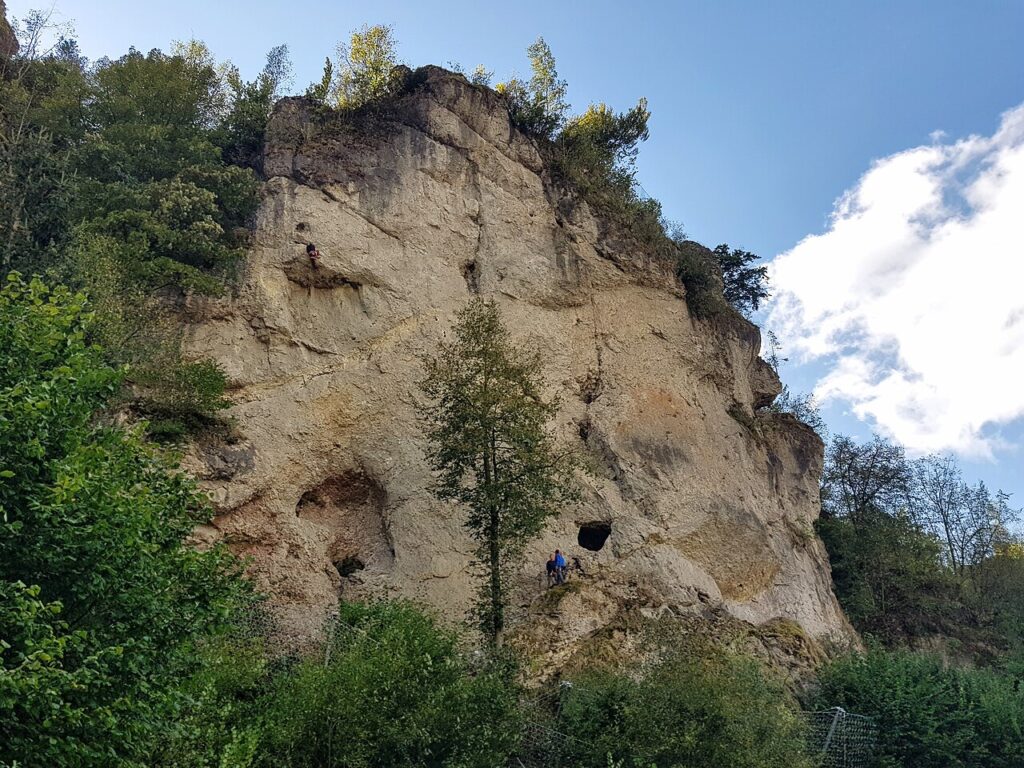
Tucked into northern Bavaria between Nuremberg, Bamberg, and Bayreuth, Franconian Switzerland (Fränkische Schweiz) is one of Germany’s most underrated outdoor playgrounds. Despite its name, there are no snow-capped peaks here—just dramatic limestone karst formations, over a thousand caves, medieval castle ruins perched on cliffs, and some of the best rock climbing in Central Europe. It’s a region that combines serious adventure with quiet Franconian villages, family-run breweries, and hiking trails that feel worlds away from Bavaria’s tourist circuit.
Why It’s Called Switzerland (And Why That’s Misleading)
The name dates to the late 18th century, when Romantic-era travelers compared the region’s craggy valleys to the Swiss Alps. The comparison doesn’t quite hold—Franconian Switzerland’s highest point barely tops 600 meters—but the landscape is striking in its own right. The Wiesent and Püttlach rivers cut through valleys flanked by white limestone cliffs, creating a terrain that feels alpine in miniature. Dense forests, cave systems, and dozens of castle ruins add to the drama.
The region covers about 2,300 square kilometers, roughly bounded by the towns of Forchheim, Pottenstein, Gößweinstein, and Ebermannstadt. It’s compact enough to explore in a long weekend, yet packed with enough trails, caves, and viewpoints to keep you busy for a week.
The Caves: Germany’s Underground Wonderland
Franconian Switzerland sits atop one of Europe’s most extensive karst landscapes, honeycombed with over a thousand caves. Several are open to visitors, and they’re far more than tourist traps—these are genuine geological marvels.
The Teufelshöhle (Devil’s Cave) near Pottenstein is the most famous, a massive cavern system discovered in 1922. Guided tours lead you through cathedral-sized chambers filled with stalactites, stalagmites, and flowstone formations up to 340,000 years old. The cave stays a constant 9°C year-round, so bring a jacket even in summer.
For a wilder experience, head to the Binghöhle near Streitberg, where the tour includes squeezing through narrow passages and climbing steel ladders. It’s family-friendly but more adventurous than the Teufelshöhle. The nearby Sophienhöhle is smaller but beautifully lit, with delicate formations that glow amber and white under the cave lights.
Most caves are open April through October, with tours running hourly. Arrive early on weekends—groups are limited to preserve the formations.
Castle Ruins and Cliff-Top Views
Medieval lords loved Franconian Switzerland’s defensive terrain, and the region is littered with castle ruins. Many sit atop limestone cliffs, accessible by short but steep trails.
Burg Rabenstein, just outside Ahorntal, is one of the few still intact, a privately owned 12th-century fortress with a falconry center. You can tour the castle and watch birds of prey demonstrations in the courtyard.
Burgruine Neideck, above the town of Streitberg, is a classic ruin—crumbling walls, an intact tower you can climb, and sweeping views over the Wiesent Valley. The 20-minute hike up from the village is steep but worth it, especially at sunset when the valley glows gold.
For the most dramatic approach, hike to Burg Gößweinstein, which towers over the pilgrimage town of the same name. The castle is still inhabited, but you can walk the grounds and enjoy the view. The trail from the town’s baroque basilica takes about 15 minutes.
Climbing, Hiking, and Outdoor Adventure
Franconian Switzerland is a pilgrimage site for German rock climbers. The region has over 12,000 documented climbing routes on solid limestone, ranging from beginner slabs to overhanging 8a+ challenges. The cliffs around Obertrubach, Gößweinstein, and Waischenfeld are particularly popular. Climbing here is traditional (trad) style—bring your own gear or join a guided climb through one of the local climbing schools in Gößweinstein or Pottenstein.
If you’re a hiker, not a climber, the Fränkische Schweiz Panoramaweg is a 200-kilometer loop trail that connects the region’s highlights. You don’t need to hike the whole thing—day sections like the 18-kilometer stretch from Ebermannstadt to Gößweinstein pass through river valleys, forests, and clifftop viewpoints.
For a shorter walk, try the Walberla, a twin-peaked hill near Forchheim with Iron Age fortifications and panoramic views. The hike takes about an hour from the village of Schlaifhausen, and there’s a beer garden at the summit.
Where to Eat and Drink
Franconian Switzerland has the highest density of breweries per capita in the world. Nearly every village has a Brauerei serving its own kellerbier or ungespundetes lager, often paired with Schäufele (roasted pork shoulder) or Forelle (trout from local streams).
In Pottenstein, try Mühlen-Bräu, a mill-turned-brewery with a beer garden overlooking the river. In Gößweinstein, Brauerei Behringer serves unfiltered lager in a 400-year-old half-timbered inn. For something quieter, seek out Rittmayer in Hallerndorf, a family brewery with a shaded garden and excellent smoked beer.
Getting There and When to Visit
Franconian Switzerland is easiest to reach by car—it’s about an hour from Nuremberg or Bamberg. Regional trains connect Forchheim and Ebermannstadt to Nuremberg and Bamberg, and from Ebermannstadt, buses run to Gößweinstein, Pottenstein, and Waischenfeld, though schedules are limited on weekends.
Spring (April to June) and fall (September to October) offer the best hiking and climbing weather. Summer can be hot in the valleys but pleasant in the caves. Winter is quiet—many caves close, but the castles and trails remain accessible, and the villages are uncrowded.
Base yourself in Pottenstein or Gößweinstein for access to caves and trails, or in Ebermannstadt if you prefer a larger town with better train connections.
Franconian Switzerland rewards slow exploration—villages where brewers still fill bottles by hand, trails that dead-end at cliff-edge views, caves that took millennia to form. It’s Germany off the beaten path, where adventure and tradition meet in equal measure. Want more stories like this? Subscribe to the Love Germany newsletter and get one short story a day, straight to your inbox.
Tours & experiences in Germany


Powered by Viator. Some links are affiliate links — we may earn a small commission at no extra cost to you.