
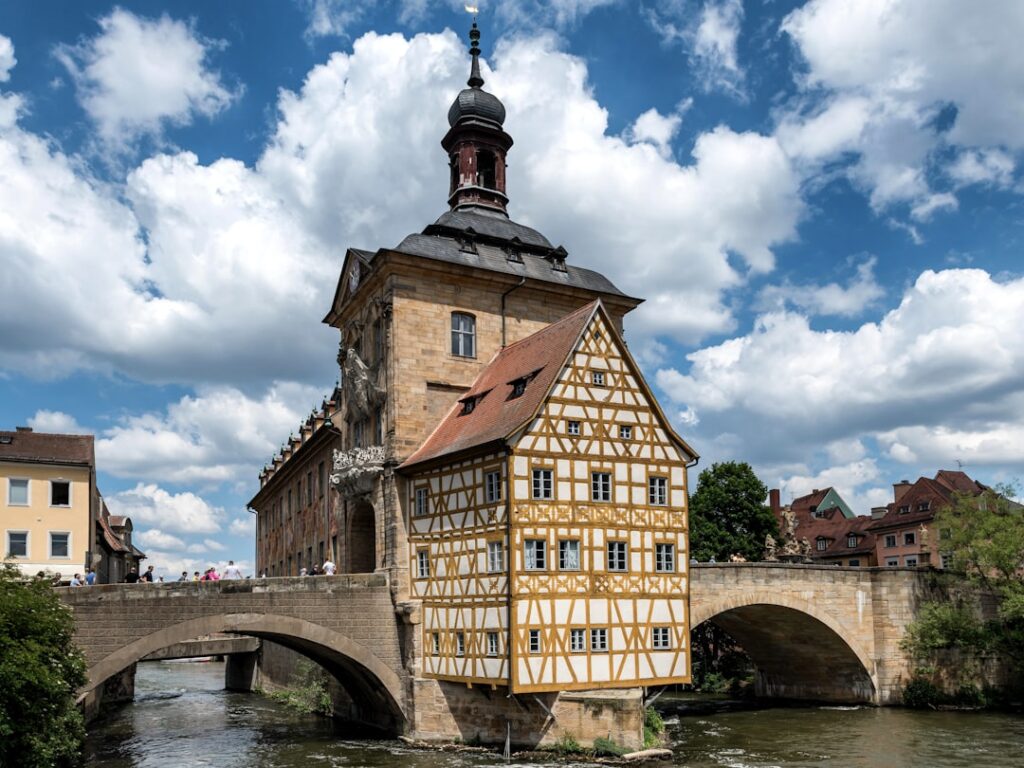
While tourists crowd into Rothenburg and Nuremberg, Bamberg sits quietly 60 kilometers north of Nuremberg, its entire Altstadt protected by UNESCO since 1993. Built across seven hills like Rome, this Franconian town offers an intact medieval streetscape, eleven historic breweries, and a cathedral that’s been standing for nearly a thousand years.
The town escaped World War II bombing runs because its lack of heavy industry made it a low-priority target. What remains is one of Germany’s largest preserved old town centers—roughly 1,200 listed buildings spanning a millennium of architecture.
The Island District and Little Venice
Bamberg’s Altstadt splits into three districts. The island quarter sits on the Regnitz River between two arms of the water, connected by stone bridges. The Altes Rathaus perches impossibly on its own island mid-river, built there in the 15th century after the bishop refused to give the citizens land for a town hall. Half-timbered facades jut out over the water on both sides, and frescoes cover the exterior walls.
Walk downstream along the Regnitz’s east bank to reach Klein Venedig—Little Venice—where former fishermen’s houses line the water. Their tiny gardens run right down to the riverbank, and in summer, geraniums spill from window boxes. It’s not actually Venetian in any meaningful way, but the canal-side views make it the most photographed spot in town after the Rathaus.
Cross any bridge to the Sandgebiet, the merchants’ and craftsmen’s quarter, where the Maximiliansplatz hosts a farmers’ market several days a week. The streets here are wider than in the medieval bergstadt above, laid out in the 18th century when the prince-bishops expanded the town.
The Cathedral Quarter
Climb the narrow lanes uphill to the Domberg, where Bamberg Cathedral anchors the ecclesiastical district. The four-towered Romanesque and early Gothic structure dates to 1237—the third cathedral built on this site since 1002. Inside, the Bamberg Horseman sculpture remains one of medieval Germany’s most mysterious artworks. No one knows for certain who the rider represents, though theories range from Hungarian King Stephen I to a generic Christian knight.
The cathedral also holds the only papal tomb north of the Alps: Pope Clement II, who died in 1047, lies in the west choir. The carved tomb of Emperor Henry II and his wife Kunigunde, created by Tilman Riemenschneider around 1513, sits in the east choir.
Next door, the Alte Hofhaltung’s half-timbered courtyard served as the bishops’ residence until they built the extravagant Neue Residenz across the square in the 17th century. The Residenz’s state rooms are open for tours, and the rose garden behind offers views across Bamberg’s red rooftops.
Rauchbier: Bamberg’s Liquid Specialty
Bamberg produces Rauchbier—smoked beer—unlike anywhere else in Germany. Two breweries, Schlenkerla and Spezial, still malt their barley over beechwood fires, giving the finished beer a distinctly smoky, almost bacon-like flavor. It’s an acquired taste, and locals will tell you it takes three glasses before you start to enjoy it.
Schlenkerla’s tavern on Dominikanerstrasse has been serving Rauchbier since 1405, though the current building dates to 1678. The vaulted cellar rooms fill nightly with locals and curious visitors nursing half-liter steins. Order the Schäufele—slow-roasted pork shoulder—to go with it.
Beyond Rauchbier, Bamberg has nine other breweries within city limits, more per capita than anywhere else in Germany. The Franconian Brauereimuseum in the old Benedictine monastery walks you through 900 years of local brewing history.
Practical Details
Bamberg sits on the main rail line between Nuremberg and northern Germany. Direct trains from Nuremberg take 40 minutes; from Munich, expect 90 minutes with one change in Nuremberg. The Altstadt is compact enough to cover on foot in a day, though spending a night lets you experience the breweries properly.
Come in late September for the Sandkerwa, Bamberg’s huge five-day folk festival centered in the Sandgebiet. The entire riverside fills with beer tents, stages, and crowds. For quieter visits, May through June or September through early October offer pleasant weather without peak summer tourist numbers.
The tourist information office in the Geyerswörthstrasse, just off the island district, offers brewery walking tours in English during summer months. Most historic sites cluster within 15 minutes’ walk of each other.
Want one short story a day about Germany’s towns, tastes, and traditions? Subscribe to the Love Germany newsletter and we’ll send you travel insights you won’t find in the guidebooks.
Tours & experiences in Germany


Powered by Viator. Some links are affiliate links — we may earn a small commission at no extra cost to you.