Trier doesn’t just claim to be Germany’s oldest city—it proves it with every street corner. The Porta Nigra, a towering Roman gate blackened by centuries of soot, still guards the northern entrance. Constantine’s throne hall stands nearly intact. An amphitheater where 20,000 Romans once cheered gladiators sits beneath grape-covered hillsides producing some of the Moselle Valley’s finest wines.
Founded as Augusta Treverorum around 16 BC, Trier served as the capital of the Western Roman Empire for much of the 4th century. Today, nine UNESCO World Heritage monuments share the city with half-timbered houses, student cafés, and wine taverns pouring Riesling from vineyards visible from the city center.
The Roman Monuments
Start at the Porta Nigra, the largest Roman city gate north of the Alps. Built around 170 AD from massive sandstone blocks held together without mortar, it survived because a Byzantine monk turned it into a church in the 11th century. Climb to the upper levels for views across the Altstadt and understand why this location commanded the trade routes between Gaul and Germania.
The Aula Palatina, Constantine’s throne hall, is even more impressive for what it preserves—a vast brick basilica 220 feet long with 100-foot ceilings, heated by an underfloor system that required 4 million bricks. It’s now a Protestant church, but stand in the apse where the emperor’s throne once sat and the acoustic engineering still works perfectly.
The Imperial Baths rank among the largest Roman bath complexes ever built, though Constantine never finished them. Wander the underground tunnels where slaves stoked fires and managed the elaborate heating system. Above ground, enough walls remain to trace the hot rooms, cold plunges, and exercise yards where Roman officials conducted business between steam baths.
Don’t miss the Amphitheater, carved into a hillside east of the center. Unlike purpose-built arenas, Trier’s takes advantage of natural topography—the hill provided seating, and underground passages for gladiators and animals are remarkably well preserved. Entry is €4, or get the combined ticket for €12 covering all Roman sites plus the Landesmuseum.
Medieval Trier and the Market Square
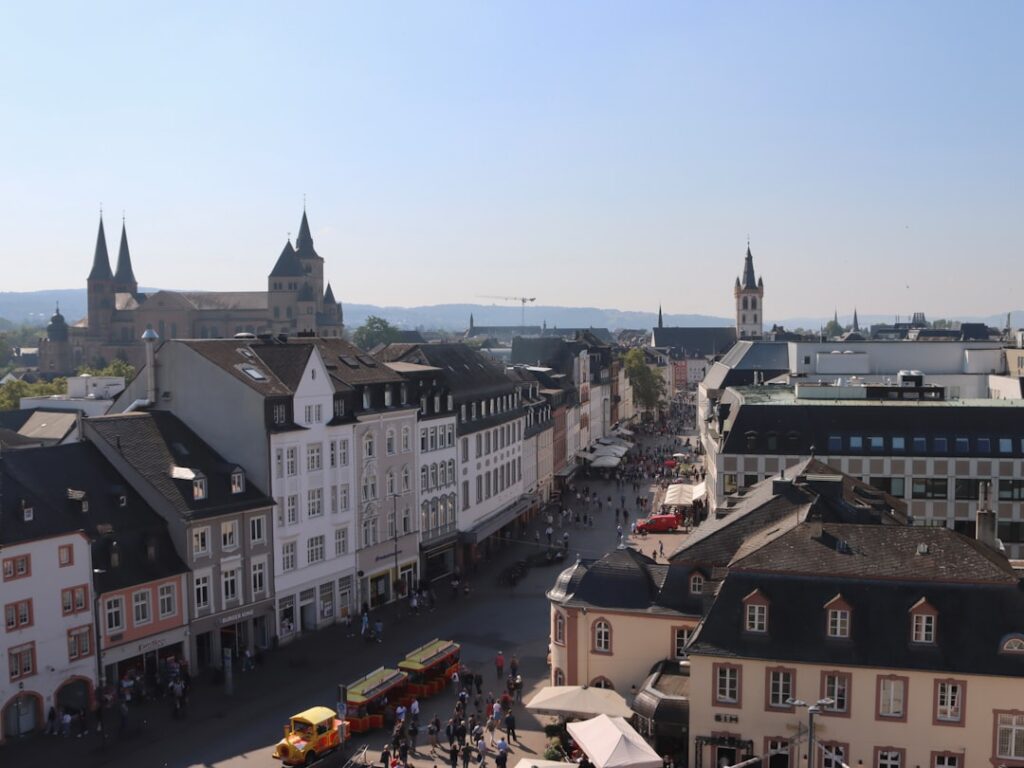
The Hauptmarkt, Germany’s oldest market square, has hosted traders since the 10th century. The Renaissance St. Peter’s Fountain stands at its center, surrounded by Gothic and Baroque facades hiding medieval foundations. The Steipe, a 15th-century banquet hall with an arcaded ground floor, anchors the east side—local festivals still use it for ceremonial events.
Trier Cathedral, built over the palace of Constantine’s mother Helena, claims to house the Holy Robe, the seamless garment Jesus supposedly wore at his crucifixion. The massive Romanesque structure incorporates Roman brick walls, Gothic vaulting, and Baroque altars. The adjacent Church of Our Lady (Liebfrauenkirche) is one of Germany’s earliest Gothic churches, its centralized plan and rose windows inspired by French cathedrals.
Karl Marx’s birthhouse at Brückenstraße 10 is now a museum. Whether you’re interested in his philosophy or not, the exhibits on 19th-century Trier and industrial-era social conditions provide context for understanding modern Germany.
Wine, Food, and Practical Details
Trier sits at the heart of Moselle wine country. The steep vineyards visible from Roman monuments produce exceptional Riesling—the slate soil and river microclimate create wines with distinct minerality and crisp acidity. Weinstube Kesselstatt, in a Renaissance courtyard near the cathedral, pours estate wines alongside traditional dishes. Try Teerdisch, a local potato-and-bacon casserole, or Moselle fish caught from the river that flows past town.
For serious wine tasting, head to Zum Domstein, a wine tavern operating since 1745. The wine list focuses on small Moselle producers, and the staff knows every vineyard by name. In warm weather, the courtyard under ancient plane trees is perfect for afternoon Riesling and cheese plates.
Trier is 150 kilometers west of Frankfurt and 180 kilometers south of Cologne. Regional trains connect from both cities in 2.5 to 3 hours. The Altstadt is compact—everything described here sits within a 15-minute walk. The tourist office at Porta Nigra sells the Trier Card (€12 for three days), which includes public transport and discounts on attractions.
Visit between April and October for the best weather, though Trier’s Christmas market transforms the Hauptmarkt in December. Summer brings open-air concerts in the Amphitheater—watching classical performances or contemporary acts where Romans once fought wild animals creates memorable contrasts.
Avoid weekends in September and October during wine harvest season unless you’ve booked ahead. The combination of wine tourists and university students fills hotels quickly, though the festive atmosphere and new wine (Federweißer) poured in every tavern might make the crowds worthwhile.
Ready to discover more of Germany’s hidden corners and local secrets? Subscribe to the Love Germany newsletter—one short story a day, delivered to your inbox each morning.
Tours & experiences in Germany


Powered by Viator. Some links are affiliate links — we may earn a small commission at no extra cost to you.