
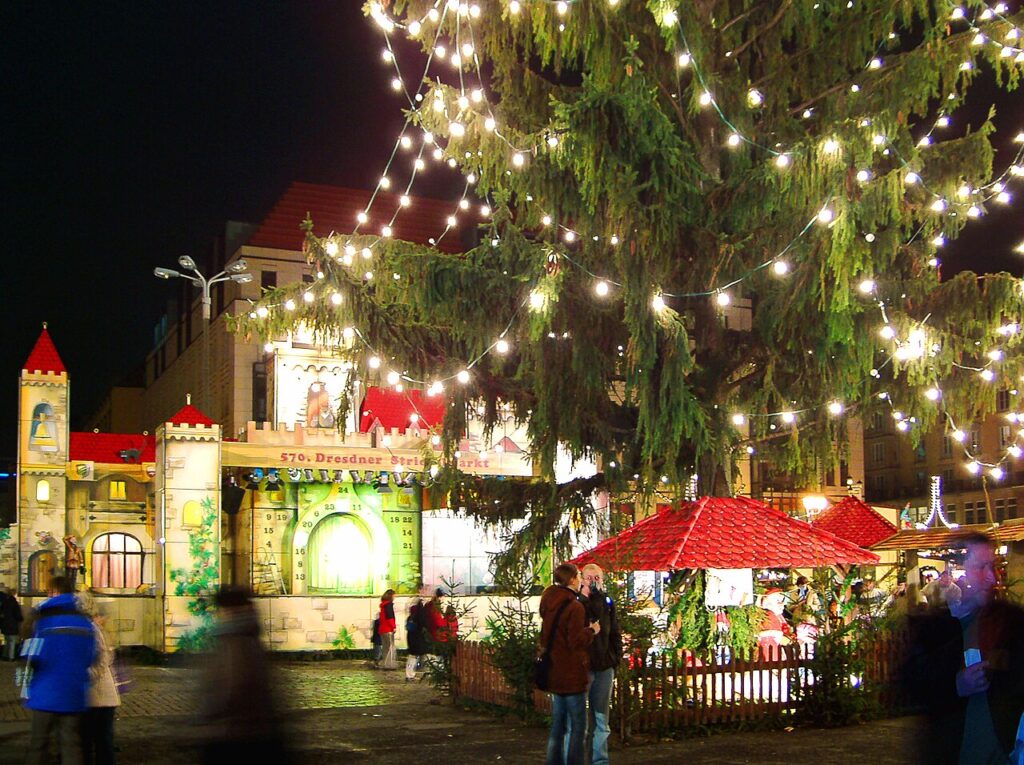
While Nuremberg’s Christkindlesmarkt gets most of the attention, Dresden’s Striezelmarkt quietly holds the title of Germany’s oldest Christmas market. Operating continuously since 1434, this Saxony tradition brings medieval market culture into the present with 240 wooden stalls, towering pyramids, and the world’s largest nutcracker standing guard over Altmarkt square.
The market takes its name from the Striezel, Dresden’s historic name for its famous Christmas stollen. This fruit-studded bread wasn’t always the butter-rich treat we know today—early versions were austere Lenten loaves. When Saxon bakers finally won papal permission to use butter in 1491, the Dresdner Christstollen became the rich, marzipan-centered centerpiece of Saxon Christmas baking.
The Giant Stollen and Stollenmädchen
Every year on the second Saturday of Advent, Dresden hosts the Stollenfest, a procession featuring a multi-ton Stollen carried through the Old Town on a decorated carriage. The parade ends at the Striezelmarkt, where the enormous cake is ceremonially sliced with an oversized knife weighing 12 kilograms. Portions are sold for charity, and the Stollenmädchen—young women in traditional 18th-century dress—preside over the festivities.
You can watch master bakers compete in the Stollen-baking championship or visit the dedicated Stollen shop at the market’s center, where Dresden’s best bakeries sell their versions wrapped in the official seal that certifies authentic Dresdner Christstollen.
What to See and Buy
The 14-meter-tall Christmas pyramid—the world’s largest—dominates Altmarkt square, its tiers rotating with carved nativity scenes, miners, and forest animals lit by dozens of candles. Nearby, the Plum People Fountain features carved wooden figures that have become symbols of the market.
Stalls sell everything from hand-carved Ore Mountains nutcrackers and smoking men to Saxon blue-and-white pottery from Meissen. The Pulsnitz gingerbread stands offer spiced Pfefferkuchen in every shape, from hearts to houses. Look for handmade tree ornaments from Lauscha, the Thuringian town where glass Christmas ornaments were invented in the 1840s.
For something warm, order a mug of Feuerzangenbowle, a theatrical mulled wine preparation where a rum-soaked sugarloaf is set aflame and drips into spiced wine below. The traditional Dresdner Christstollen remains the must-try food, ideally paired with a cup of thick, spiced Eierpunsch.
Planning Your Visit
The Striezelmarkt runs from late November through Christmas Eve, typically opening around 10 a.m. and closing at 9 p.m. on weekdays, with extended hours on weekends. Altmarkt square sits in Dresden’s reconstructed Old Town, a five-minute walk from the Frauenkirche and fifteen minutes from the Zwinger Palace.
The best time to visit is mid-afternoon on a weekday, when crowds thin and you can move freely between stalls. Evening brings the full atmospheric effect as lights illuminate the pyramid and the baroque skyline, but expect shoulder-to-shoulder crowds, especially on weekends.
Dresden Hauptbahnhof lies within walking distance, and trams 1, 2, and 4 stop directly at Altmarkt. If you’re staying in Berlin, regional trains make the trip in just over two hours—early enough to spend a full day exploring both the market and Dresden’s rebuilt architectural treasures.
The Striezelmarkt offers something Nuremberg’s more famous market doesn’t: six centuries of unbroken tradition in a city that has rebuilt itself twice. Between the stalls, you’re standing where Saxon merchants traded spices when Columbus was still a child, where bakers perfected stollen recipes under Augustus the Strong, and where Dresden itself rose again from ruins to reclaim its Christmas heritage.
Want more stories about Germany’s hidden traditions and seasonal celebrations? Subscribe to the Love Germany newsletter and get one short story a day in your inbox.
Tours & experiences in Germany


Powered by Viator. Some links are affiliate links — we may earn a small commission at no extra cost to you.