
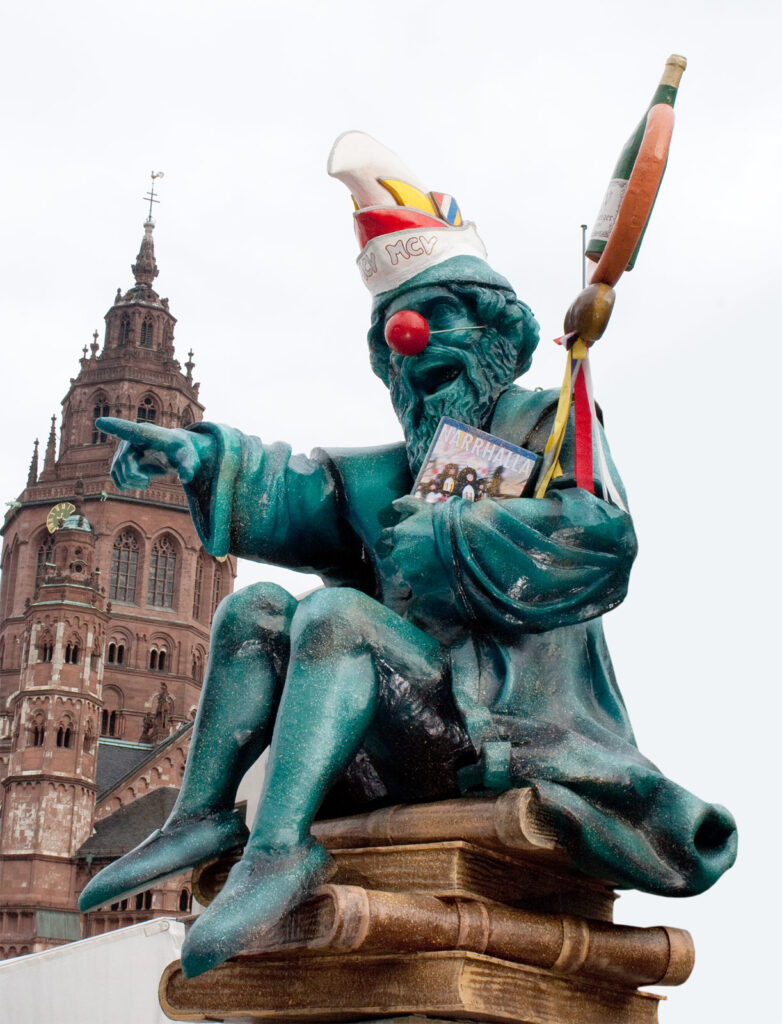
Mainz sits at the confluence of the Rhine and Main rivers, a sunny Rhineland city where wine culture runs as deep as its two-thousand-year history. This is where Johannes Gutenberg invented movable-type printing in the 1450s, where Roman aqueducts still stand, and where half-timbered Altstadt lanes lead to wine taverns pouring glasses of local Riesling. Overshadowed by nearby Frankfurt and Heidelberg, Mainz rewards travelers who make the trip with authentic charm, world-class museums, and a lively spirit shaped by centuries of wine trade and carnival tradition.
The Gutenberg Museum and the Birth of Printing
The Gutenberg Museum, steps from the cathedral, houses one of the world’s most important collections of printing history. Two original Gutenberg Bibles from the 1450s sit in climate-controlled cases—only 49 copies survive worldwide. The museum traces printing from ancient seals through digital type, but the centerpiece is the reconstruction of Gutenberg’s workshop, where demonstrations show how individual metal letters were cast, arranged, inked, and pressed by hand. Entry costs €5, and English audio guides provide context that brings the revolution to life. The museum is closed Mondays, and weekend mornings can be crowded; arrive early or come on a weekday afternoon.
Gutenberg himself is buried somewhere in Mainz—his grave was lost during later construction—but a statue of him stands in the square outside the museum, quill in hand, overlooking the half-timbered Marktplatz.
The Dom and Old Town
Mainz Cathedral, a massive Romanesque basilisk with six towers, dominates the skyline. Built over a thousand years starting in 975, it blends red sandstone with soaring Gothic additions. The interior holds elaborate bishops’ tombs and a cloister filled with carved capitals and quiet light. Entry is free, though donations are welcomed. Climb the tower for views over the Rhine Valley and the vineyards rising on the opposite bank.
The Altstadt around the cathedral was heavily rebuilt after World War II, but pockets of original half-timbered houses remain, especially along Kirschgarten and Augustinerstrasse. The Markt square hosts a farmers’ market Tuesday, Friday, and Saturday mornings, where vendors sell asparagus in spring, mushrooms in fall, and local Handkäse cheese year-round.
Walk down to the Rhine promenade—locals call it the Rheinufer—where a wide pedestrian path stretches along the river. Cargo barges churn upstream toward the Rheingau vineyards, and the waterfront fills with cyclists, joggers, and families on warm afternoons. Benches line the path; bring a bottle from one of the wine shops and watch the sunset over the water.
Wine Taverns and Rhineland Kitchens
Mainz sits at the northern edge of Rheinhessen, Germany’s largest wine region, and wine taverns—Weinstuben—fill the old town. These aren’t tourist traps; locals gather here after work for a glass of the region’s dry Riesling or Silvaner, paired with Spundekäs, a creamy, tangy cheese spread served with onions and pretzels. Weinstube Hottum on Grebenstrasse is a reliable choice, pouring wines from small producers and serving honest Rhineland cooking—roasted pork shoulder, potato soup, and seasonal asparagus in May.
For something livelier, head to the Altstadt’s southern edge, where modern wine bars like Weinhaus Michel offer a younger crowd and a rotating list of regional bottles. Most taverns close Sunday and Monday, and many take a summer break in August—check ahead.
Don’t leave without trying Mainzer Rippchen, brined and smoked pork chops served with sauerkraut and mashed potatoes. It’s winter food, rich and satisfying, best eaten with a glass of local white wine to cut the salt.
Practical Details
Mainz sits 40 minutes by regional train from Frankfurt Airport (lines S8 and S9 run every 20 minutes), making it an easy first or last stop on a Rhine itinerary. The Hauptbahnhof is a ten-minute walk from the Altstadt, and the old town is small enough to cover on foot in an afternoon.
The city is worth a full day—morning in the Gutenberg Museum, lunch in a wine tavern, afternoon exploring the cathedral and riverside, and evening watching the light fade over the Rhine. If you’re here in February, Mainz hosts one of Germany’s largest Carnival celebrations, with parades, costumes, and街头 parties that shut down the city for days. Outside Carnival season, the city hums quietly, busy with university students and commuters but never overwhelmed with tour groups.
For day trips, the Rheingau wine region begins just across the river—Eltville and Rüdesheim are each 20 minutes away by train or ferry. Wiesbaden, the elegant spa capital of Hesse, is a 15-minute ride on the S-Bahn.
Want more stories like this—one short dispatch on Germany’s cities, food, and hidden corners delivered to your inbox each day? Subscribe to the Love Germany newsletter and get a little piece of Germany every morning.
Tours & experiences in Germany


Powered by Viator. Some links are affiliate links — we may earn a small commission at no extra cost to you.