
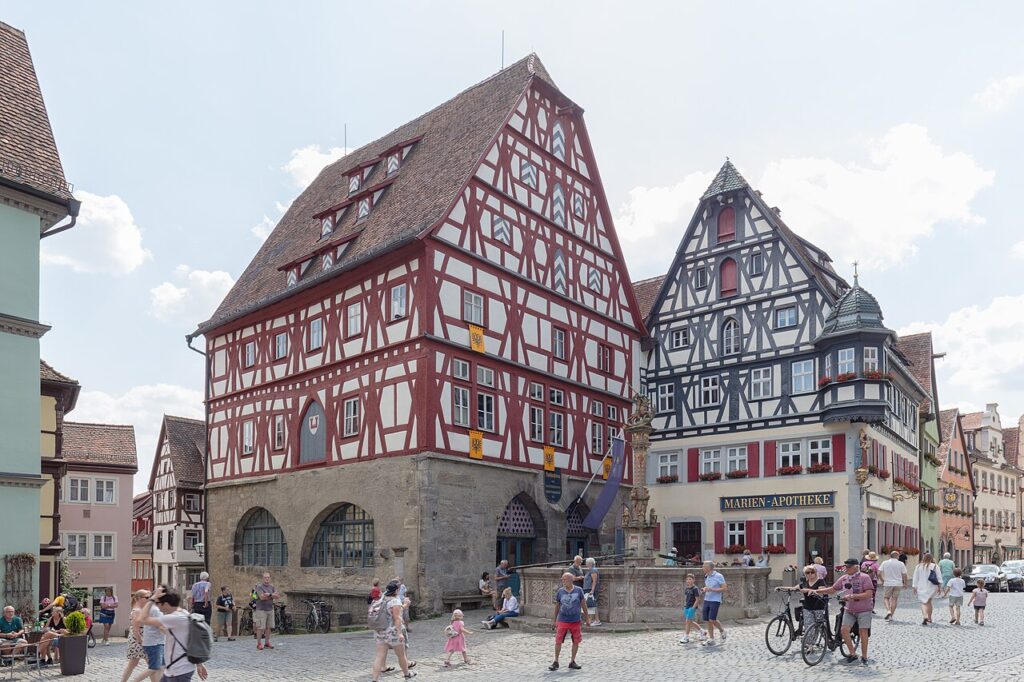
Rothenburg ob der Tauber looks like a film set, but it’s entirely real. Perched above the Tauber River in Franconia, this walled town has preserved its medieval character better than anywhere else in Germany. Walking through the Plönlein, standing where two lanes converge beneath a tower, you’ll understand why this place captivates millions of visitors each year.
Unlike towns rebuilt after wartime destruction, Rothenburg’s fortifications, churches, and half-timbered houses survived largely intact. The result is an open-air museum where you can walk complete circuits of city walls, peer through medieval windows, and lose yourself in lanes that haven’t changed in five centuries.
Walking the Town Walls
Rothenburg’s defensive walls stretch for more than two miles around the old town, and you can walk nearly the entire circuit on a covered wooden walkway. Enter at any of the tower gates—the Rödertor on the eastern side offers the best combination of views and accessibility.
The walkway takes you past towers, gatehouses, and lookout points where defenders once watched for approaching armies. Plaques along the route identify donors who funded reconstruction after World War II damage. Budget about an hour for the complete circuit, longer if you’re stopping for photographs at every turn.
From the wall walk, you’ll see Rothenburg’s terracotta rooftops spreading below, with the Tauber Valley dropping away to gardens and forests beyond. The northern section near the castle gardens provides the most dramatic views, especially in late afternoon when the light turns golden.
The Plönlein and Market Square
The most photographed spot in Rothenburg is the Plönlein, where Untere Schmiedgasse forks around a tiny half-timbered house, with the Sieberstor tower gate rising behind. It’s impossibly picturesque, and impossibly crowded between 10 a.m. and 4 p.m. Visit early morning or evening for your best shot without tour groups in frame.
The Marktplatz forms the town’s heart, dominated by the Renaissance town hall with its Gothic tower. Climb the 220 steps to the observation platform for panoramic views—the narrow spiral staircase isn’t for the claustrophobic, but the vista rewards the effort. The tower is open daily from April through October, weekends only in winter.
Behind the Rathaus stands St. Jakob’s Church, home to Tilman Riemenschneider’s masterwork, the Altar of the Holy Blood. This carved wooden altarpiece from 1505 ranks among Germany’s finest examples of late Gothic sculpture. The church charges a small admission fee, but the craftsmanship justifies it.
Museums and Curiosities
Rothenburg packs an unusual number of specialized museums into its small area. The Medieval Crime and Justice Museum presents three floors of punishment devices, legal documents, and instruments of torture. It sounds grim but proves fascinating, documenting how medieval justice actually functioned.
The German Christmas Museum occupies rooms above the famous Käthe Wohlfahrt Christmas shop on Herrngasse. If you’ve ever wondered about the history of glass ornaments, nutcrackers, and advent calendars, this collection provides answers. The shop itself operates year-round, transforming every season into December for determined Christmas enthusiasts.
For a quieter experience, visit the Imperial City Museum in a former Dominican convent. The displays cover Rothenburg’s history from free imperial city to tourist destination, including the baroque kitchen where nuns once cooked and the monastery garden restored to its medieval plan.
Practical Information
Rothenburg sits on the Romantic Road between Würzburg and Füssen, making it a natural stop on that popular route. By train, you’ll need to change at Steinach bei Rothenburg—the branch line journey takes about ten minutes and runs hourly. If you’re driving, parking is available outside the walls; the town center is car-free.
Summer brings crowds and higher prices. Spring and fall offer better value and fewer tourists, while winter transforms Rothenburg into a Christmas card, especially when the Reiterlesmarkt (Christmas market) fills the squares. Snow on medieval rooftops creates magic, but many shops and restaurants reduce their hours from November through March.
For accommodation, stay inside the walls if possible. Small hotels and guesthouses occupy historic buildings—book ahead, as the best properties fill quickly. The town empties dramatically after day-trippers depart around 6 p.m., leaving evening streets to overnight guests and locals.
Plan at least half a day in Rothenburg, a full day if you want to walk the walls, climb the town hall tower, and visit museums without rushing. The town is compact enough to explore on foot—comfortable shoes matter on cobblestones worn smooth by centuries of use.
Want more stories about Germany’s most captivating destinations delivered to your inbox? Subscribe to the Love Germany newsletter and get one short story a day about the places, traditions, and experiences that make Germany unforgettable.
Tours & experiences in Germany


Powered by Viator. Some links are affiliate links — we may earn a small commission at no extra cost to you.