
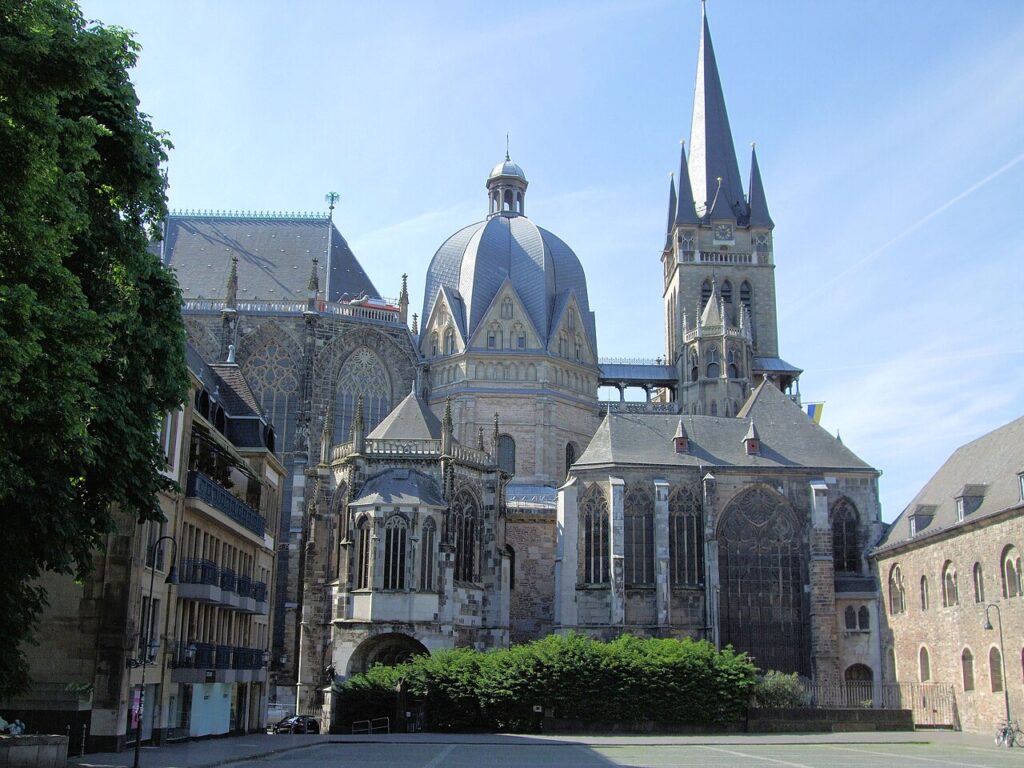
In the westernmost corner of Germany, just a few kilometers from both Belgium and the Netherlands, stands the cathedral that changed Europe. Aachen Cathedral isn’t just Germany’s oldest cathedral—it’s where Charlemagne, the first Holy Roman Emperor, built his palace chapel in the 8th century and where thirty German kings were crowned over six centuries.
This UNESCO World Heritage site remains one of Northern Europe’s finest examples of Carolingian architecture, and visiting it feels like stepping into the very heart of medieval European power.
The Octagonal Wonder
The cathedral’s centerpiece is the Palatine Chapel, an octagonal marvel completed around 800 AD. Charlemagne brought craftsmen and materials from across his empire—marble columns from Rome and Ravenna, bronze doors cast in his own workshops, and mosaics glittering with gold.
Stand in the center and look up: the octagonal dome soars above you, its mosaics (restored in the 19th century) depicting Christ in majesty surrounded by the twenty-four elders of the Apocalypse. The eight-sided design was revolutionary for its time, inspired by Byzantine churches Charlemagne had never seen but deeply admired.
On the upper gallery, you’ll find Charlemagne’s marble throne—simple, unadorned, and powerful. Between 936 and 1531, thirty kings sat here to be crowned. You can visit the throne on a guided tour, which runs hourly and is well worth the small additional fee beyond the cathedral admission.
The Treasury and Charlemagne’s Relics
The cathedral treasury, housed in a modern building adjacent to the cathedral, holds one of the most significant collections of ecclesiastical art north of the Alps. The golden shrine containing Charlemagne’s remains gleams in the center—he was canonized (though never officially by Rome) and his cult drew pilgrims for centuries.
You’ll also see the Lothar Cross, a 10th-century processional cross containing what was believed to be a fragment of the True Cross, and the Bust of Charlemagne, created around 1350 and said to contain parts of the emperor’s skull. The imperial crown jewels were kept here until Napoleon’s time, and replicas are on display.
The treasury’s collection of medieval textiles is extraordinary—silk shrouds, embroidered vestments, and the famous Aachen altar frontal from the 11th century. Photography isn’t permitted, so take your time to really look.
Practical Information for Visitors
Aachen is easily reached by train from Cologne (one hour) or Düsseldorf (90 minutes), making it an excellent day trip from either city. The cathedral sits in the center of the old town, a five-minute walk from the main train station.
The cathedral itself is free to enter, though donations are encouraged. It’s open Monday through Saturday from 7:00 AM to 6:00 PM, and Sunday from 1:00 PM to 6:00 PM, though times may be restricted during services. The treasury requires a separate ticket (€6 for adults) and is open daily except Wednesdays.
Guided tours in English run several times daily and last about one hour. They include access to Charlemagne’s throne and provide context you won’t get from simply wandering. Book ahead during summer months, as groups fill up.
After your visit, explore Aachen’s old town. The city hall, built on the foundations of Charlemagne’s palace, stands just across the square. The Elisenbrunnen, a neoclassical pavilion, marks one of the thermal springs that made Aachen a spa destination for centuries—you can taste the sulfurous water, though it’s an acquired taste.
Beyond the Cathedral
If you’re visiting in late November or December, Aachen’s Christmas market spreads around the cathedral and city hall, transforming the medieval squares into a wonderland of timber stalls selling Aachener Printen—the local spiced cookies that are the city’s edible trademark. They’re similar to Lebkuchen but with a distinctive flavor from a secret spice mix.
The cathedral’s significance to European history can’t be overstated. This is where the idea of a unified Christian Europe was given architectural form, where kings were made, and where the memory of Charlemagne—the father of both France and Germany—was kept alive for over a millennium. You’re not just visiting a church; you’re standing at one of the birthplaces of European civilization.
Want more stories about Germany’s hidden treasures and legendary landmarks? Subscribe to the Love Germany newsletter—we send one short story a day, straight to your inbox, with no fluff and plenty of insider tips for your next adventure.
Tours & experiences in Germany


Powered by Viator. Some links are affiliate links — we may earn a small commission at no extra cost to you.