
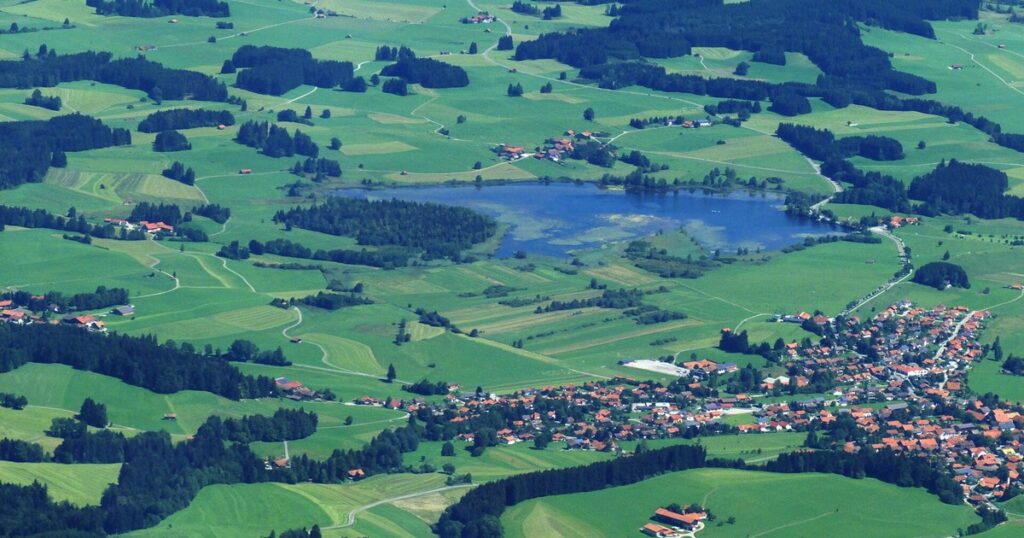
The Allgäu stretches across Bavaria’s southwestern corner, where the foothills of the Alps meet a patchwork of dairy pastures, onion-domed churches, and villages that still make cheese the way their great-grandparents did. This is Germany’s milk and cheese heartland, a place where cows wear bells, farmhouses have flower boxes on every window, and the mountains rise just close enough to remind you you’re in the Alps.
The region doesn’t get the fame of Garmisch or Berchtesgaden, but it offers something quieter and more pastoral: walking trails that wind through working farms, cheese dairies you can visit, and small spa towns where the air smells like fresh-cut hay in summer and wood smoke in winter.
Oberstdorf and the Southern Valleys
The town of Oberstdorf sits at the southern end of the Allgäu, backed by the Nebelhorn and surrounded by trails that lead into Austria. It’s Germany’s southernmost municipality, a compact resort town with ski jumps, thermal baths, and access to more than 200 kilometers of hiking routes. The Nebelhorn cable car rises to 2,224 meters, where you can see 400 peaks on a clear day, including the Zugspitze to the east.
South of town, the Stillachtal and Oytal valleys open into narrow gorges and cirques. The Oytal trail follows a rushing stream past grazing cattle and ends at the Käseralpe, where hikers stop for Brotzeit and homemade mountain cheese. In winter, Oberstdorf hosts the first leg of the Four Hills ski jumping tournament every year between Christmas and New Year.
Kempten and the Northern Foothills
The city of Kempten anchors the northern Allgäu. It’s one of Germany’s oldest settlements, founded as the Roman town of Cambodunum in the first century. Today, the Cambodunum Archaeological Park preserves the forum, baths, and temple foundations. The prince-abbots who ruled Kempten in the baroque period left behind the Residenz, a palace complex with gilded stucco halls and a throne room open for guided tours.
Kempten also serves as a gateway to the region’s cheese culture. The surrounding countryside is dotted with small dairies producing Allgäuer Bergkäse and Emmentaler using raw milk from Alpine pastures. Several farms offer tours and tastings during the summer months.
The Allgäu Cheese Road
The Allgäuer Käsestraße is a driving and cycling route that connects farms, dairies, and cheese cellars across the region. The loop runs roughly 200 kilometers, passing through Sonthofen, Immenstadt, Wangen, and Lindau on the Bodensee shore.
Along the way, you can visit working cheese dairies where Senner (Alpine cheesemakers) still stir copper kettles over wood fires, taste wheels aged in sandstone cellars, and buy loaves of Bergkäse wrapped in linen. Many farms welcome visitors in late spring and summer when the herds are up on the high pastures. The Sennalpe Hohenegg above Steibis offers guided tours and a small museum explaining the traditional cheese-making process.
Spa Towns and Castle Views
The Allgäu has a handful of spa towns where Kneipp therapy (alternating hot and cold water treatments) remains popular. Bad Hindelang and Bad Wörishofen both have wellness hotels, outdoor Kneipp basins, and forest walking paths designed for therapeutic walks.
For castle enthusiasts, Schloss Hohenschwangau and Neuschwanstein lie just northeast of the Allgäu proper, near Füssen. Hohenschwangau is the more restrained of the two, a 19th-century royal residence where Ludwig II spent his childhood. It’s painted pale yellow, filled with murals of medieval legends, and offers views across the Alpsee below.
Practical Details
The Allgäu is accessible by train from Munich via Kempten or Oberstdorf. Regional trains connect the smaller towns, and buses serve the mountain valleys. Renting a car gives you the flexibility to follow the cheese road at your own pace and reach remote trailheads.
Summer (June through September) is ideal for hiking and farm visits. Autumn brings the cattle drives down from the Alpen, decorated with flowers and bells. Winter turns Oberstdorf and Oberstaufen into ski bases, though the Allgäu is better known for cross-country skiing and ski touring than downhill runs.
Pack layers. The weather can shift quickly in the foothills, and even summer mornings start cool. Trails are well-marked, but a regional hiking map helps when you’re linking routes between valleys.
If you want one story about Germany delivered to your inbox each day—small towns, regional food, trails worth walking—subscribe to the Love Germany newsletter and we’ll send you the details that make this country worth exploring slowly.
Tours & experiences in Germany


Powered by Viator. Some links are affiliate links — we may earn a small commission at no extra cost to you.