
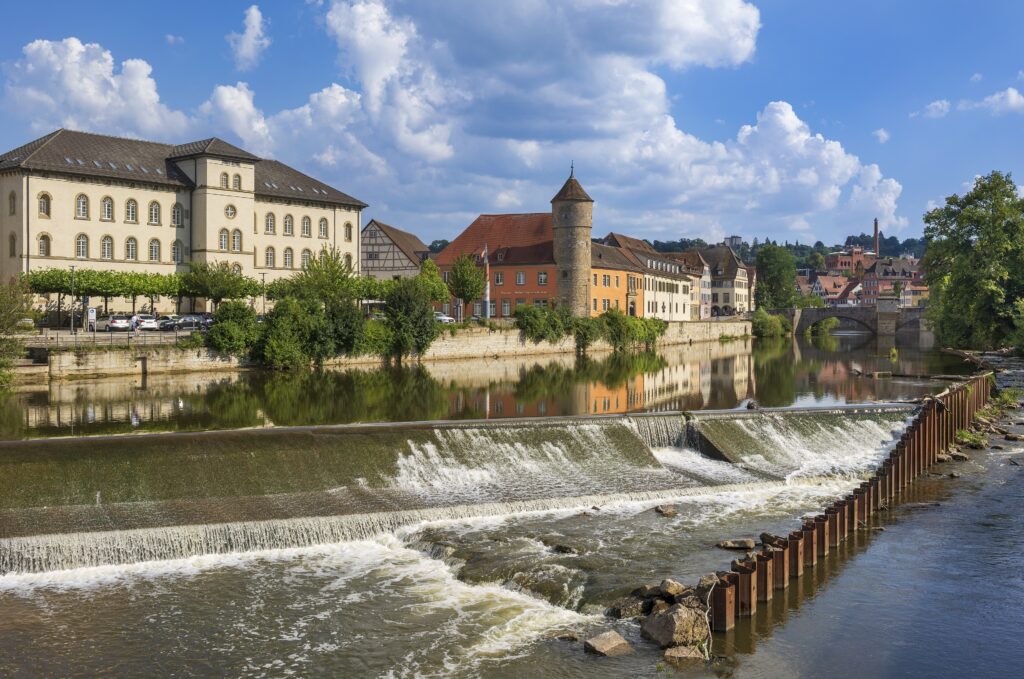
Schwäbisch Hall sits above the Kocher River in Baden-Württemberg, a town where wealth flowed from underground brine springs rather than trade routes or royal favor. For centuries, salt production funded the grand merchant houses and civic buildings that still line the steep hillsides. The result is a compact medieval center that rewards slow exploration on foot.
The town center feels vertical. Stone steps connect terraced streets, and the signature Marktplatz cascades down toward St. Michael’s Church in 54 broad stairs that become theater seating each summer. Arrive in the morning when market vendors set up and the church bells echo off half-timbered facades, and you’ll understand why filmmakers keep returning here.
The Marktplatz and St. Michael’s Church
The Marktplatz has been the town’s stage since the 13th century. The stone staircase was built to accommodate crowds during market days and civic ceremonies. St. Michael’s Church anchors the lower end, its Gothic tower visible from across the valley. Inside, the carved wooden altar and late-medieval choir stalls survived the Reformation intact.
Every summer from June through August, the stairs transform into the open-air Freilichtspiele Schwäbisch Hall theater, one of Germany’s oldest. Productions range from Shakespeare to contemporary drama, with the illuminated church facade as backdrop. Even if you don’t catch a performance, the technical setup—lighting rigging suspended between medieval buildings—is worth seeing during rehearsals.
The Marktplatz is also where you’ll find the Rathaus with its ornate Renaissance clock and the pink sandstone façade of the salt storehouse, a reminder that this square was built on brine profits.
The Old Town and Henkersbrücke
Walk uphill from the Marktplatz and the streets narrow into the Altstadt, where half-timbered houses lean over cobblestone lanes. Many of these buildings date to the 15th and 16th centuries, when salt revenue allowed merchants to rebuild in stone and timber after fires.
The Henkersbrücke—the Executioner’s Bridge—spans the Kocher at the town’s northern edge. The name comes from the executioner’s house that once stood at the bridgehead. The covered wooden bridge offers a postcard view back toward the town’s rooftops and church spires, especially in late afternoon light.
On the opposite bank, the riverside path follows the Kocher downstream past weeping willows and old mill buildings. It’s a flat, easy walk that provides perspective on how tightly the old town clings to its hillside.
The Hällisch-Fränkisches Museum
Housed in seven connected medieval buildings, the Hällisch-Fränkisches Museum tells the story of salt production and civic life. The collection includes original brine pans, guild artifacts, and a recreation of a 19th-century salt works. One gallery displays Heller coins—the silver pfennigs minted here in the Middle Ages that gave the town its name and funded its independence.
The museum’s attic galleries showcase regional furniture and folk art, with painted marriage chests and ceramic stoves that illustrate how Swabian prosperity translated into domestic craft. It’s a compact museum that takes about 90 minutes to tour thoroughly.
Getting There and Practical Details
Schwäbisch Hall lies 50 kilometers northeast of Stuttgart. Regional trains run from Stuttgart Hauptbahnhof to Schwäbisch Hall-Hessental station, with connecting buses to the Altstadt (journey time around 90 minutes). By car, take the A6 and exit at Schwäbisch Hall.
The town works well as a day trip from Stuttgart or Heidelberg, or as an overnight stop if you’re driving the Romantic Road or exploring Hohenlohe. Arrive mid-morning to catch the market atmosphere, have lunch at one of the restaurants along Hafenmarkt, and spend the afternoon walking the old town and riverbank.
Parking is limited in the center; use the Kocherquartier garage near the tourist office and walk five minutes uphill to the Marktplatz. The tourist information office stocks a walking-tour map that highlights architectural details you might otherwise miss.
For the theater festival, book tickets well in advance through the official site—performances sell out quickly, especially weekend shows in July.
Want more stories about Germany’s lesser-known towns and practical tips for visiting? Subscribe to the Love Germany newsletter and get one short story a day in your inbox.
Tours & experiences in Germany


Powered by Viator. Some links are affiliate links — we may earn a small commission at no extra cost to you.