
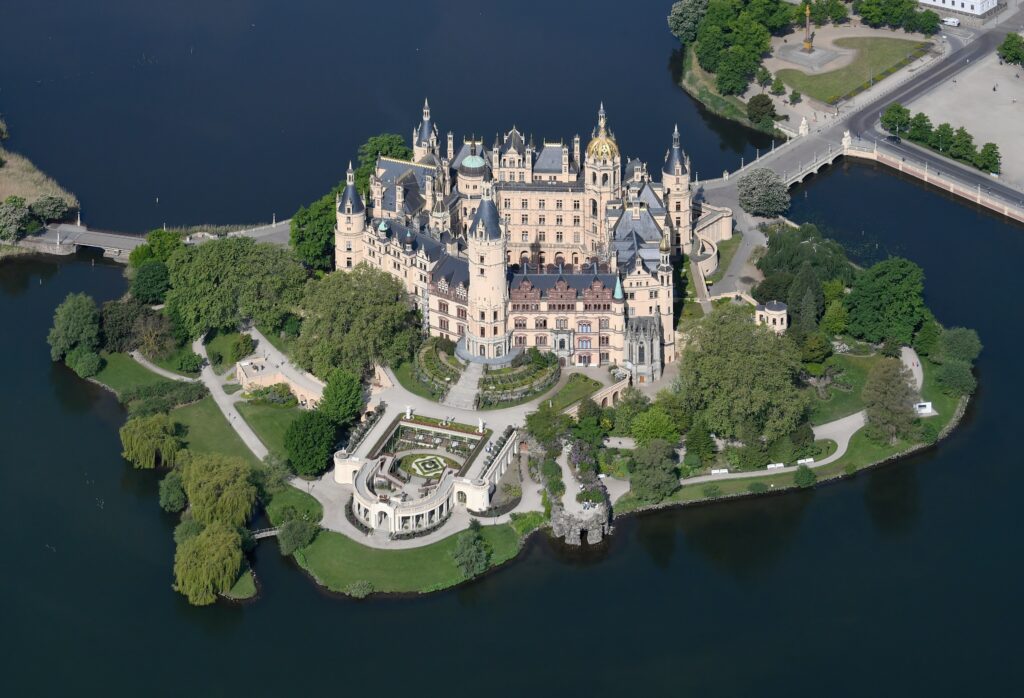
Most visitors racing between Berlin and the Baltic coast miss one of northern Germany’s finest palaces entirely. Schloss Schwerin sits on its own island in the Schweriner See, connected to the state capital by a short causeway. Its silhouette—golden dome, pointed turrets, ornamental gables—looks more Loire Valley than Mecklenburg, and that’s exactly what Grand Duke Friedrich Franz II intended when he rebuilt it in the mid-1800s.
A Palace Built on a Thousand-Year Foundation
The site has been fortified since 965, when a Slavic fortress stood here. By the Renaissance, the Dukes of Mecklenburg-Schwerin had turned it into a residence. The present structure dates mostly to 1845–1857, when architect Georg Adolph Demmler and others transformed the older wings into a palace inspired by French châteaux, especially Chambord. The result is eclectic: north German brick, French Renaissance arcades, and a neo-Gothic throne room under a central dome.
Today the palace serves as the seat of the state parliament, but most of the building is open as a museum. You can walk through state apartments, the ancestors’ gallery lined with ducal portraits, and the ornate throne room where no duke ever actually ruled—it was completed in 1857, just as the grand duchy’s power was fading.
What to See Inside
The museum route covers around 30 rooms. Start in the throne room, where gilded columns and a coffered ceiling frame a space that feels far grander than Mecklenburg’s modest size warranted. The ducal apartments on the second floor include a smoking room paneled in carved oak, a dining room with porcelain from the Meissen and Fürstenberg manufactories, and bedrooms where Friedrich Franz II and his family actually lived.
Don’t skip the basement grotto, a vaulted chamber decorated with shells, coral, and colored glass that was a fashionable Renaissance folly. It’s one of the oldest parts of the palace still intact.
The palace church, tucked into the northeast corner, is small but richly decorated, with wood carvings and a ducal box where the family attended services without mingling with courtiers.
The Palace Gardens and Orangery
The Schlossgarten stretches across the island and onto the mainland, covering more than 20 hectares. The Baroque garden closest to the palace was restored in recent decades based on 18th-century plans. Gravel paths, clipped hedges, and a central parterre lead your eye toward the lake.
Cross the causeway to the orangery and English-style landscape garden on the far shore. The orangery, designed by Demmler, now hosts concerts and exhibitions. In summer, citrus trees in giant planters are wheeled out onto the terrace, a tradition continued from the ducal era.
Walk the perimeter path along the Schweriner See for views back toward the palace. Early morning and late afternoon light turn the golden dome into a beacon visible from across the water.
Visiting Schwerin
Schwerin lies roughly halfway between Hamburg and Rostock, about an hour by regional train from either. The Altstadt, a ten-minute walk from the palace, centers on the Markt with its neo-Gothic town hall and the 14th-century cathedral, whose 117-meter tower offers a panorama over the lakes.
The palace is open year-round except Mondays in winter; check the official site for current admission details. Plan at least two hours for the museum and another hour for the gardens. If you’re visiting between April and October, consider a boat trip on the Schweriner See—ferries depart from the landing below the palace and circle the lake, stopping at smaller villages along the shore.
Schwerin makes an easy day trip from Hamburg or a worthwhile overnight if you’re exploring Mecklenburg’s lakes and manor houses. The city is small, walkable, and still feels like a regional capital that never quite grew into its grand architecture—which is exactly its appeal.
We send one short Germany story every day to readers who want to go deeper than the guidebooks. Subscribe to the Love Germany newsletter and get the country’s castles, villages, and traditions delivered to your inbox.
Tours & experiences in Germany


Powered by Viator. Some links are affiliate links — we may earn a small commission at no extra cost to you.