
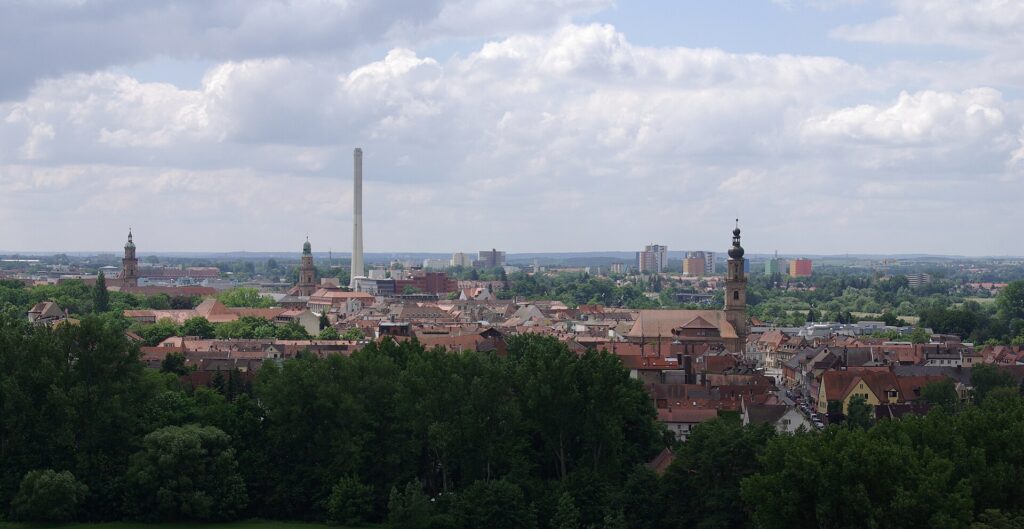
Erlangen sits in the heart of Franconia, a university town where academic life and brewing culture have intertwined for three centuries. The Huguenot refugees who arrived in the late 1600s built the baroque core, and Friedrich-Alexander-Universität brought students and scholarship. Today the town’s compact center pairs elegant arcaded streets with a thriving beer scene—and above it all, a forested hillside honeycombed with cellars where brewers once stored their lager through the summer heat.
The Bergkirchweih: Franconia’s Spring Festival
Every May and June, Erlangen hosts the Bergkirchweih, a twelve-day beer festival that predates Munich’s Oktoberfest by decades. Locals call it simply “the Berg.” The celebration takes place in the Burgberg, a forested hillside just north of the old town where breweries dug deep sandstone cellars in the 1700s to keep beer cool before refrigeration. They planted chestnut and oak trees above for shade, and the roots helped stabilize the tunnels below.
Today, those cellars serve as the festival’s beer halls. Wooden tables fill the forest paths, and Erlangen’s breweries—Steinbach, Kitzmann, and Erich—pour fresh lager under the canopy. The atmosphere skews local: families, students, and regulars who return year after year. The Berg draws more than a million visitors, yet it retains a neighborhood feel that sets it apart from Bavaria’s larger festivals.
Outside festival season, you can walk the Burgberg year-round. The cellar entrances are visible along the paths, and several beer gardens operate through the warmer months. The hilltop offers views over Erlangen’s rooftops and the surrounding farmland.
Baroque Streets and Huguenot Heritage
Erlangen’s old town is a grid of wide streets and arcaded buildings, the legacy of Christian Ernst, Margrave of Brandenburg-Bayreuth, who invited French Huguenot refugees to settle here after Louis XIV revoked the Edict of Nantes in 1685. The new town was designed with purpose: straight avenues, uniform facades, and a central market square that still anchors daily life.
The Hugenottenplatz and surrounding streets show off this baroque planning. The arcades provide shelter from rain and summer sun, and small shops and cafés occupy the ground floors. The Schlossplatz, at the northern end of the grid, fronts Erlangen’s baroque palace, now part of the university. The palace gardens stretch west, open to the public and popular with students between lectures.
At the heart of the old town, the Hugenottenkirche stands as a reminder of the French Protestant community that shaped the city. Services are still held in German today, but the church’s architecture and history link directly to those 17th-century refugees.
Beer Cellars and Keller Culture
Erlangen claims one of the highest concentrations of breweries per capita in Germany. Beyond the Bergkirchweih, the town’s beer cellars—Bierkeller—operate as seasonal beer gardens from spring through early autumn. These aren’t just outdoor bars; they’re built directly above the old sandstone storage cellars, and the cool air rising from below keeps the gardens comfortable even on warm days.
The Steinbach Bräu Keller and Kitzmann Bräu Keller are two of the most traditional. Both allow you to bring your own food—a practice called Brotzeit—while buying beer on site. Locals arrive with baskets of bread, cheese, radishes, and cold cuts, then settle in for an afternoon under the trees. It’s a social ritual older than the festival itself.
If you visit in cooler months, Erlangen’s brewery taprooms remain open. The Entla’s Keller serves year-round and offers a small menu of Franconian dishes alongside its house lager. The emphasis is always on the beer: unfiltered, amber, and served in half-liter steins.
Getting There and Practical Notes
Erlangen is twenty minutes north of Nuremberg by regional train and sits on the main line toward Bamberg. The Hauptbahnhof is a short walk west of the old town. If you’re driving, parking is available near the Schloss, though the compact center is best explored on foot.
The Bergkirchweih runs for twelve days starting on the Thursday before Pentecost. The festival grounds open at midday, and weekends draw the largest crowds. For a quieter experience, visit on a weekday afternoon. The beer cellars outside festival season typically open in late April and close in September, weather depending.
Erlangen’s university keeps the town lively during the academic year, with lectures, concerts, and exhibitions open to the public. The city’s tourism page lists current events and provides maps of the Burgberg walking trails.
We send one short story about Germany every day to thousands of subscribers. If you’d like Franconian festivals, baroque towns, and the places where beer and history meet delivered to your inbox, subscribe to the Love Germany newsletter.
Tours & experiences in Germany


Powered by Viator. Some links are affiliate links — we may earn a small commission at no extra cost to you.